
Join the huddle. Sign up here for Ravens updates in your inbox.
The Ravens left Brazil with an improbable 34-31 win over the Dallas Cowboys after Lamar Jackson’s miraculous pass with seven seconds left set up Tyler Loop’s game-winning 56-yard field goal. Here are five things we learned from a game we won’t soon forget.
A would-be nightmare turned into an all-time Ravens classic.
If you allow yourself to care, a mere game will twist your guts into a pretzel, convince you all hope is lost, then fill you with elation beyond compare.
We endure the crushing endings, the tedious summer workouts, the injuries that make us wonder if it’s all worth it to get to evenings like the one the Ravens just gave us from Rio de Janeiro.
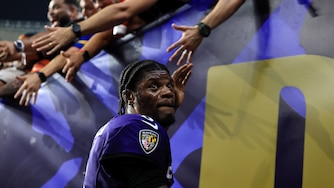
How can you beat Jackson, an idol to millions, sprinting across the field like a kid going to recess so he could embrace Tyler Loop, the kicker fans wanted to cut for the last eight months?
How do you win a game with seven seconds and 65 yards to go? You have Jackson show the wherewithal to fire a 27-yard strike over the middle to Zay Flowers and signal timeout before the last second of regulation can tick away. Then you have Loop, second-guessed ever since he missed from 44 yards to end last season, line up to boot a 56-yard game winner against the team he cheered for as a boy.
Read More
It doesn’t matter that he’s kicking off a ragged soccer pitch that launched a thousand concern-trolling social media posts over the last week. He nails that football, sending it soaring just inside the left upright.
Pandemonium. Another fourth-quarter disaster averted. The most improbable hero. An NFL thrill ride on the international stage.
That did not feel like the Ravens’ destiny when the fourth quarter dawned with them clinging to a 24-21 lead.
With the Baltimore offense poised to build its advantage, Cowboys rookie (and former Maryland Terp and St. Frances Panther) Jaishawn Barham instead knifed in to blow up Derrick Henry at the goal line. Two plays later, brilliant wide receiver CeeDee Lamb raced past Marlon Humphrey for a 49-yard catch to launch Dallas the other way, toward a go-ahead touchdown.

All of a sudden, we had CBS analyst J.J. Watt talking about a bogeyman on the Baltimore sideline, accompanied by an all-too-familiar graphic showing the Ravens have blown an NFL-high 15 leads of 10 points or more since 2019.
When Barham dropped Henry for a 4-yard loss on third-and-1 to cut short the Ravens’ next drive, it was official. They had bumbled into a deepening nightmare. The script felt prewritten. The Ravens would lose a game they had led by 11 in the third quarter.
Their defense would again be pilloried for failing to close the door. Their offensive line would again be accused of faltering on the edge of paydirt. This defeat, paired with the one a week earlier against the New Orleans Saints, would cast a pall over Jesse Minter’s quest to bring a new day to Baltimore football.
The Ravens did not roll over and accept this fate. Jackson drove them steadfastly, mixing magical scrambles with sharpshooter throws, to retake the lead, 31-28, with less than two minutes left. But even then the goblins would not let them be.
Dak Prescott drove the Cowboys right back, and then the officials stepped in, inexplicably whistling Ravens cornerback Nate Wiggins for pass interference at the goal line, despite the fact Lamb had hooked his arm and dragged him to the ground. Dallas would surely score the go-ahead touchdown and leave the Ravens without enough time to respond.
Only it did not. A false start pushed the Cowboys back, and they had to accept a field goal, assuming those mundane three points would push the game to overtime.
Jackson and Loop decided otherwise.
So what on Earth does this all mean? Have the Ravens cast off seven years of evidence that they’re shaky in the clutch? It’s premature to go that far. They’ve won plenty of dramatic games in that span, only to revert to their worst habits at inopportune times.
They’ll have to build on this for us to regard it as anything more than a wonderful one-off. But the Ravens will come out of this experience with ample reason to believe in their own resilience. If the season ends where they want it to, in the Super Bowl on Valentine’s Day, we’ll talk about this victory as an early indicator.
And Loop, who’d quietly been excellent since the Ravens brought in competition for him at the end of an unconvincing preseason, won’t have to answer questions about his job security for some time to come. How can we not feel joy for him, shaking the albatross of that miss in Pittsburgh last January? We wouldn’t wish such public torment on a sworn enemy, much less a 25-year-old who has spent much of his life attempting to kick a football perfectly.

Even in a deeply imperfect performance, the Ravens’ offense couldn’t be contained
This couldn’t be a reassuring watch for a defensive coordinator slated to face the Ravens later in the season. Their passing game misfired early. They came up small on third and fourth downs, most crucially on the cusp of the goal line. They continued to set themselves back with presnap penalties. They finished the game with a rookie guard playing center. And still they put up 34 points, averaging 6.5 yards per play and eating up the field in chunks with the game on the line.
A lot of that is Jackson, who averaged more than 9 yards per attempt as a passer and more than 8 as a runner, reminding us that there’s still no one exactly like him.
And we again saw what a difference Flowers makes, both as a downfield target and as an option to create mayhem closer to the line of scrimmage, which he did with a 20-yard end-around at the start of the fourth quarter. If offensive coordinator Declan Doyle has flashed a superpower in his first three games as a play caller, it’s wrong footing defenses with presnap eye candy. Flowers is key to much of that.
We thought this might be Henry’s day, given Dallas’ weakness against the run, but he averaged just 3.4 yards on 28 carries. That the Ravens still won a shootout against a top offense feels like another tantalizing sign for where this attack is headed.
The offense was stagnant as ditch water to start the game, with Jackson missing a wide-open Mark Andrews in the face of pressure on their opening drive and the Cowboys stonewalling Henry on fourth-and-1 the next time they got the ball.
Jackson was off for much of the first half, throwing too low to an open Andrews and too short to a streaking Devontez Walker on a second-quarter drive that nonetheless ended in the end zone thanks to a bailout interference call on the deep attempt to Walker.
Flowers, back after missing the loss to New Orleans because of a sore hamstring, dropped a pass that could have given the Ravens first-and-goal late in the second quarter.
We’ve already covered their inability to punch in an essential touchdown at the start of the fourth quarter, a reminder that, for all his once-in-a-generation virtues, Henry isn’t as automatic in short yardage as his imposing physique would make us believe.
Yes, as we said after the Ravens’ Week 1 demolition of the Colts, there’s much to clean up. They’re nowhere near optimal efficiency in Doyle’s complex system. But, if this is what they’re doing in third gear, imagine them hitting fifth.
On the day of Nnamdi Madubuike’s long-awaited return, the Ravens struggled to close out a top offense.
Minter didn’t ease Madubuike into his first game in more than a year. The Pro Bowl defensive lineman started and played about as many snaps as Trey Hendrickson and Travis Jones.
His most memorable play was a negative one, when he was called for roughing Prescott on a third-quarter drive that ended with a Dallas touchdown to cut the Ravens’ lead to three. But that overzealous moment was small potatoes compared to Madubuike simply holding his own in NFL interior combat after we spent much of the last 12 months worrying that a serious neck injury might end his career.
We saw how dearly the Ravens missed his pass rushing juice last season. And, on a more elemental level, it was awful to watch a young athlete as exuberant as Madubuike face career peril for reasons entirely out of his control. So we can be patient as he works to regain the form that made him a pillar of the franchise’s plans.

The bigger-picture worry for the Ravens is their continued inability to sack opposing quarterbacks, cover elite receivers or simply tackle cleanly when protecting a lead. They executed Minter’s plan for much of Sunday’s game, limiting Prescott’s downfield looks and forcing Dallas to move in small increments. But, once they took that 11-point lead in the third quarter, the floodgates opened and the Cowboys put together three long scoring drives on their last four possessions.
That wasn’t supposed to keep happening with Minter calling the defense and Hendrickson attacking from the edge, but as players and coaches have said, this group is searching for its identity in those anxious moments that inevitably arise against an excellent quarterback in a tight fourth quarter.
“Happy we got the win,” said safety Kyle Hamilton, who was, as usual, the best all-around defender on the field. “But, like I said, [it’s] unacceptable to be saying we are a ‘Ravens defense,’ whatever that means at this point, and be going out there and doing that; it feels like [we did that] every time we got a lead. Obviously, we have a new staff in, so it is on the players. We have to get it fixed as players and do right by these guys to put us in better positions.”
Lamar Jackson needed just a few designed runs to charge up the offense.
Though Jackson had run efficiently — 11 carries for 74 yards — in the Ravens’ first two games, almost all of his production came on scrambles rather than designed runs. Option carries out of the shotgun, a bread-and-butter setup that has led to many of his most memorable breakaways, were largely absent. Which left us to wonder: Was this Doyle’s preference or Jackson’s?
“I mean, we’ve called a number of zone reads for [Lamar]. It just so happens that defensive ends also know that he has the ability to keep it,” Doyle said Thursday, suggesting game circumstances have dictated Jackson’s carry load. “You obviously can scheme things up where you’re putting him in the interior of the defense, but the more you do that, the more shots he can take, the more harm you put him in.
“I think that he’s one of the best in the world at it. We try to build it into every plan that we have, whether that’s situational football, whether that’s in base downs and [having] the ability to threaten with the run.”
Would we see more of Jackson the runner against a Dallas defense that had been gashed at a rate of 5 yards per carry in its first two games?
Yes, and it didn’t take long. Jackson glided 21 yards down the sideline off a classic read-option to get the offense rolling late in the first quarter. We know he can and will use his legs in improvisatory fashion, as he did when driving the Ravens in the fourth quarter. But the designed carry was a powerful reminder of how much more potent the Ravens are when a defense has to worry about his full range of skills. He’s a world-class pocket passer, no matter what his critics say, but it’s his effect on the running game that makes him unique in NFL history.
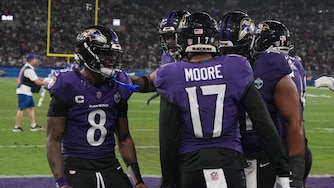
For good measure, Jackson picked up a first down on a quarterback draw in the third quarter to set up a short touchdown strike to Chris Moore.
This wasn’t the guy who might carry the ball 20 times in a big game back in 2019. That’s too risky for a 29-year-old whose health is everything for the franchise he leads. And it’s unnecessary. A few schemed runs per game will be plenty to make life impossible for defenses.

Carson Vinson held his own on a chaotic night for a young offensive line.
Left tackle won’t be the Ravens’ most pressing concern for the next week as they sift through the wreckage of their decimated depth chart at center. Both Jovaughn Gwyn and Ethan Pocic exited Sunday’s game, forcing Vega Ioane, who started taking warmup reps at center only a few weeks ago, to step into the breach. The rookie did fine, on top of playing his best overall game to date as a pass blocker.
Ioane’s emergency service overshadowed Vinson’s equally important work filling in for injured left tackle Ronnie Stanley.
Vinson played a grand total of seven offensive snaps last season after he was drafted in the fifth round as a developmental prospect out of Alabama A&M. He showed up as a noticeably improved player in his second training camp, quickly cementing himself as the team’s swing tackle.
Still, he entered Sunday’s game almost entirely unproven as an understudy for the Ravens’ most experienced and most important offensive lineman.
With their interior blockers already struggling to protect Jackson, the Ravens could not afford a catastrophe on the left edge. And Vinson was far from catastrophic, helping to keep the franchise quarterback clean for most of the night. Though he wasn’t facing the most accomplished edge rush, he was a quiet hero on an evening full of loud performances.
The same could not be said for left guard John Simpson, who struggled to keep Cowboys defensive tackle Quinnen Williams out of the backfield and was flagged for three false starts.
Between the continued penalties and the mess at center, there’s plenty to worry about with this unit. Credit to Ioane and Vinson for showing they’re part of the solution despite their youth.


Comments
Welcome to The Banner's subscriber-only commenting community. Please review our community guidelines.