
Join the huddle. Sign up here for Ravens updates in your inbox.
For the first time since the Ravens franchise was born, the team introduced an entirely new trio of coordinators.
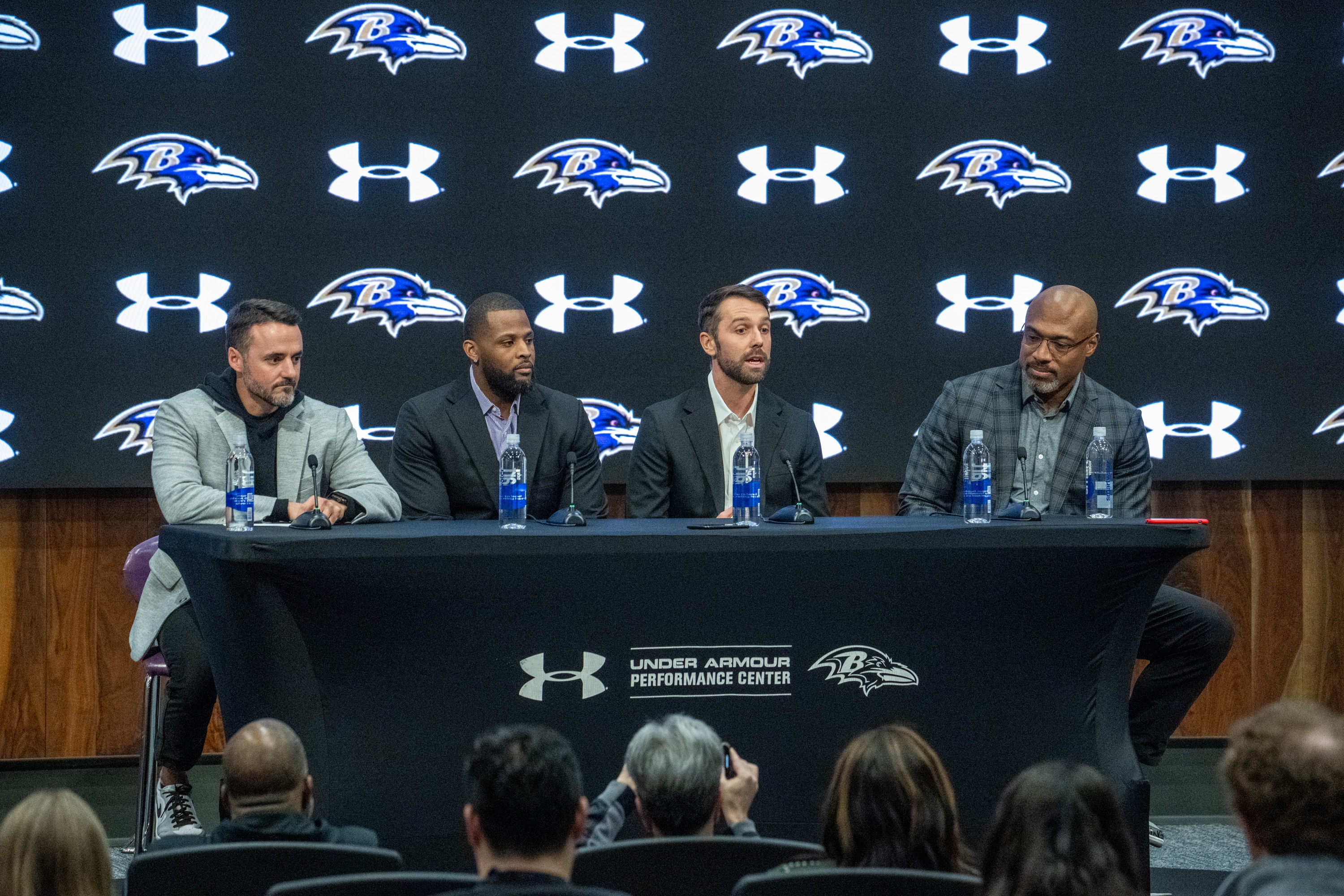
Flanked by new head coach Jesse Minter, offensive coordinator Declan Doyle, defensive coordinator Anthony Weaver and special teams coordinator Anthony Levine Sr. took the stage at the team facility in Owings Mills for their introductory news conference Wednesday.
Each coordinator shared his vision and plans for the Ravens as the new coaching staff looks to hit the ground running. Here are the biggest takeaways from each coach.
Minter’s the puzzle master
In 2025, after his first successful season as defensive coordinator of the Los Angeles Chargers, Minter’s name started being thrown around in head coaching conversations.
Read More
Those conversations got Minter thinking harder about how he would build his coaching staff, particularly on the offensive side. With Minter’s defensive background, the offensive coordinator would be one of his biggest hires if he were to become a head coach.
He looked at systems he admired and really liked the one used by Bears head coach Ben Johnson.
Johnson wasn’t going to leave Chicago, so Minter looked at someone who knew his system. And as he turned his focus to Johnson’s offensive coordinator, Doyle, he heard great things about him.
The two also found they see football the same way, just from opposite sides of the ball.
From there, he added Weaver, who had been in the mix for head coaching positions around the league, as defensive coordinator. Although the two didn’t overlap in Baltimore, both have a history with the team. Minter called him a relationship builder.
To round out the leadership group, Minter promoted Levine, whom he’d coached in Baltimore, from his position as assistant special teams coach to coordinator. Just as with Doyle and Weaver, Minter called Levine a connector and relationship builder.
Minter pulled from past coaching staffs to fill out his group. He also added coaches he had no connection with. He brought in experienced NFL coaches, and he elevated assistants from the college ranks.
“It all fits together as a puzzle,” Minter said.
Doyle believes in Jackson’s ‘growth mindset’
In case Doyle was under any delusions about his most important responsibility as offensive coordinator, they were put to bed with the first question Wednesday.
It was about — who else? — quarterback Lamar Jackson.
Doyle said he spoke with Jackson for over an hour on a Zoom call as he interviewed for the position, and they’ve texted several times since. Their initial conversation hit on “a lot of different subjects,” Doyle said, from Jackson’s 2025 season to his vision for the offense to what he needs to succeed.
“I really wanted to see if we were compatible, and if that was a fit, and you’re trying to figure out what the coaching structure is going to look like in that way,” Doyle said. “Certainly very excited about the caliber of player he is, but also, just in all the conversations, his willingness to listen, his hunger to learn, his hunger to grow. He is a guy with a growth mindset. He’s played at a really high level, and still, I think that he wants to continue to work and feels like he can get better, and so me and the rest of the staff are really excited to chase that with him.”
Doyle, who helped elevate Bears quarterback Caleb Williams in his second year in Chicago, indicated that a well-run Ravens offense would ask less of Jackson as a scrambler and improviser. But, as with the mobile Williams, there will be welcome exceptions.
Sometimes, Doyle said, “the quarterback’s going to put the cape on and go be Superman.”
Doyle and Jackson are both 29, but Minter said “age is just a number” for the first-time play-caller. Doyle’s coached in the NFL since 2019, the year after Jackson’s rookie season.
“The thing that stood out to me about him is, he’s a connector,” Minter said. “He’s a collaborator. He’s creative. He’s got a great vision for what our offense should look like. We see football the same way and what it takes to be successful when it comes to creating standards, being very detailed, doing things at a high level. He’s been phenomenal to work with so far. Very excited about him and his ability to lead our offense.”
Weaver wants to make the defense feared
Anthony Weaver remembers a T-shirt from his rookie year. Underneath the Ravens logo, it said: “It’s better to be feared than loved.”
The Ravens’ defense was feared when Weaver last coached it, in 2023. Not so much since.
After an inconsistent 2024 season, defensive leaders spoke last year of their hopes of striking fear into opponents’ hearts. That vision was never realized.
But Weaver thinks they can get back there.
“It’s about us going out there and flying around to the ball, having 11 guys connected, right, that are in a flow state, that kind of know what each other is doing, and we’re just flying around and it looks like a pack of wolves,” Weaver said. “The one thing I know is, just having been with so many of these guys prior, it’s ingrained in their DNA.”
Weaver’s face lit up when he spoke of safety Kyle Hamilton, the “ultimate chess piece.” The back end has a lot to work with, he said, citing young defensive backs such as safety Malaki Starks and cornerback Nate Wiggins.
The pass rush needs work, but Weaver thinks the issues are solvable.
“From a talent standpoint, we certainly have some dudes that can get there,” Weaver said.
Although Weaver, who has play-calling experience, will be deferring to Minter on game days, he will be critical in helping the defense rediscover what “play like a Raven” means.
“I don’t think there’s anybody that will get more out of our guys than him,” Minter said. He added: “I was looking for a leader and somebody to run that room.”
Levine’s strength is his connection to Ravens culture
Of all the coaches who spoke Wednesday, only one was returning from last year’s staff — and only one had a Ravens player fly in to watch his introduction.
In the middle of one of his first public comments, Levine pointed to the back of the room, toward Keondre Jackson, one of the Ravens’ special teams standouts from last year.
“That speaks to the value to the type of players we have and the type of connection I have with these guys,” Levine said. “They understand the culture.”
Levine played on the unit for 10 years, ascending to captain and sage veteran before becoming a coach. He was in Baltimore last season under Chris Horton, who prepared him for the coordinator role by throwing him in front of the room to run meetings.
Levine was a direct pupil of Jerry Rosburg, who coached the special teams unit through some of its best seasons. As a player, he was an emotional leader, but also a teacher for the newcomers — incorporating his knowledge playing several positions and roles to adapt.
Beyond his experience, the biggest thing Levine brings to Minter’s staff is his relationships. He’s tight with Horton, Rosburg, linebacker Jameel McClain, Ozzie Newsome and other figures who have helped shape the culture of the special teams.
When he was a player, Levine said, he frequently texted with revered former Raven O.J. Brigance, as the two kept up a never-ending argument over which of them was a better special teams ace. “It’s always back and forth with ‘Juiceman,’” he said.
After seeing improvement, especially in kick and punt coverage, under Horton last year, the Ravens’ special teams seek to exploit the edges that made them among the most respected groups in the NFL under John Harbaugh and Rosburg. The physicality and execution of the team’s third phase will try to set a tone that can help the other units build.
“These guys, they respect me,” Levine said. “We don’t talk a lot about what I did when I played, because it’s not about how I played. … It’s more about me being able to teach them to go out there and be productive and have the great career that they want to happen.”

Comments
Welcome to The Banner's subscriber-only commenting community. Please review our community guidelines.