
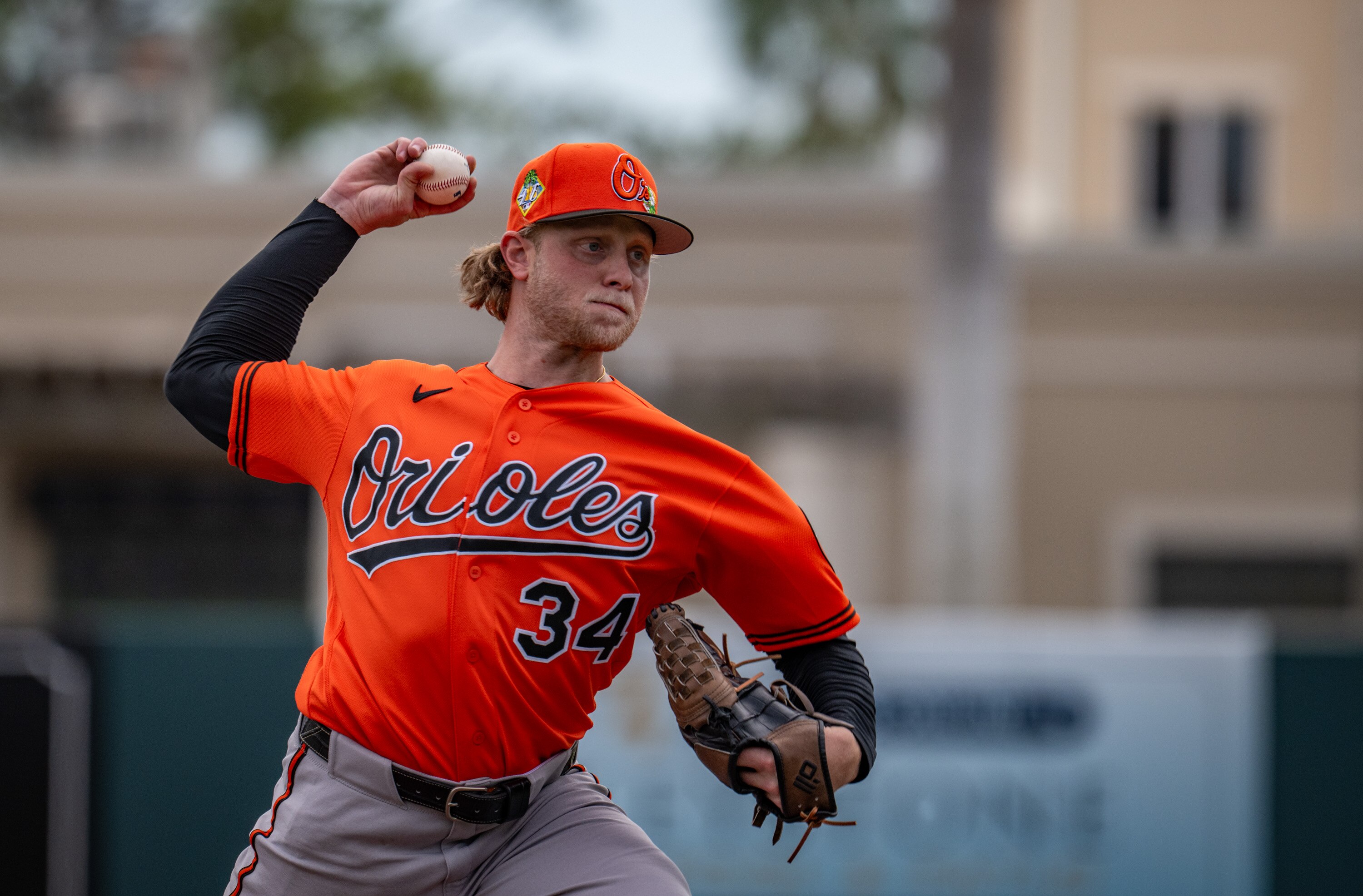
When a team signs a player to a contract extension, it’s a bit like catching a fish. The world only ever takes notice when it’s a Big One.
Shane Baz for five years and $68 million? On the surface, it’s a hard deal to get excited about. The first real game the fireball right-hander will pitch for the Orioles isn’t until Sunday.
It’s a nice catch, but fans want to hear about the Big Ones. Trevor Rogers. Kyle Bradish. And the biggest one of all: Gunnar Henderson. In the scheme of things, Baz’s contract doesn’t tip the scales.
If your cynical side is wondering if the Orioles just signed a starter with an injury history because they felt like buying low on a former first-round pick, sure, it’s understandable. But that doesn’t mean you should hit the snooze button on these smaller-scale moves.
Believe it. This is a new way of doing business for the Orioles, who are quickly leaving the John Angelos school of miserly ownership behind and taking calculated risks.
It’s a refreshing shift — yes, for president of baseball operations Mike Elias, but perhaps more importantly for the David Rubenstein-led ownership group that is trying to figure out how to get guys to take its money.
Read More
When players do accept the bag, we shouldn’t sniff just because it isn’t nine digits.
If Baz were an isolated case, you could poke more holes in it. The Orioles essentially have bought out three years of arbitration. They keep Baz under contract until his age-31 season and give him the chance to still score in free agency before 2031. Yes, there’s upside, and, yes, Baz could potentially well outpace the contract he just signed.
But, when you combine the Baz deal with the similar extension for Samuel Basallo, the trend starts to take a more concrete shape.
When Basallo signed last August, there was some critical background analysis that was not exactly fair or kind. Some people fixated on a young Dominican selling off his arbitration years, potentially at a steep discount for the No. 7-ranked prospect in baseball, and wondered if the move was more about providing for his family than making a sound business decision.

Would folks have whispered the same way about an American-born prospect? Maybe not.
In that sense, Baz is a compelling counter to Basallo: a Texas native, the No. 12 pick in the 2017 draft, a guy who made millions when he first signed in 2017 and who had fewer years of team control. Baz has played in three organizations, and you’d have to assume he sees something promising in Baltimore that makes him comfortable sticking around.
A huge difference might just be a coaching staff that believes in him, with manager Craig Albernaz saying this offseason that Baz, “has all the potential in the world to be an ace and to go out there and be in the conversation for a Cy Young.”
Whatever Baz’s reasoning, the Orioles clearly appreciate a guy who is willing to have the conversation about signing extensions.
Rubenstein was celebratory when he signed Basallo but clearly not willing to stop at one extension. He signaled that he saw Basallo’s deal as but the first domino in a chain.
“The Orioles’ ownership group is fairly well capitalized, and we have the resources to do these kinds of deals,” Rubenstein said in August. “It takes two to do deals, but we thought this was a perfect one for the first one of this type.”
Now there are two — and if you count Pete Alonso’s $155 million deal in free agency, you can appreciate the evidence that ownership is willing to spend in a meaningful way. It has not been perfect, striking out on acquiring a true front-of-rotation ace, but the momentum is building for the Orioles to eventually keep at least one of their own, Rogers or Bradish, for many years to come.
It’s a far cry from the last big public outpouring we heard from Angelos, when he griped to the New York Times about the existential future of his franchise if he had to pay for extensions. It’s true that Rubenstein and his group have raised ticket prices at Camden Yards and cordoned off parts of the stadium for exclusive clubs and seating, but at least you can see the owners are trying to apply some of those profits to a competitive roster.
Baz and Basallo are not the biggest deals, but they’re definitely an improvement from the era that came before.
If you’re waiting for a deal for Henderson — whose agent, Scott Boras, has reportedly not done much responding to the front office’s overtures — you’ll be waiting a long time, I’d expect.
Boras advised Juan Soto to wait for free agency, eventually netting a $765 million contract for the star outfielder. Henderson may not break records, but he could land in that neighborhood.
But, with Basallo and Baz, the proof of concept is apparent. The Orioles are willing to negotiate and, if it makes sense, they’re willing to pay up, too.
Basallo was an outlier. Baz adds credence that this is a pattern – that more extensions could be on the way in the near future.
Even if this contract isn’t the one that gets folks to pull out the tape measure and gape in awe, it should provide a bit of reassurance for the future. If the trend continues, and the Orioles stay aggressive, the next big contract extension might be a Big One.




Comments
Welcome to The Banner's subscriber-only commenting community. Please review our community guidelines.