
If you blink, you might miss Dustin Glant.
The Nationals’ assistant pitching coach/bullpen coach strides through the clubhouse, constantly looking for a player or heading to a meeting. Then he’s gone again. Catching him at a standstill is rare. There’s always work to do.
“I’ve never seen someone drink more coffee, but he’s always locked in,” reliever Clayton Beeter said. “He loves what he does, so he’s really bought in and trying to have as much information as he possibly can to help us out.”
Glant joined the Nationals this past offseason after serving as Indiana University’s pitching coach for three seasons. It was an outside-the-box hire, given he had never coached in the majors. But many of the team’s coaching hires were. And the team was sold on his character and work ethic.
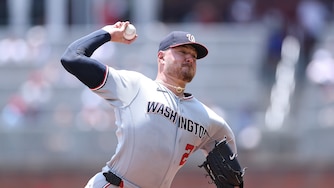
He’s constantly challenging the relievers, focusing on sharpening their process after each outing. He’s helped a largely unproven bullpen deliver for a Nationals team that is one of the biggest surprises in baseball as they stay above .500.
On the plane after road trips, he’s watching video of the previous day’s game with a cup of coffee in hand to prepare for the next day’s after-action review, a structured technique designed to improve performance. The process was developed by the Army in the 1970s to help soldiers learn from their mistakes and achievements. Glant brought that same strategy to the Nationals.
In those meetings, Glant has a sheet on which he jots down how players felt during the outing, what they feel they need to work on and how they performed in key metrics such as first-pitch strikes.
“He’s not gonna be outworked,” manager Blake Butera said. “He really takes it upon himself to make sure these guys are absolutely prepared when they get into the ballgame. If they don’t pitch as well as maybe they should have or could have, he takes that on himself and feels like it’s because he didn’t prepare them the right way.”
Nationals relievers have thrown the most innings in baseball and posted an unremarkable 4.71 ERA, the eighth highest in baseball. But the numbers don’t give the full picture of the progress the group has made. In May, the unit’s ERA dropped to 4.22 with an expected ERA of 4.02.
Glant plays a role in ensuring relievers are tethered to their process in each at-bat.
“He’s up their ass, dude,” pitching coach Simon Mathews said. “Like, they don’t get away with shit with him. It’s really awesome to have a guy like that on staff who can just have that level of attention to detail with that group down there.”

That commitment is contagious and important as the Nationals’ new front office tries to establish a culture rooted in development and teaching. Working hard is embedded in Glant, a mindset that has been fortified during his baseball journey.
Glant pitched for Purdue and was drafted in the seventh round by the Arizona Diamondbacks in 2003, topping out at the Triple-A level before being released by the organization in 2008. He pitched in independent leagues before retiring in 2011.
Glant dove into coaching and worked his way up from high school (2014-15) to the college level. He became the head coach of Anderson University (2016) in South Carolina. His path led him to Ball State, where he served as head coach for three years before the he joined Yankees organization as a minor league pitching coach.
There, he was influenced by a handful of his peers. Among them: Sam Briend (now the Yankees’ senior director of pitching), Desi Druschel (currently the Yankees’ assistant pitching coach) and Daniel Moskos (the Marlins’ pitching coach).
“If you’re in a room with Sam Briend, Desi Druschel and Daniel Moskos, you have to learn to grind to keep up,” Glant said. “I’m not smart enough to do it any other way, so I’m putting my head down and put in the extra time to hopefully be right.”
In 2020 he was scheduled to be the pitching coach for the Staten Island Yankees, the team’s Single-A short-season affiliate, but the COVID-19 pandemic wiped out the season.
Even without a team to coach, Glant continued to learn about the craft of pitching during the shutdown, which paid off when the Nationals were searching for an assistant pitching coach.
Moskos is thought of highly throughout the league for his knowledge of pitch grips and pitch usage. Glant said he learned about workload management, biomechanics of a pitcher’s delivery and pitch design while in the Yankees organization.
“It was like getting a doctorate in pitching,” Glant said.
Glant left the Yankees in 2021 to become an assistant pitching coach at Indiana. He is from the Hoosier State, and he wanted to spend more time with his two small children and to work for Indiana head coach Jeff Mercer.
Becoming a college coach presented a new challenge. How could he distill the information he accumulated with the Yankees in a digestible way for his players?
“I learned how hard winning is,” he said. “I learned some really good management and leadership skills. I tried to bring as much as I could from the Yankee side over to the Indiana side, and sometimes it worked, sometimes didn’t go so well.”
Glant said he tried to “chase pitch shapes” and increase his pitchers’ velocity but quickly discovered it’s different developing in college, where wins and losses matter more than in the minors.
So Glant simplified his goals and focused on building winners. He went back to the fundamentals of pitching: throwing strikes, limiting walks and getting batters to chase outside the strike zone.
At Indiana, Glant developed nine pitchers who were selected in the MLB draft.
His ability to solve problems was a plus for Butera because Glant was leading a pitching staff that wasn’t the most high-profile and didn’t have the most NIL resources, yet it was productive. The Hoosiers led the nation in strikeouts in 2025 and produced the three highest single-season strikeout totals in program history.
Even when Indiana scrounged the transfer portal, Glant and the coaching staff would find unheralded players they felt could be unlocked with an adjustment or two.
He’s carried that same approach to the majors. If a player has a bad outing, they talk about it and forget about it, preparing to work on that pitcher’s strengths to aid him the next time out. Left-hander Richard Lovelady allowed two runs in two-thirds of an inning in a 7-3 loss to the Marlins, but the two didn’t do their after-action review. Lovelady doesn’t like to focus on the negatives of an outing. He’s experienced how baseball can beat a player down and prefers to stay positive.
Glant was receptive to that and played a Lovelady video highlighting how to maximize those traits for his next outing. Lovelady opened the next game and threw two scoreless innings.
“They’re super fun to work with,” Glant said. “They’re hungry; they want to be here; they love competing. The most fun thing is, when the phone rings, they want it to be for them.
Knowing how to talk to each player is one of Glant’s strengths, and it helped him integrate with the Nationals. He holds a high standard and can be firm, but it’s because he wants the best for each pitcher.
“There’s something beautiful about having a guy who, no matter what happened yesterday, no matter how it went, no matter how bad your arm hurts the next day, he’s going to grab you and he’s going to talk about it,” Mathews said. “The guys have come to sort of rely on that and expect that, and he’s an invaluable resource for the team.”



Comments
Welcome to The Banner's subscriber-only commenting community. Please review our community guidelines.