
Join the huddle. Sign up here for Commanders updates in your inbox.
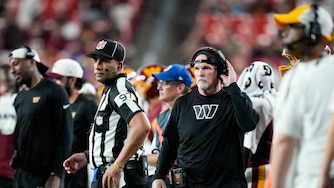
A few moments before the moment, Dan Quinn hopped on the headset to offer advice to his young offensive coordinator.
He heard David Blough deep in conversation, waffling over a late-game decision. Was a trick play the right call? Was this the moment to unveil it?
Quinn’s instincts, hard-earned over two decades in the NFL, told him it was. A tight divisional game in Philadelphia, a few yards from the goal line, the Commanders had to stay aggressive to keep the Eagles off balance. Over the next three plays, Quinn told Blough to unleash it when it felt right.
“That’s good, man. Let’s go for it,” Quinn told him. “You are calling it either way. Whether it is [now] or we got two more plays.”
Read More
Quinn then switched off his headset and watched it play out. He was there to help, not hover.
Two snaps later, on a game-tying 2-point conversion attempt, Blough dialed up an indirect shovel pass. Before the play even developed, the Eagles swallowed up the misdirection. The Commanders’ comeback bid ended. The criticism started.
But, standing outside the locker room 20 minutes later, Quinn was steadfast.
“I knew the play,” he said. “I thought it was a good one.”
This is how Quinn is handling his young play-callers in his critical third season leading Washington. He’s directing the flow but giving them space to make their own mistakes. It’s a philosophy he pulled from Super Bowl-winning coach Pete Carroll, who stood by his coordinators through growing pains.
Quinn baked that into the equation when he hired two first-time play-callers this offseason in Blough and defensive coordinator Daronte Jones to change the direction of the team after a 5-12 season. How he guides them, and supports them, might dictate his future.

“I don’t want to be the person while they’re making the call be like, ‘Man, that’s a good call’ or ‘Why did you call that?’” Quinn said. “I try to lead ahead of it. … Sometimes it’s my time to step in to say, ‘This is that time. Take your shot.’ But I try to give guidance in between, not while they’re about to make it. And certainly not right after.”
Quinn’s first NFL coordinating job followed a similar approach in 2013. Carroll hired him at the peak of the Legion of Boom era to lead the defense in Seattle, where he had served as defensive line coach for two seasons. Quinn was handed a roster loaded with superstars: Kam Chancellor, Earl Thomas, Richard Sherman, Bobby Wagner.
He had just won the Southeastern Conference Eastern Division at Florida, coordinating one of the best units in the country. But the NFL was a different game.
Carroll refused to override his play-caller. If there were situations Carroll had seen before, he’d pass them along as reference points. He wanted Quinn to grow into the position, eventually standing on his own as he helped Seattle to back-to-back Super Bowl appearances with the best defense in the league.
“I can clearly remember examples where Pete Carroll did that with me,” Quinn said.
So now, in a must-win year for Quinn, he’s opting for the same approach. He hired Blough and Jones knowing both had the traits of a strong play-caller. Quick on their feet, decisive, thoughtful in their approach.
To help them get a feel for it, Quinn presented his notes on the opponent early in the week — all the little details he’s recorded over the decades.
“I’ve been going against Philly for five years in the division,” said Quinn, who was the defensive coordinator in Dallas for three seasons prior to getting the head coaching job in Washington. “So here are some wisdoms to share and say, ‘These are some of the scars. These are some of the things that have been good.’”
When he saw Blough or Jones in the office alone, he swung by and gave them scenarios. This down and distance, this time and score, what are you running? Quick answers were preferred. After that, they could stress test their line of thinking.
“It’s him coming in and sitting in the office and saying, ‘Hey, when are you gonna get to this play?’ Or, ‘Hey, when are we thinking that this could come up?’” Blough said. “It’s all of us being on the same page about how we’re going to attack.”

In coaches meetings, Quinn wants his coordinators to be vocal about their plans. He then encourages or corrects parts of them, pulling examples from his past.
“I would be a fool if I didn’t lean on the experience of Quinn and all the things that he’s brought to the game,” Jones said. “There’s constant dialogue that’s going on. ‘Hey, Coach, what are you thinking here? What do you see? What about this?’”
But, once he sufficiently runs through the scenarios, Quinn wants Sundays to be up to the coordinators. In a game, he will interject with reference points they’ve talked about or tendencies he’s seen.
But he doesn’t want to dictate. That isn’t how they will grow for the bigger games in November and December. Those are the ones Quinn needs to win to keep his job.
“That’s my role for all the coaches, to make sure, ‘Hey, be on top of this look here.’ Like, I’m the checks and balances,” Quinn said.
After that, he can live with the result.
And Week 1 was a telling case study.
Blough’s late-game decision to run a trick play cost Washington the game. It is heading to Dallas in nearly a must-win scenario. Less than 15% of teams make the playoffs after starting the season 0-2. But Quinn held firm that his play-caller would be just fine.
“He’s gonna be fantastic, David is. He’s aggressive; he’s thoughtful; he’s quick on his feet; he’s decisive. Does all that mean your first game goes fantastic? No, hell no, it doesn’t,” he said. “It means that this guy’s gonna be an excellent play-caller in the NFL.”




Comments
Welcome to The Banner's subscriber-only commenting community. Please review our community guidelines.