
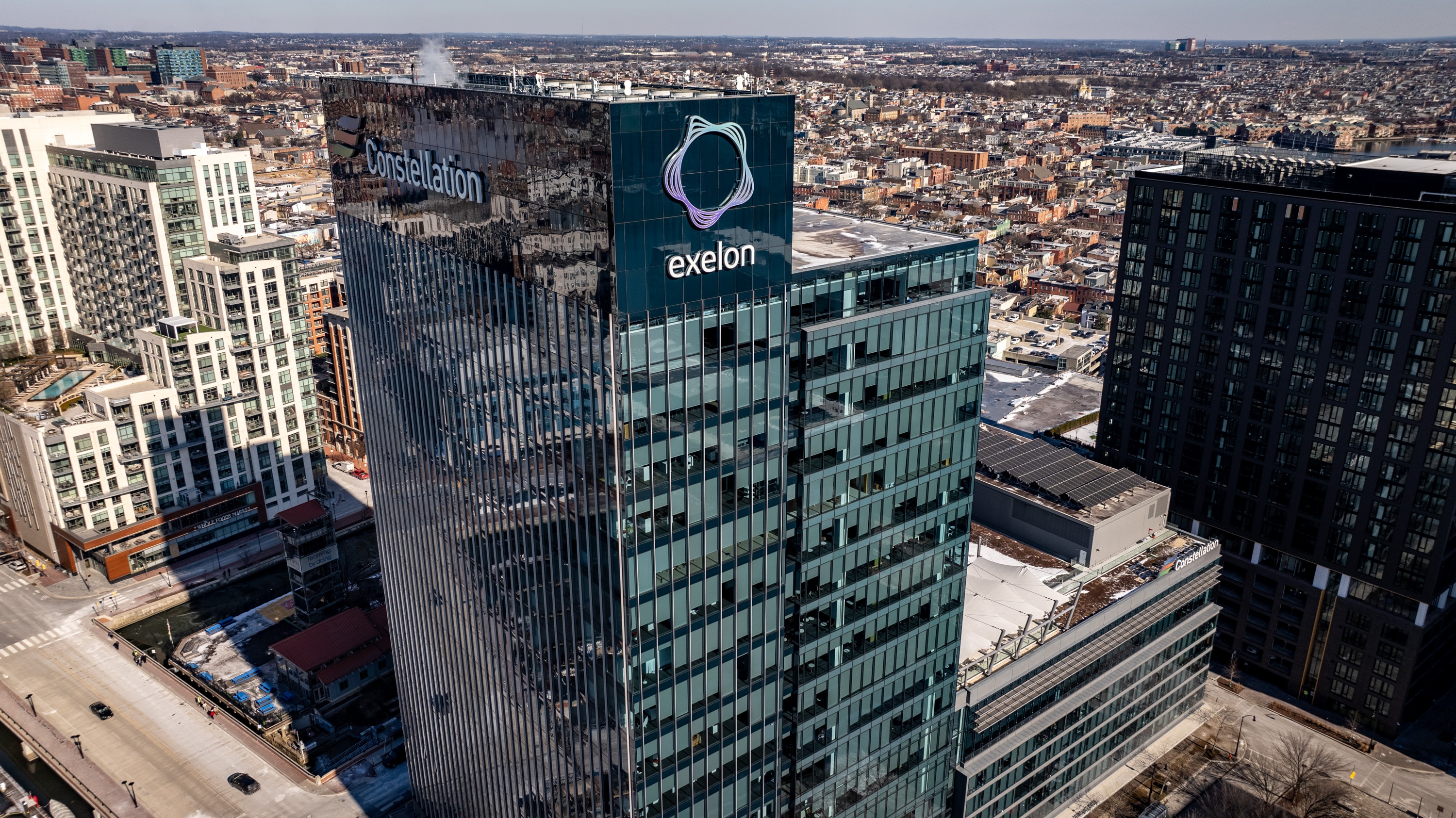
Exelon spread its message just about everywhere this year. On TV during the Olympics and before Super Bowl kickoff. On highway billboards. On Spotify. And throughout the Maryland state house.
Executives at the company, the owner of major mid-Atlantic utilities, seek to address what grid operators warn is an urgent problem: the region doesn’t generate enough power. If Maryland can’t bring more online, Exelon argues, the state economy will stagnate and customers could face rolling blackouts as early as summer 2027.
To fix it, Exelon wants to undo decades of regulatory precedent barring utility companies from owning and operating the sources of power — an idea they spent months pushing to Gov. Wes Moore’s office and state lawmakers, records show.
Despite the company’s multimillion-dollar messaging campaign, though, the idea landed with a thud in Annapolis this session. Exelon, whose subsidiaries include Baltimore Gas and Electric Co. and Potomac Electric Power Co., instead became a punching bag — in one case literally — for Democrats looking to establish populist bona fides in an election year defined by affordability.
Last month, BGE paused a project in South Baltimore after revelations of the cost — over $500 million — ignited a political firestorm. Lawmakers are on the verge of passing legislation that would stop Exelon from underwriting executive salaries with ratepayer money and subject utilities to even more oversight for infrastructure projects that are billed to ratepayers. That bill also projects to save average customers at least $150 a year by cutting energy efficiency surcharges.
To Speaker of the House Joseline Peña-Melnyk, actions like these are how the legislature stands up to utilities for Marylanders.
“Corporate utilities have lobbyists who advocate for them in Annapolis,” she said in a statement to The Banner. “Who do the ratepayers have? Legislators. They rely on their public servants to be their voice and their vote.”
But with more Marylanders struggling to make ends meet — a recent poll from the University of Maryland and Baltimore County Institute of Politics found 2 in 5 residents were at least “very” worried about paying their utility bills — and more data centers projected to strain regional power grid, these fights over energy generation may only intensify in the years ahead.
“These are complex challenges and reducing them to ‘who’s up and who’s down’ political narratives does nothing to help frustrated Marylanders bearing the burden of an energy supply crisis,” said Michelle Hook, Exelon’s vice president of communications for its Mid-Atlantic South region.
Power and politics
The Chicago-based Exelon spent months aggressively campaigning around the mid-Atlantic for the right to build and own power plants.
The company is among Maryland’s most generous campaign donors. Exelon and its subsidiaries spent nearly $1 million lobbying in Annapolis last year and this session employed more lobbyists than any other company — twice the number of Baltimore-based Constellation Energy, the country’s largest electricity producer.
Constellation has fought Exelon’s proposal to allow it to own power plants, even threatening to cut investment in Maryland if lawmakers approved it.

The juggernaut generator helped fund an opposition group, the Alliance for Competitive Power, to make their case, buying online advertisements and close to $55,000 in TV spots, according to filings corroborated with the group.
Utility companies have angled for permission to build generation around the country, said Rob Nichols with the Alliance, but he called Exelon “among the most aggressive.” The utility campaign hasn’t found much traction, but Nichols expects it’s just beginning.
“My experience in other states is that utilities don’t take no for an answer easily,” he said.
Exelon spent more than $1 million on local television advertisements to push its legislative agenda, including for spots that aired during Olympics and Super Bowl coverage. The company also purchased advertisements on websites, streaming platforms and billboards as part of a public relations campaign.
Hook, Exelon’s vice president of communications, declined to share the total cost of these ads, citing what she characterized as The Banner’s unfair coverage of the company. She questioned the relevance of the advertising costs other than for “upsetting our customers by skewing the facts.”
Behind the scenes, officials spent months laying the groundwork for their energy generation proposal, according to records obtained by The Banner.
An Exelon lobbyist reached out to Moore’s office about the idea in October, and records show company officials met with the administration in November, December and twice in January. Pepco and BGE also organized a meeting of key delegates in December for a “virtual education session.”
Pepco invited Moore’s chief of staff, Lester Davis, to give remarks at a dinner for Maryland utility CEOs at a Ruth’s Chris Steak House on Jan. 7, according to records obtained by the Energy and Policy Institute and reviewed by The Banner. Davis is also married to an Exelon employee.
A copy of the governor’s calendar lists a meeting between Moore and BGE CEO Tamla Olivier in the early days of session.
Moore and Exelon CEO Calvin Butler have met at least twice during the governor’s first term. They appear to be on good terms: Butler called the governor “friend" after an appearance together in March 2024.


None of this stopped Moore from criticizing the industry in a January social media post, which piqued Exelon. Records obtained by The Banner show one lobbyist, whose phone number is redacted, sent a screenshot of the post to Saif Ratul, one of Moore’s energy advisors, with the caption “yikes.”
In another message, a number appearing to belong to Anne Klase, Pepco’s senior manager of state government affairs, sent a screenshot to an unidentified Moore official with a raised eyebrow emoji. The official had moments earlier thanked Klase for Pepco’s holiday card.
“Send it back!” Klase apparently wrote. “You know I’m just kidding! Sort of!”
Ammar Moussa, a spokesperson for Moore, said the governor is focused on addressing consumer anxiety about energy costs, which is why Moore backed the legislature’s energy savings bill.
Moore “has been clear that the status quo is not good enough for Maryland families,” Moussa said.
Swipes at the utility industry have featured in Senate President Bill Ferguson’s Democratic primary. Ferguson’s challenger, online influencer Bobby LaPin, has painted the South Baltimore senator as an Exelon tool while styling himself as a grassroots fighter: In one video, LaPin boxes with a punching bag labeled “BGE” to the “Rocky” theme song.
In another social media post, LaPin warned about a possible data center at Baltimore Peninsula, which BGE has targeted for $500 million of transmission line improvements. Within days, Ferguson announced legislation to block data center development there, and Exelon paused its project.
In a statement, Ferguson said that holding utilities accountable is nothing new for him. “This work is about the constituents I serve — who organized alongside my office for months to get BGE to pause an underground transmission project — not a political campaign,” he said.
Some, though, remain frustrated by Ferguson’s efforts.
On Monday evening, a small group of activists used a projector to post their grievances with the energy bill onto a downtown Baltimore building, criticizing the Senate’s version as too friendly to utility companies.
One projected image pictured Ferguson and the BGE logo in a giant heart beneath the words: “True Love.”

Looking toward the future
In this challenging political environment, Exelon struggled to recruit backers for its controversial bill but eventually found two: Del. Pam Queen and Sen. Kevin Harris.
Outside the bill’s only hearing, in a House committee, Queen was candid about her bill’s chances.
Some have wondered why she sponsored the legislation, she said, “because people see it as a betrayal [of] one side or the other.” If utilities were allowed to build power generation, they could pass those costs along to customers. Utility executives have argued that allowing their companies to build power plants would actually lower consumer costs in the long-term.

The Montgomery County Democrat said she felt lawmakers should explore all options to boost Maryland’s power generation.
“I’m not going to ask anybody to put their neck out,” she said. “I wanted to make sure it got this conversation. I think it’s a good conversation.”
Harris, a Democrat representing Charles and Prince George’s counties, didn’t respond to messages seeking comment.
Michelle Hook, the Exelon spokesperson, said the company never expected their proposal would pass this year, and suggested it would fare better in future sessions.
“This was mainly a year to build new relationships and educate legislators who are less familiar with the complex issues in the energy space,” Hook said.

To Emily Scarr, a ratepayer advocate with the Maryland Public Interest Research Group, Exelon’s controversial campaign to build power generation has distracted from its other priorities, which she thinks are going just fine.
A proposal to repeal a controversial 2013 law — which critics blame for encouraging utilities to pursue costly, ratepayer-funded infrastructure upgrades — fizzled without a vote, while efforts to bar utilities from using forecasts to set rates may be watered down. State regulators granted BGE an extension on disclosure of a requested rate hike until after session, while Pepco has asked to raise DC-area rates by an average of almost $12 a month.
“I wouldn’t say they’ve had a rough year,” Scarr said of Exelon. “The status quo serves them pretty well.”
On this, advocates and industry agree.
Hook called it “inconsistent to suggest that Exelon has had outsized influence” in the statehouse “while simultaneously characterizing the session as unsuccessful for the company.”




Comments
Welcome to The Banner's subscriber-only commenting community. Please review our community guidelines.