
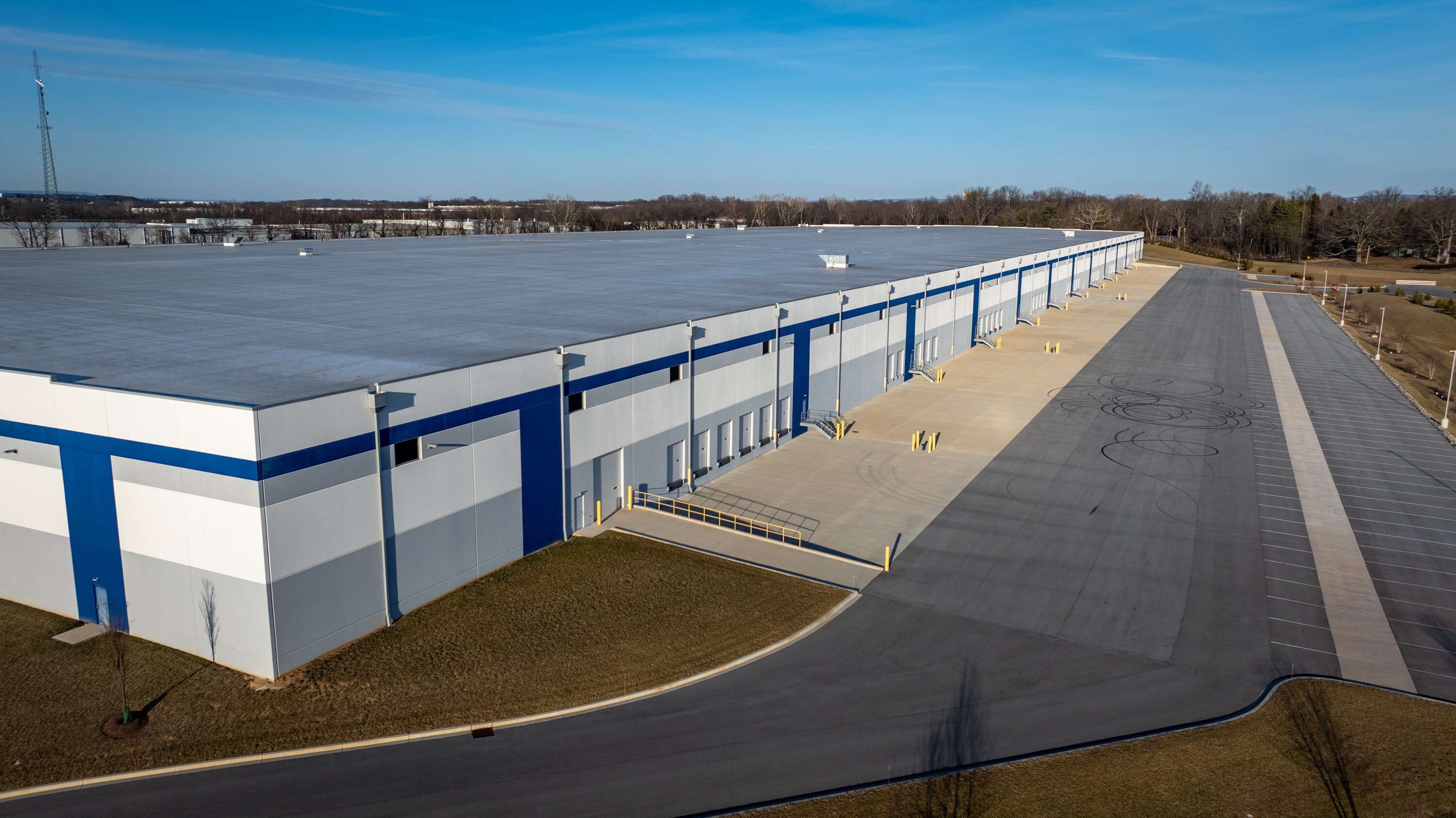
When the news first broke in late January about the federal government’s purchase of a massive warehouse for immigration detention in Western Maryland, Gov. Wes Moore’s administration expressed shock that the project was launched “with no coordination with the state.”
But the Department of Homeland Security notified a state agency about the plans in mid-January — days before the warehouse sale was finalized and two weeks before the public would learn about the undertaking.
The Jan. 12 DHS letter to the Maryland Historical Trust, a state agency housed in the Department of Planning, carried the heading “New ICE Baltimore Processing Facility.” State and federal law requires Maryland’s historic preservation agency to review certain construction projects, and it receives thousands each year.
While the letter did not explicitly describe plans to house immigration detainees at the site in Williamsport, it offered clues, including a reference to a guard shack, “holding and processing spaces,” visiting spaces, cafeterias and health care facilities.
The historical trust “did not notify anyone else in Gov. Moore’s administration about this letter or escalate the letter,” said David Buck, a spokesperson for the Maryland Department of Planning.
“MHT typically reviews 5,000 to 6,000 of these projects per year ... and does not typically notify the administration about projects submitted for review,” he said.
The governor’s office learned of U.S. Immigration and Customs Enforcement’s plans from media inquiries on Jan. 27, Moore spokesperson Ammar Moussa said.
Moore’s office did not answer questions about the letter or say whether ICE’s plans should have been brought to the governor’s attention.
ICE declined to comment for this story, citing a pending lawsuit over the warehouse project.
ICE’s Washington County plans have been controversial and secretive from the start. The news blog Project Salt Box first reported that the Department of Homeland Security bought an 825,000-square-foot mega warehouse in Williamsport on Jan. 27, fueling talk of a possible immigration detention center there.
A deed recorded Jan. 22 shows the federal government finalized the agreement Jan. 16. Once the deal became public, ICE released few details about its plans for the site. On Jan. 28, Washington County’s government revealed in a statement that its Historic District Commission had received a letter about plans for an ICE processing facility two weeks earlier.
Also on Jan. 28, the Moore administration told The Banner: “It is deeply troubling that the federal government has initiated an operation requiring a building of this size with no coordination with the state.”
But like Washington County’s government, the state got a heads up in the form of a letter to its historical preservation office. ICE explained that it was sending the letter pursuant to the National Historic Preservation Act, which requires the federal government to consider the effects of its projects on historic properties.
The letter went on to describe ICE’s plans for the warehouse in broad terms, never using the word “detention.”
“The interior of the structure may be renovated or rebuilt to support ICE operational requirements, which may include but are not limited to construction of holding and processing spaces, office space, public-facing visitor spaces, and installation of amenities, such as cafeterias, bathrooms, and health care spaces,” wrote Gabrielle Fernandez, an environmental protection specialist with DHS.
ICE has faced intense pushback as it tries to expand its detention footprint in Maryland, where state lawmakers forbid local jails from holding immigration detainees for the federal government. Its holding cells at the George H. Fallon Federal Building in downtown Baltimore became so overcrowded that a federal judge ordered the agency to cap the number of detainees it held there.
ICE temporarily shut down those holding cells and cleared out the detainees a day before a congressional oversight visit last month. It has since reopened the space, but remains under a court order to keep capacity limited. ICE’s efforts to move its field office to a private building in Elkridge have been blocked, at least for now.
The warehouse in Washington County offered a workaround that would have allowed ICE to detain people in Maryland without violating a state ban on local jurisdictions detaining immigrants for the federal government. The proposal divided the community, with grassroots protests growing even as county leaders backed ICE.
Maryland Attorney General Anthony Brown sued over the project in February and accused the Trump administration of “secretly” purchasing the warehouse without consulting with the state or local community.
The lawsuit, however, references the Jan. 12 letter from DHS to the Maryland Historical Trust. The complaint also included a copy of the letter, which concluded that the project would not impact any historic properties.
The historical trust responded to DHS on Jan. 29 and agreed with its findings.
“The undertaking will have no effect on historic properties,” the historical trust wrote. “Additional consultation with our office may be required if there are any significant changes in project scope or location.”
On Feb. 10, after receiving comments from community members, the historical trust wrote back to ICE and requested more information.
“These communications suggest that MHT has not been provided with complete information about the project,” wrote Dixie Henry, the historical trust’s review and compliance administrator.
ICE has not responded to the Feb. 10 letter, a Planning Department spokesperson said.
The warehouse project is on hold for now after a judge ordered a pause on construction in response to Maryland’s lawsuit. The judge will consider extending the stop-work order at a hearing next week in federal court in Baltimore.
In the meantime, ICE has said it is reconsidering the scope of its plans for the warehouse. The agency wrote in a court filing that it “will not be imminently pursuing any retrofitting work for detention purposes.”
In a response filed Thursday, the Maryland attorney general’s office argued that it could not trust ICE’s pledge to hold off on construction.
“Any self-imposed pause could lift at any moment, in secret and without warning,” the office wrote.




Comments
Welcome to The Banner's subscriber-only commenting community. Please review our community guidelines.