
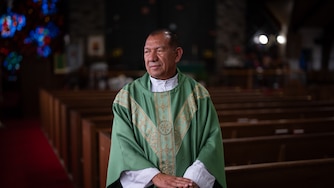
At Hyattsville’s St. Matthew’s Episcopal Church, the Rev. Vidal Rivas leads a nervous congregation. Many parishioners, like him, immigrated from Central America. Unlike him, they live under the threat of detention and deportation.
To ease their worries, Rivas has pledged more than spiritual support for his parishioners.
Over the past four years, the priest has agreed to serve as the standby guardian for 31 children whose parents could be detained under the Trump administration’s aggressive immigration crackdown.
A standby guardian is someone who has been legally designated to care for a child under 18. The designated guardian can make medical and educational decisions for children in their care and fly domestically and internationally with them.
“There are some families that don’t have anyone they trust, and they are trusting me with something so serious,” said the 62-year-old Rivas, who conducts services in Spanish.
Maryland has one of the nation’s most generous standby guardianship laws, a legal tool now reluctantly employed by immigrant parents in Rivas’ church who are reacting to the Trump administration’s immigration enforcement efforts.
Read More
To designate someone a standby guardian, parents must fill out legal paperwork identifying the person who will care for the child. Then, if a parent can no longer care for their child because the parent is mentally incapacitated, physically debilitated, deceased or subject to an adverse immigration action, the guardianship can immediately go into effect. If the guardianship remains necessary after 180 days, it can be extended via a county court hearing.
The nation’s first standby guardianship law was enacted in New York in 1992 to safeguard the children of parents dying of AIDS. Maryland soon followed. During the first Trump administration, as rhetoric against immigrants heated up, Maryland amended its law to serve parents targeted by U.S. Immigration and Customs Enforcement.

“They have pretty extensive powers,” said Cam Crockett, director of the Standby Guardianship Project, a Takoma Park-based nonprofit. “But the parents get to check boxes to say that they agree on all those powers in the form itself.”
In 2018, Crockett and Susan Silber, then Takoma Park’s city attorney, lobbied the General Assembly to expand Maryland’s standby guardianship law.
“We figured out one way to protect [immigrants] and to try to keep their children out of foster care or being traumatized,” Crockett said.
Crockett and others involved in the program say participation has increased significantly since the beginning of President Donald Trump’s second term, when ICE stepped up its immigration enforcement efforts.

Since volunteering as a standby guardian in 2022, Rivas, known as Padre Vidal, has cared for two children — a toddler boy and his baby sister — from January to July of this year.
He considers stepping in for detained or deported parents part of his calling. Most of the children for whom he is a standby guardian are St. Matthew’s congregants, Rivas said.
“I ask God to never change my head or change my heart, because that doesn’t belong to me,” Rivas said. “That belongs to the people who are trusting in you and who believe in you.”
‘Changing Pampers’
Rivas came to the United States from El Salvador in 1998 as a Catholic priest. He became a citizen in 2007 and later transitioned to the Episcopal Church and married.
ICE’s aggressive deportation efforts have hurt his church, he said.
He counts at least 15 parishioners who have been deported since Trump’s reelection and estimates that almost a third of the congregation no longer attend services for fear of ICE raids.
“They stopped coming to church, they stopped going to work, many have self‑deported out of fear,” Rivas said. “One Sunday they’re in church, and the next Sunday they’re not.”
Fears heightened last month when the Trump administration threatened — and then held back from — ending temporary protected status for roughly 200,000 Salvadoran immigrants.
Rivas, who has no children of his own, said he was at first hesitant to sign up for standby guardianship. But he said he was the only trusted adult available for many families.


In January, when ICE detained a South American woman who attends Rivas’ church, he became guardian for the woman’s two children, who split their time between Rivas’ home on the church property and rooms in the church’s basement.
“I would take them to the doctor,” Rivas said. “I would change Pampers. I was their father.”
Rivas’ wife, 61, also cared for the children and slept in the same room with them.
“The biggest issue was the girl,” the priest said. “She was looking for breasts because she wanted milk.”
The children reunited with their mother in July in Maryland.
There have been three other instances in which at least one parent from a family in the congregation has been deported, Rivas said. The priest and congregants support those families by babysitting and cooking for them, he said.
Crockett said that unlike the foster system, most standby guardians are people known to the family, like a relative or close friend — but for many families, a religious leader is their best option.
She has organized several workshops at schools and community centers across Montgomery and Prince George’s counties to recruit standby guardians and assure people who might need one that the paperwork they file will be kept confidential.
“Parents can privately sign this document, and they can just put it away once it’s signed by all the parties,” Crockett said. “It can be put in a drawer until the children are 18.”

She shared the written testimony of a parent who had arranged for a standby guardianship and was then detained by ICE; the testimony was provided on condition of anonymity because the parent feared retribution.
The immigrant initially didn’t see the need for the paperwork but changed their mind after a friend was detained.
After being detained, the parent was relieved that the designated guardian would care for the children.
“When I was caught, I was worried about my family,” the parent wrote. “When I was able to contact my family, I was very happy to know that my business was in good hands and that my children were in a safe place.”
Maryland’s law
Maryland has one of the nation’s best standby guardianship laws for undocumented immigrants, said Priya Baskaran, a law professor at American University who studies these statutes. It is one of only nine jurisdictions nationwide — eight states and D.C. — whose standby guardianship laws are immediately invoked when a detention or deportation occurs. This is what’s called a triggering event for the statute.
However, undocumented families in states with laws that don’t explicitly consider immigration enforcement as a triggering event may still be able to use the law, Baskaran said.
But “if it’s not explicitly protected in the statute itself, it’s kind of a gamble,” she added.
And while Maryland allows standby guardians to assume custody without court intervention for up to six months, many other states require papers to be filed in court before the guardianship can begin. That presents more than an administrative burden for undocumented families, Baskaran said.
The Trump administration has changed many immigration enforcement rules, and “what used to be undeniable sanctuary spaces like churches, hospitals, schools and courthouses no longer feel safe,” Baskaran said. “People are more at risk, and so they’re less willing to go to court.”
Rivas said he will continue serving as a standby guardian as long as families need him — and will help recruit others.
“There are many immigrants who don’t have anyone in their family, and they need a person or a family who can volunteer to protect these children who are left defenseless,” Rivas said.
“It’s very heartbreaking to see a child suffer and that there’s no one.”

Banner reporter Antonio Planas contributed to this story.



Comments
Welcome to The Banner's subscriber-only commenting community. Please review our community guidelines.