
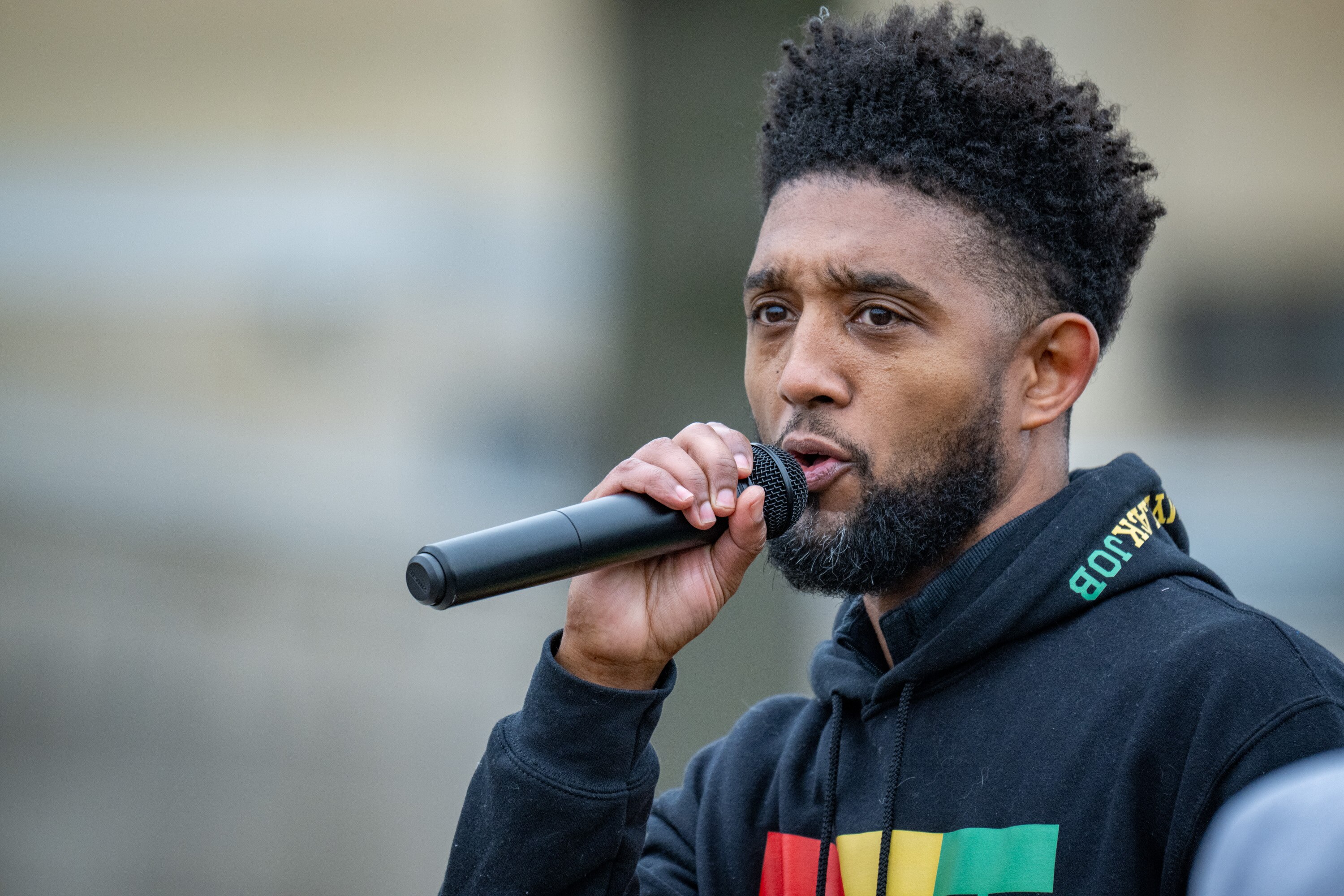
Mayor Brandon Scott is chronically online.
Wade into his Threads, X or Instagram accounts, and there’s a good chance you’ll see the 41-year-old deep in the comments section.
So when the question of whether Baltimore is part of the “DMV” — shorthand for D.C.-Maryland-Virginia — blew up online this month, the Park Heights native happily weighed in.
“My name is Brandon Scott and I approve this message!” he wrote on X, responding to a post that said Baltimore and the DMV had mutually agreed they’re separate.
Replies came in fast: “That’s my mayor 👑🔥🔥🔥” “Case closed.” “Now that the mayor has spoken, we gotta lay this discussion to bed.” There were requests for pothole fixes, lighthearted memes and racist hatred mixed in, too.
It was just another day on the internet for Scott, whose social media usage is often cheered, jeered and scrutinized, whether he’s talking about crabs (“Yo its March shouldn’t be eating them yet anyway they not from the Chesapeake Bay”) or starring in Reels that explain city services.

In a no-nonsense city where residents say they value authenticity, Scott, who has been mayor since 2020, said he has no plans to pull back.
“To me, it’s second nature,” the Democrat said. “It’s an extension of who I am.”
Scott began his career as an aide handling Mayor Stephanie Rawlings-Blake’s social media before joining the City Council in 2011 and establishing a social media presence of his own. The medium came naturally to the digital native.
For today’s politicians, however, being competent at social media is no longer enough. They need to feel comfortable publicly replying to voters and leading slickly produced video clips. The most effective politicians at this — such as New York City Mayor Zohran Mamdani, 34, and U.S. Rep. Maxwell Frost of Florida, 29 — tailor their content to specific platforms, said Gayatri Bhalla, managing director of digital strategy for national political communications firm GMMB.
“They aren’t cutting and pasting the reel from Instagram and putting it on TikTok,” Bhalla said. “They’re really taking the time to figure out which audiences and which issues are engaging on those specific platforms.”
Locally, Scott’s use of social media is not novel, as more leaders boost their online presence. You can find video posted by Gov. Wes Moore, a former college football player, practicing with the University of Maryland’s team. Zeke Cohen has been in front of the camera more since becoming City Council president in 2024, producing polished videos like one with a Little Italy pizza shop lamenting increasing energy bills. Councilwoman Phylicia Porter has rolled out clips attempting to explain various levels of government.
But there’s something about Scott’s voice on these platforms that has resonated, observers said.
Voters crave moments of perceived realness from politicians that stand out from the deluge of social media posts filled with misinformation and AI-generated content, said Jen Golbeck, a University of Maryland, College Park, professor with expertise in social media and politics.
“Having the real voice of someone who you feel like understands what you’re going through, who’s speaking to you directly through the platform, I think people really appreciate that,” Golbeck said of Scott. “It feels like there’s something to grab onto besides just corporate-speak.”
Scott said the content on his accounts is a mix of self-authored posts and those crafted by Ciara Wake, digital strategist for the mayor’s office. The difference isn’t hard to spot. Sleeker content like graphics and videos about city announcements is the product of Wake, while posts about sports (see Scott needling mayors of cities with competing teams) and hip-hop (like the mayor posing with Wu-Tang Clan members on tour) are Scott’s.
While most of the mayor’s interactions in the comments section are with constituents who need something — Scott’s staff implores you to call 311, not message him directly — it’s also where Scott goes unapologetically hard for the city.
“We know they love us so much because we live rent-free in their heads,” he said of Baltimore’s detractors.
Scott welcomes, even relishes, online haters who respond with racist language and memes. It can be a favor, he argued. They create a showcase.
“If we go a week when some racist hasn’t called me n----- online, I’m not doing it right,” Scott said. In an Instagram post Friday, Scott posted screenshots of direct messages he received that included racial slurs and identified the senders.
This defiance has shown up on TV, too, like in 2024 following the collapse of the Francis Scott Key Bridge. After right-wing commentators dubbed him a “DEI mayor” — a racially charged use of the acronym for diversity, equity and inclusion — Scott wore a sweatshirt emblazoned with “duly elected incumbent” during national media appearances.

Scott’s sartorial choices feel in line with his social media usage, Bhalla said, as both are often casual but intentional in their messaging. She pointed to Scott donning a purple “from Baltimore with love” hoodie during Key Bridge press conferences, while others wore suits.
“His authenticity and his love of the city comes through in all of the visual cues,” she said.
On other occasions, Scott has taken private fights to his social media to make a point. After a Fox45 reporter questioned whether members of the city’s Safe Streets team wearing blue clothing were affiliated with a gang, Scott posted a photo of the reporter wearing blue.
“Gary, does wearing a blue suit make you a Crip?” he wrote.
In some ways, Torrey Snow, a former WBAL NewsRadio host who now co-hosts the “Free Range Politics” podcast, admires Scott’s bold social media usage. Republicans have a lot of work to do to catch up to Democrats on that “new political battleground,” he said. But there are times Snow thinks the mayor goes too far, like when he weighed in on the “DMV” debate.

“Is this someone that should be seen as a role model for decorum?” Snow recalled thinking.
“Free Range Politics” co-host Yuripzy Morgan, who previously ran for Congress as a Republican, said Scott and many politicians have seen how President Donald Trump’s “unfiltered” approach on social media can effectively draw attention.
“They’re using the same playbook,” Morgan said, “which is to directly connect and get their message to their constituents as fast as you can hit send.”
Simone Phillips, who runs the popular @charmcitytable Instagram account, said the Scott she follows online reflects the Scott she sees out and about.
“He’s an intelligent man, but there’s no huge code-switching. He sounds like a guy from Baltimore,” said Phillips, a former Banner contributor. “It makes me feel like he understands the people of Baltimore and the issues that they face.”
“You can’t lie to us. You can’t try to sell us things,” said D. Watkins, a culture writer from Baltimore, of the straightforward honesty that earns trust with locals.
Scott’s bluntness online can cause some unease among his staff, but his stance remains the same: He will continue to use social media as he sees fit. Besides, he likes his batting average.
“Anytime we’ve had a discussion about [posting something or not], I win because they always hit,” Scott said. “The mayor’s ones always hit.”


Comments
Welcome to The Banner's subscriber-only commenting community. Please review our community guidelines.