
Flee the police in Maryland and it instantly raises the risk that someone will die.
The teenage driver killed last month in a fiery Howard County crash was at least the 31st person in the state to die in a police-related accident in the past five years. Almost all were killed when a driver fled from flashing lights on Maryland roads.
“One out of every three officer-involved deaths — and it still continues to be the trend — one out of every three is a fleeing suspect,” state Attorney General Anthony Brown told me last summer. “It’s unbelievable. I never imagined that.”
Brown’s office began investigating police-related fatalities in October 2021, part of a package of reforms aimed at greater police transparency following the murder of George Floyd a year earlier in Minneapolis.
It’s not just Brown. No one was thinking about the people who die fleeing police on the roads. Yet the very first effort by the AG’s Independent Investigations Division was sorting out a crash in Baltimore County.
Maryland Transportation Authority Police Officer Theodore Jeremenko followed Jawuan Ginyard when he ran a red light at 2:45 a.m. on Oct. 9, 2021, on Conway Street in downtown Baltimore.

With the officer trailing, Ginyard drove from Interstate 395 to the Beltway, at times topping 110 mph. Jeremenko’s dashboard camera captured the 26-year-old’s fatal crash on the Wilkens Avenue exit.
You see similar patterns in many of the collisions that followed. Sometimes, an officer is involved in a high-speed chase after a crime.
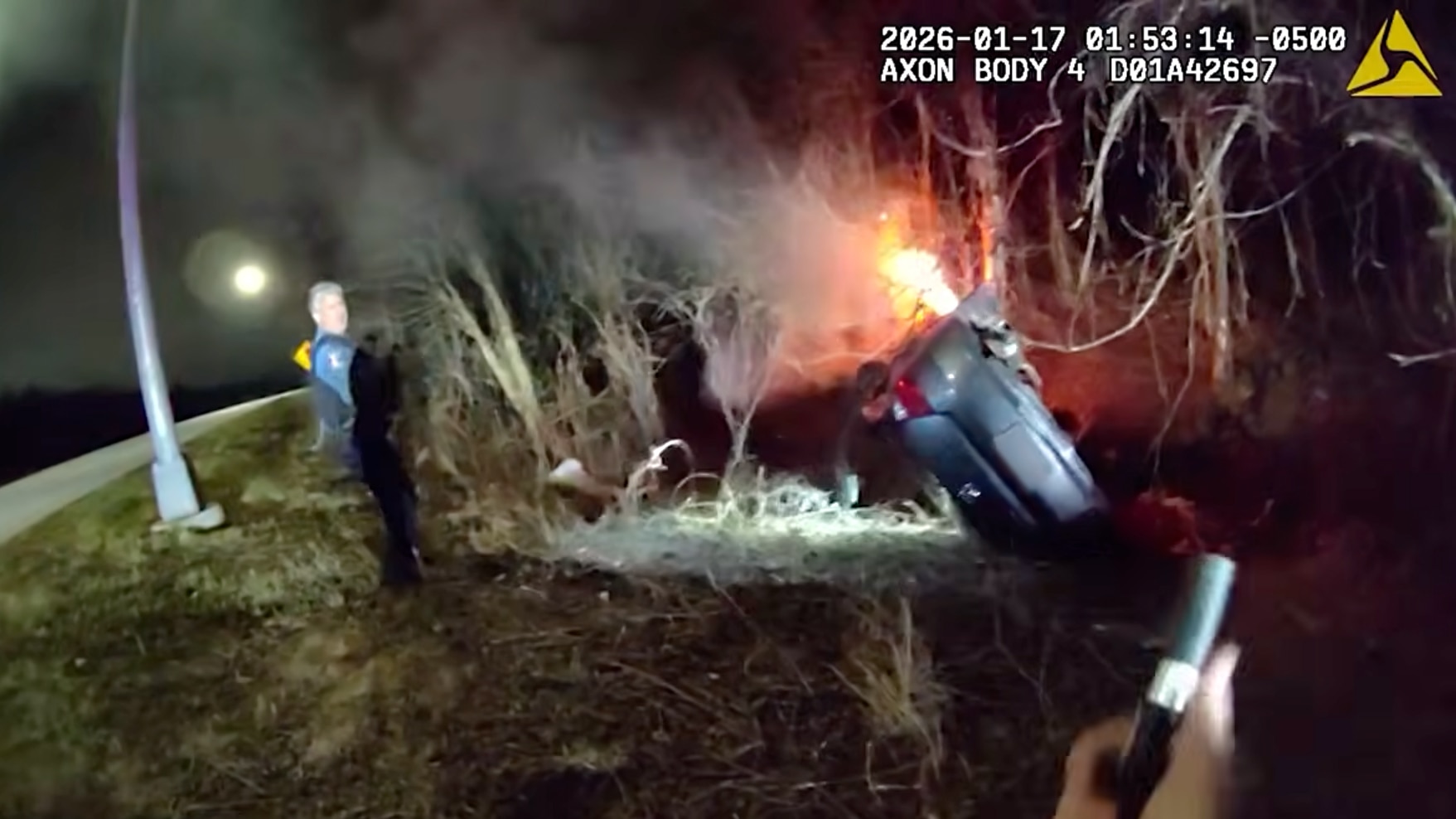
In others, including the Jan. 17 crash on Route 32, it’s a driver who just won’t stop.
“This incident was not considered a ‘pursuit,’” said Sherry Llewellyn, a Howard County Police spokesperson. “It was an attempted traffic stop. The officer attempted to pull over the driver by activating his emergency equipment and the driver immediately sped off.”
Officer Brian Maurantonio spotted the Honda sedan at 1:50 a.m. while on a traffic detail in an unmarked vehicle on Columbia Pike. He followed in his Ford Interceptor at 100 mph.

By the time Maurantonio caught up to the car on eastbound Route 32, it was overturned in a wooded area off the Broken Land Parkway exit.
In video from his body camera, the officer pulls out his gun and, clearly concerned, tells dispatchers he’s waiting to approach the smoking car until help arrives.
“Send me units. He’s in the ditch. Go ahead and start E — EMS, excuse me. I’m waiting for a back.”
As flames emerge, the officer waits. It’s a dangerous idea to stick your head into an overturned, burning car, particularly when it got that way after someone decided to bolt.
“County police! Howard County Police! County police!” Maurantonio shouts. “Show me your hands!”
The video image bounces as he sprints back to his SUV and unlocks a fire extinguisher. He struggles to remove the safety pin.
Police-related crashes occur across the state, from rural Calvert County to the densest part of the state’s Baltimore-Washington population center.
Since 2021, there have been eight road deaths involving police in Baltimore, six in Prince George’s County and five each in Montgomery and Charles counties.
So far, Brown’s office has charged just three officers, two in Anne Arundel and one in Baltimore.
A judge dismissed one of the Anne Arundel cases; the other is awaiting trial.

And in the lone conviction generated to date by the investigations, Baltimore Police Officer Alexis Acosta pleaded guilty to vehicular manslaughter in 2024.
That was two years after she ran a red light on the way to a crime scene. She struck Terry Harrell, 58, while he was riding a scooter in the Broadway East neighborhood.
It’s not always the driver of a fleeing vehicle who dies.
Over three weeks last spring, drivers in Prince George’s County tried to flee traffic stops three times.
In each case, a local officer broadcast a description and a county officer spotted the car. The fleeing drivers all crashed into other cars, killing passengers or drivers.
“Far too many innocent bystanders are killed because the fleeing vehicle hits another vehicle, or in one case recently, the fleeing vehicle hit a pedestrian on the sidewalk,” Brown said.
We were talking about police shootings for a column I wrote last year, but he couldn’t get over the number of deaths related to police on the roadways.
The January crash was the first involving Howard County Police since Maryland began its review of police-involved fatalities.
In the same year the state began its investigations, the department adopted a 10-page policy on what to do when a driver flees.
It details who can start a chase, who’s responsible for supervising it and when it must end. The rules allow an officer in an unmarked car, like Maurantonio’s, to pursue, but require officers in marked vehicles to take over as soon as possible.

Why do people flee?
On Saturday, I drove to the off-ramp where Maurantonio found the crashed Honda. There’s nothing remarkable about it.
It’s not a dangerous curve. No flowers mark it as the end of a life.
Other drivers run because they committed a crime, or are suspected of one.
Ginyard, an autopsy later revealed, had been drinking. Court records show he was cited as recently as 2019 for driving without a license.
Maybe the young woman in Howard didn’t recognize the flashing police lights in her rearview.
In the body camera video, another officer arrives at the crash and tells dispatchers to hurry firefighters. He takes Maurantonio’s extinguisher and points it, but it doesn’t work.
More officers arrive and bring out their own extinguishers. They cloud the ditch with them, but there is little effect.
The car is soon engulfed.
Eventually, another officer escorts Maurantonio back to the latter’s car, ragged breathing audible on the recording.
You can hear Maurantonio faintly, in a moment when the winter morning hits home.
“Aw, jeez.”





Comments
Welcome to The Banner's subscriber-only commenting community. Please review our community guidelines.