
There is a fine line between cultural appropriation and appreciation. The former seeks to claim, co-opt or even rename a hallmark of a culture by someone outside it. The latter pays homage to, say, a hairstyle or a piece of clothing, while firmly acknowledging its ties to that original culture.
Which brings us to a bit of local drama from last month, when Kelly Carnes, the white female executive director of the Baltimore Rock Opera Society, wore cornrows, a traditional Black braided hairstyle with roots in Africa, at an official event. She told The Banner her hair had been temporarily braided for Nevada’s Burning Man festival after she asked those with her, including people of color, their opinion. That sounds like a careful, conscious act of appreciation to me.
But a subsequent video of Carnes apparently showing her wearing that hairstyle to the official event caused controversy and discussion. Eventually, Carnes, who had been with the organization mere weeks, was fired.
That video was deleted by the Baltimore Rock Opera Society and there’s been no official reason stated for her dismissal, but the cornrows, or at least the assumed public perception of them, seem to be relevant. If so, I think that’s ridiculous, a well-intentioned act of overcorrection, presumably to avoid cancellation.
President Donald Trump wasn’t canceled for posting a video of Barack and Michelle Obama as apes this year — but we’re gonna focus on a deleted video of a seemingly well-meaning white lady simply wearing her hair in what can be a time-consuming and expensive hairstyle? Can we not?
Cat Litten, BROS’ marketing and communications director, told me the organization was making no further media comments and referred me to statements already made to The Banner. “Our leadership and community are entirely focused on doing the necessary internal work of improving the overall experience for our community and dedicated volunteers for now and the future,” Litten wrote Wednesday.
Read More
The hairstyle certainly has spurred a curious discussion about cultural appropriation and to whom protections for certain hairstyles apply.
“As a gay urban liberal who has watched the far right vilify self expression, this is an example where the far left and the far right meet,” reader Stephen S. wrote on The Banner’s Wednesday story. “While there are times when cultural appropriation is offensive and/or with malintent, this does not meet that threshold based on the facts presented.”
This isn’t like the case of fashion writers calling cornrows “boxer braids” after the Kardashians started wearing them a decade ago, to distance themselves from their Black roots. It’s not also like, in the 1980s, when newspapers called the beaded version of cornrows “Bo Derek braids” after the blonde actress made a splash in the movie “10.” And it’s not like singer Gwen Stefani performing pop-ska while sporting a bindi, traditionally worn by Hindu and Jain women to represent the third eye.
I understand and appreciate sensitivity to cultural matters and not wanting to Columbus them. I thrifted what I thought was just a festive embroidered dress that turned out to be an Arabic outfit. Like Carnes, I asked around to see if it were appropriate for me to wear as someone not of that culture or religion. I was told it was OK and that it was good of me to ask.
The video that was taken down referenced a BROS event that Carnes allegedly wore her cornrows to, so I haven’t seen photos of them outside the one she submitted to The Banner from Burning Man. But, if that happened, I’m going to explain something to you guys who’ve never had braids or seen them done.
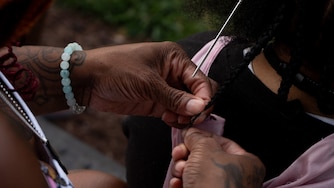
They can take hours to install and can cost upward of $150, depending on how long your hair is or if, in Carnes’ case, there are extensions added. It’s not the kind of thing you just take down immediately. You want to get every single minute out of those things.
“Maybe this is an unprecedented thing, because white women have been able to walk through the world the way they want to,” said Yasmine Young, owner of Hampden natural hair salon Diaspora Salon, which does locs, among other services. “At the end of the day, I think it’s just a hairstyle.”
Young said she doesn’t support firing someone like Carnes unless they were engaging in other racially insensitive behavior while wearing those cornrows, like blackface. “At its face, that’s weird,” she said. “I don’t think it’s appropriate.”
There was some question in the comment section for The Banner story whether Carnes is legally covered by the CROWN Act, which ensures that Black people are not penalized for wearing their natural hair or culturally relevant hairstyles, such as cornrows and locs. Though the act includes examples specifically related to Black hair, Nancy Modesitt, associate dean of legal analysis and writing at the University of Baltimore School of Law, said the way the law is written, it protects all hair.
I admit I have rolled my eyes at those who are not Black wearing styles such as locs, which were not created for nontextured hair and sometimes don’t look great. But I’m confused about the kerfuffle over Carnes, whose former organization has the word “rock” in its name. She got them for Burning Man, the natural habitat of white people with locs! You don’t have places to plug in a flatiron in the desert, you know.
This story is ongoing, and, again, the official reason for Carnes’ dismissal has not been named. All I know is the world is burning down, with Black people hanging from trees and losing jobs en masse.
“Black woman here ... who, in this year of the lord, 2026, when we are facing outright racist violence, the loudest, ongoing fascist coup from our government, multiple global genocides, environmental devastation had time to be mad at this lady wearing cornrows?” Banner reader S.J. wrote.
Nobody. Nobody has time for that.



Comments
Welcome to The Banner's subscriber-only commenting community. Please review our community guidelines.