
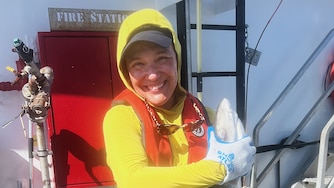
For 17 days, Cheyanne Vanderdonckt spent noon to midnight catching, tagging and surveying sharks and other fish aboard the NOAA Ship Oregon II.
And as she baited hooks and hauled in lines across the Atlantic, the first- and second-grade special education teacher saw characteristics of her students in the scientists alongside her.
Vanderdonckt is used to teaching kids who struggle to sit still and focus. This summer, she met scientists with doctorates who hated school and marine biologists who once struggled to read but took special interest in sharks. She was eager to tell her Moravia Park Elementary students that they could one day track apex predators, too.
The Baltimore educator was one of 11 teachers who took part in this year’s Teacher at Sea program, funded by the National Oceanic and Atmospheric Administration. Since 1990, the program has brought over 900 teachers on seafaring adventures, where they learn about the scientists’ work and bring lessons back to their classrooms. Vanderdonckt got to keep things her students can hold and examine, like a small shark jaw with rows of teeth, in addition to NOAA-provided learning resources.
“They describe the experience as transformative in the way they think about their work as well as their environment,” said NOAA Teacher at Sea Director Jennifer Hammond. “They become ambassadors for the work that NOAA does and why our science is relevant.”
Vanderdonckt is the 18th Maryland teacher to complete the program, which accepts educators who teach any subject from preschool through college. While Vanderdonckt has been on the water with the Downtown Sailing Center in Baltimore, she doesn’t have any formal science training.
Read More
The challenge of doing unfamiliar work on 12-hour shifts while sharing a tight bunk with a roommate gave Vanderdonckt the chance to pursue what she sees as the essential educator’s mission: lifelong learning.
“As a teacher, I’m essentially asking my students to do new things all day long, every day. And that can be really hard,” said Vanderdonckt, 50. “I thought that this would be a good experience for me to kind of see what is this like, to be somewhere where I don’t know what’s going on and I have to be the beginner.”
Vanderdonckt even held a shark after crewmates assured her she’d be safe if she clasped its jaw tightly.
“It was really cool to hold him,” said Vanderdonckt, “and I was also just like, ‘I want to get this living creature back into the water as soon as possible.’”

In Northeast Baltimore, Vanderdonckt is using her experience to teach. Her students measured shark species in millimeters and learned that they’re classified as fish. On NOAA’s website, they track the data-collecting buoys Vanderdonckt deployed in the ocean, decorated with their stickers and messages. She even brought back fish scales to accompany their reading of “The Rainbow Fish.”
Vanderdonckt can now attend conferences, workshops and webinars for free as part of the Teacher at Sea Alumni Association. She can also apply for mini grants for classroom equipment.
Interested educators can apply to the competitive program in November to sail next spring and summer. There’s no stipend, but the program covers participants’ travel to and from their cruises.
In her dispatches from the water, Vanderdonckt said she found herself “helpful with routine tasks, but way over my head in scientific conversations.” But that also helped her understand the “emotional dimensions of learning.”
“When students are struggling, they need support, but they do not need us to remove all the discomfort,” Vanderdonckt wrote. “Sometimes all we need is a reminder that we have done hard things before and we can do them again.”
About the Education Hub
This reporting is part of The Banner’s Education Hub, community-funded journalism that provides parents with resources they need to make decisions about how their children learn. Read more.




Comments
Welcome to The Banner's subscriber-only commenting community. Please review our community guidelines.