
The students wanted to make a film about pizza. They ended up making one about themselves.
The 21-minute documentary “We Are Not Limited: Our Journey Through Pie” is ostensibly about a chef. But the six blind and low-vision young people who shot and produced it are the story within the story as they navigate a visual medium with limited sight.
They ask questions behind the camera and sit in front of it for interviews. Scenes show the students, some of whom can only see up close or under bright lights, framing shots and conducting sound checks. Most people are confused by the concept, said their instructor, Charles Cohen. Why would blind kids want to make a film?
“They participate in the visual world,” said Cohen, who led the class with fellow filmmaking veteran Carlissia Young. “Everybody’s doing video — and so are they.”
The documentary came out of the first student filmmaking program at the Maryland School for the Blind, a privately run school in Northeast Baltimore that is funded by the state to serve over 200 students with visual disabilities. Students come from all over Maryland, and many have multiple disabilities, including developmental and learning challenges.
The program “opens a world for our students,” said Latisha “Tish” Brodie, a residential dorm supervisor who’s been at the school for 20 years. Brodie handpicked students for the project, funded by $6,000 in donations, and offered an initial idea for what they could film: What about food? The kids responded instantly: “Pizza!”
Read More
Like many documentarians, the students followed the story where it led. When he couldn’t find a master pizza chef to interview, Cohen set them up with Rodney Henry, a tattooed musician who typically makes a different kind of pie. The film’s focus shifted to Henry’s journey from a touring band member who sold baked goods at his merch table to the owner of Dangerously Delicious Pies.
“That was the magic,” Cohen said.
Each time Cohen brought out a new piece of film equipment, students wanted to feel it — knobs on cameras, the clicks of a camera lens. He knew that was part of the story.
“They were very curious. I loved watching them,” said Cohen, who plans to submit the film to local festivals. “I knew right away: We have to film them film this.”
The documentary opens with Olivia Lawson, 17, expressing her love for spring air, then describing her visual disability: “I’m not completely blind, but I can’t see much.” Two of her classmates explain their limited vision before the title screen rolls.
As the story unfolds, the audience watches how it got made. The film intersperses shots of Henry answering questions, kneading dough and serving dessert with clips of the students filming one another, monitoring sound levels and narrating action. They watch instructor Young fast-forward through edited footage, picking out their own shots.

Keith Lamar Jackson, 21, said filmmaking was new to him, but he loved it. The rising college freshman with low vision used zoom to get his shots, many of which appear in the documentary. He started recording by memorizing the location and feel of the small buttons with print he couldn’t see.
“I’m trying to get everybody to understand what visual impairment feels like for some,” Jackson said in the film. “By filming, I wanna expose my disability out in the world so other people can understand it.”
Young said that once she showed Jackson how to use the camera, she mostly watched him from a distance; she always lets her young filmmakers take the wheel. “Once they got it, they got it,” she said.
Young helped some students in other ways: She had to double-check exposure settings for one student who can only see up close with one eye and who didn’t notice when transitioning from inside to outside that there was too much light in his shots. She also helped students navigate unknown spaces, like on their field trip to Dangerously Delicious Pies in Hampden, which has since closed.
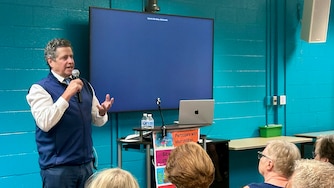
The experimental program worked wonders for the students’ confidence, their instructors said. Lawson, who usually speaks in almost a whisper, commanded the room at a panel discussion for a student and family screening. She wants to be a voice actor.
“For the first time in my entire career, I got to see the difference that one creative program made,” said Marlo Jacobson, the school’s director of advancement, who came up with the idea. “It changed my mind about everything. And I am now obsessed with making sure we have this kind of programming for all of our students.”
About the Education Hub
This reporting is part of The Banner’s Education Hub, community-funded journalism that provides parents with resources they need to make decisions about how their children learn. Read more.



Comments
Welcome to The Banner's subscriber-only commenting community. Please review our community guidelines.