
The Baltimore County Public Schools system is saying goodbye to Amira, the artificial intelligence-powered reading program the former superintendent once lauded for boosting test scores.
An email to parents this week stated that Amira will no longer be required for students in kindergarten to third grade. Schools can use it for struggling students, and families can access the platform on their own for additional practice. Next school year, however, Amira won’t be available at all.
The district’s decision was “based on school administrator, staff, and parent/caregiver feedback, and to minimize screen time for our youngest learners,” the parent email stated.
The change comes as parents locally and across the nation express concern over how much time students are spending on laptops and education technology. Now school districts are starting to respond.
The Los Angeles Unified School District enacted a moratorium on student use of generative artificial intelligence in September, New York City banned AI for students below third grade the same month, and Maryland’s Frederick County Public Schools banned AI for all grades in October.
Baltimore County board members are working to catch up with the requirements of a new state law requiring school systems to put guardrails around AI use.
Read More
Gboyinde Onijala, spokesperson for the school system, declined an interview request but wrote in an email that the district is reviewing other programs that could be phased out.
“Our priority remains ensuring that every student receives high-quality, evidence-based literacy instruction and targeted support to meet their individual learning needs,” she wrote.
During a 2024 school board meeting, former Superintendent Myriam Rogers said Baltimore County students who regularly use Amira “are growing at much higher levels than any other intervention and core instruction that we’ve provided in recent years.”
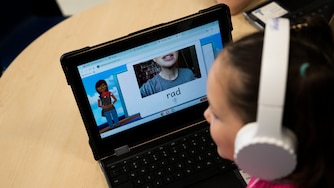
With headphones on and laptops open, students use Amira to sound out short words to practice fluency. Teachers can assist, but the work is independent.
“Data suggests that students using Amira for 30 minutes a week are showing increased rates of growth,” a 2024 BCPS document stated.
However, some parents said Amira was a problem for their children. In July, Manju Holmes told the school board she opted her rising first grader out of the program because it is “priming our youngest learners to need screens.”

Holmes said, when she and her husband started reading to their daughter at home, she became a natural reader.
Amanda Garratt, a co-leader of Baltimore County’s Schools Beyond Screens chapter, which advocates for evidence-based education technology policies, said parents were celebrating on Facebook over the news that Amira would be phased out. She said parents are grateful the school system took their feedback.
“These programs are not helping with learning,” she said. “We have seen the harms that overuse of screens has caused. If people would just look at research, they would change these policies.”
According to Stanford University, AI can improve students’ learning experiences but that doesn’t necessarily translate to stronger outcomes.
Schools Beyond Screens chapter members had been talking to educators in the county in hopes they’d change how much time students spend on laptops, Garratt said. Since the group’s efforts began, Catonsville Middle School has dubbed itself a “distraction-free” school with a strict cellphone policy and a mandate for students to leave Chromebooks at the front of the classroom when they’re not needed, she said.
The advocacy continues.
Baltimore County’s Schools Beyond Screens chapter is among a coalition of parent groups representing a dozen school districts across the Baltimore, Washington and Northern Virginia regions calling for an immediate moratorium of student-facing AI for all grades. They’re asking school districts to invest in librarians and credible research materials and to refuse to turn on Google’s AI search feature.
About the Education Hub
This reporting is part of The Banner’s Education Hub, community-funded journalism that provides parents with resources they need to make decisions about how their children learn. Read more.




Comments
Welcome to The Banner's subscriber-only commenting community. Please review our community guidelines.