
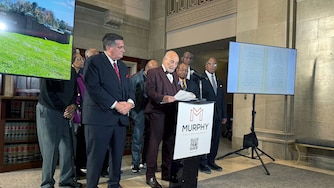
Two students and several alumni at the University of Maryland Eastern Shore have filed a $6 billion lawsuit against five state leaders, including Gov. Wes Moore and University System of Maryland Chancellor Jay Perman, alleging that their campus is owed more than a century of state funding.
The lawsuit, announced Tuesday morning, claims that Maryland has deliberately underfunded UMES since 1890, when federal law required the state to create a land-grant university for Black students with funding equal to the University of Maryland, College Park.
The plaintiffs’ attorneys spent hundreds of hours poring over publicly available budgets from UMES and College Park to come to the $6 billion figure, said Billy Murphy, senior counsel on the case. Both campuses sit under the University System of Maryland, though the lawsuit seeks to remove the Eastern Shore campus from the system and create its own governing board.
The lawsuit follows a separate effort to recoup state funding by a legal advocacy group called the 1890 Project, whose leaders say they’re entering talks with state lawmakers, including Moore and Attorney General Anthony Brown, to obtain the $321 million they say the campus was shorted.
The groups aren’t working together; they’re seeking different amounts and using different strategies. But both groups point to the same federal analysis, which found that Maryland underfunded UMES by $321 million relative to the College Park campus between 1987 and 2020.
“As a direct result of Maryland’s overt racial discrimination against its Black population, UMES, Maryland’s 1890 land-grant institution, has been overwhelmingly, intentionally and shockingly short-changed and neglected by Maryland’s governing bodies from 1890 through today,” the lawsuit states. “Maryland’s treatment of UMES has never deviated from this model.”
Read More
Unequal footing
If all of this sounds familiar, it’s likely because Maryland settled another court battle over HBCU funding just five years ago. In 2021, the state agreed to pay its four historically Black colleges $577 million to end their 15-year-old lawsuit accusing Maryland of providing inequitable resources to their campuses.
But the state owes UMES more, lawyers and advocates say.
The Eastern Shore campus is what’s known as a land-grant university, eligible for a specific pot of federal money through the Morrill Act. That act first allowed states to use proceeds from the sale or lease of federally granted land to form public universities in 1862. Then, in 1890, states whose land-grant universities only admitted white students were required to create second institutions for Black students.
College Park became a land-grant institution under the 1862 act and UMES under the 1890 act.
According to law, the state must match the federal research and extension funds that the University of Maryland Eastern Shore receives, dollar for dollar, or the institution loses the unmatched federal money. While Maryland lawmakers funded College Park’s federal match from the state treasury, the state left the University of Maryland Eastern Shore to pay its own match out of its operating budget, lawyers for both the UMES students and the 1890 Project say.
States also have to pay each land grant institution the same per student, but a 2023 analysis by the U.S. Department of Education and the agriculture department indicates that that didn’t happen.
The Biden administration found that states with historically Black land-grant universities almost always underfunded them. In a 2023 letter from then-U.S. Secretary of Education Miguel Cardona and former U.S. Secretary of Agriculture Thomas Vilsack, 16 governors, including Gov. Wes Moore, were informed of the over $12 billion funding disparity between the 1862 land-grant universities and the 1890 institutions.
“These funds could have supported infrastructure and student services and would have better positioned the university to compete for research grants,” Cardona and Vilsack wrote in their letter to Moore. “The University of Maryland Eastern Shore has been able to make remarkable strides and would be much stronger and better positioned to serve its students, your state, and the nation if made whole with respect to this funding gap.”
The governor’s office cannot comment on active litigation, but Moore’s dedication to supporting the University of Maryland Eastern Shore is “unwavering,” said Rhyan Lake, the governor’s senior communications strategist, in a statement.
“In the wake of an inherited structural budget deficit, the Moore-Miller administration has kept its commitment to our state’s HBCUs — investing record funding for UMES as an 1890 Land Grant University,” she said. “UMES is a shining example of one of our state’s prize institutions for molding the next generation of minds, and the state will continue to invest in UMES to ensure it has the resources it needs to continue that legacy.”
Brown, the attorney general, declined to comment, as did the University System of Maryland.
UMES ‘pales in comparison’
The University of Maryland Eastern Shore educated about 3,400 undergraduate and graduate students last year, according to data from the University System of Maryland. While undergraduate enrollment at the university, located in Princess Anne County, has increased 48% since the 2021 settlement, from 1,811 to 2,695, degrees awarded have steadily shrunk by 27%, from 384 in 2021 to 280 last year.
The university, according to documents from the University System of Maryland Board of Regents, has almost $82 million in deferred maintenance, like building renovations.
In prerecorded video and audio clips played at Tuesday’s press conference, students said the university’s facilities are ripe with mold and frequently flood. One student said the school’s gymnasium was recently closed after testing positive for mercury.
“To this day,” the lawsuit announced Tuesday reads, “the laboratory facilities at UMES pale in comparison to those at UMCP — as they have through the long history of the two campuses.”
The plaintiffs in the suit are UMES students Chad Lance and Andre Cooper, as well as a group of alumni, faculty and and supporters of the university called ForUMES, who are represented by attorneys at Murphy, Falcon & Murphy and Peter Angelos Law.
The attorneys involved presented their findings to Gov. Moore’s staff last year, Murphy said.
“The governor inherited this problem, he didn’t create it,” Murphy said. “But it’s up to him, because he has the power to correct it.”
UMES is not involved in either effort to recoup state funding.
The University of Maryland Eastern Shore “appreciates any and all attempts to address the systemic underfunding of public HBCUs throughout our existence,” said Robert Vickers, the university’s vice president for strategic communications and marketing, in a statement.
“The university also acknowledges the Maryland legislature’s role in championing the HBCU Settlement, Gov. Hogan for signing it, and the ongoing good faith efforts of Gov. Moore to make Maryland’s public HBCUs whole,” Vickers continued. “We look forward to working with him and our legislative partners to see UMES and our fellow Maryland HBCUs funded properly and according to the law.”
‘It’s existential’
Leaders of the 1890 Project, a newly formed legal advocacy group, believe the state owes UMES $321 million. The group last month filed a lawsuit in Missouri over what it called inequitable funding of Lincoln University, another land-grant HBCU.
Don Calloway, a Montgomery County lawyer and former Missouri legislator who cofounded the group, says Maryland is next on his list.
“To spend a single day on an 1890 campus is to realize that it’s underfunded,” Calloway said. “It’s existential.”
Calloway acknowledged that Gov. Moore increased the state’s matching funds for the university to $4.85 million in fiscal year 2025 and $5.1 million in fiscal year 2026.
“We credit him for that,” Calloway said. “It fixes the match going forward. It does not touch the $321 million.”
That figure was drawn from a gap in per-student funding, calculated from Maryland’s own reports to the federal government.
Calloway said his team is seeking an appropriation for UMES in this year’s state budget to make up for decades of underfunding faster. He said they expect a short-term appropriation rather than a spread-out settlement.
That’s despite Maryland’s expected deficit. The Department of Legislative Services last year projected the state’s budget shortfall to grow to $2.3 billion starting in July 2027, which means finding $321 million for UMES may prove difficult.
There is a precedent for it, however. After leaders at Tennessee State University discovered a similar funding gap, they worked with state lawmakers to at least partially rectify the issue. Though the HBCU is owed $2.1 billion in state funds, according to the federal government’s 2023 analysis, then-president Glenda Glover secured $544 million for the university in back pay and convinced lawmakers to change the funding structure in the future.
“I can’t see Maryland being excited about it at all,” Glover said. “But if you’re silent when you know there’s injustice going on, then you’re complicit in betraying the legacy of HBCUs.”
About the Education Hub
This reporting is part of The Banner’s Education Hub, community-funded journalism that provides parents with resources they need to make decisions about how their children learn. Read more.



Comments
Welcome to The Banner's subscriber-only commenting community. Please review our community guidelines.