
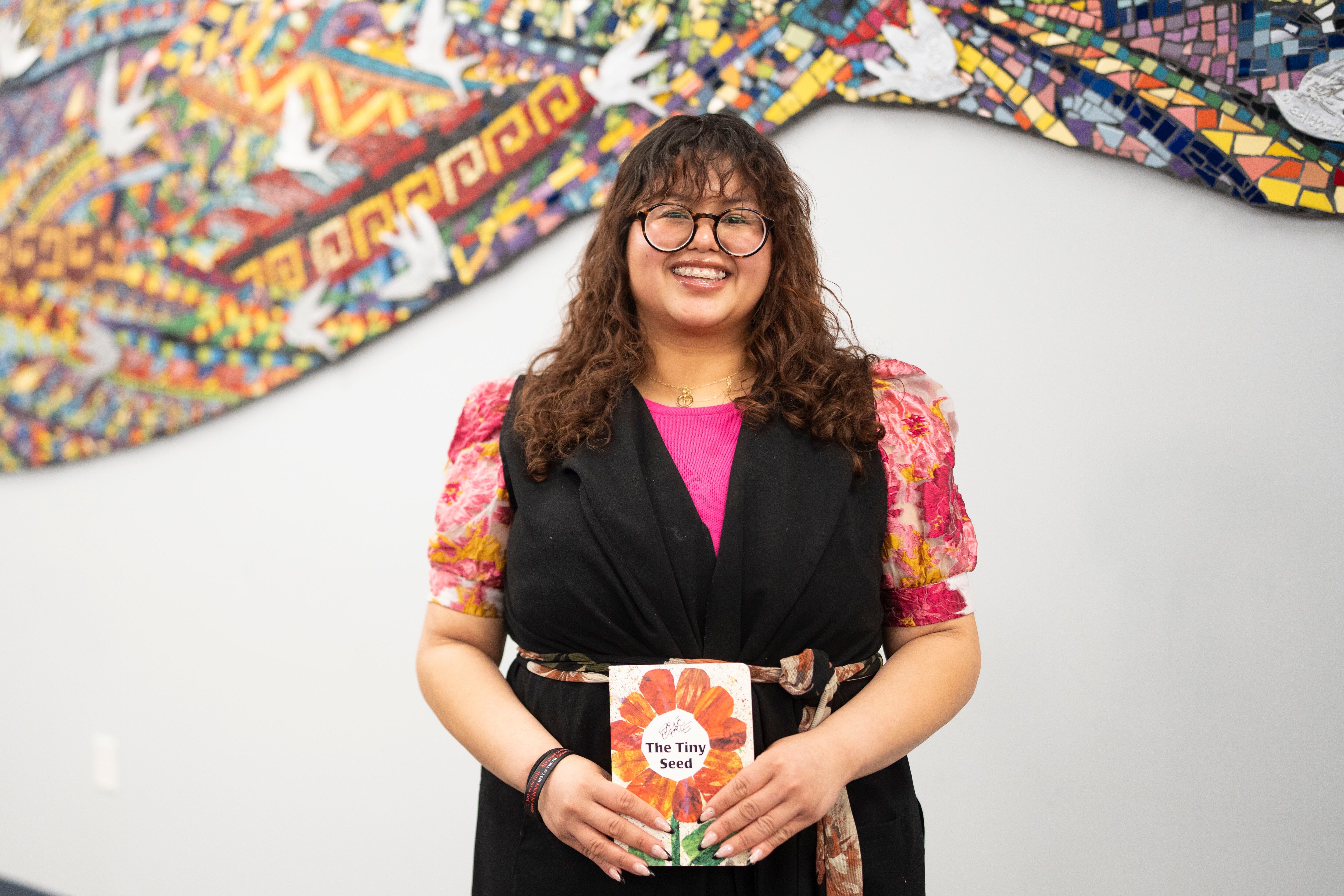
Amid a federal immigration crackdown, scared families are avoiding public spaces and staying home. Norma Montesino is one of the few people they’ll let in.
The reading expert in round spectacles is East Baltimore’s bilingual Santa Claus. Twice a week, she shows up at homes and small day care centers with a rolling tote of free children’s books, toys and a lesson plan. Her goal: help Spanish-speaking parents teach their kids to read at home.
Montesino, 30, leads the local branch of ParentChild+, an internationally renowned literacy program for low-income and marginalized families with small children. It’s a lifeline for immigrant families who don’t feel safe sending their children to preschool as Immigration and Customs Enforcement agents increasingly detain people they suspect are in the U.S. illegally, even without proof. Some simply can’t afford or don’t have a way to get kids to preschool.
Since visits started last May, she’s grown the program to about 30 families in East Baltimore, where the Latino population is growing rapidly.
“These parents truly want the best for their children,” she said. “They’re inviting us into their home, which is very vulnerable.”
Montesino was born in New York, a fact that often surprises clients, she said.

“Then why do you speak Spanish?” they ask.
“Because I’m a proud daughter of immigrants.”
Montesino’s parents are from El Salvador — she’s a first-generation American, just like her clients’ children. That puts them at ease, she said.
Montesino, who has degrees in social work and early childhood education, selects dual-language books — or if one doesn’t have a Spanish translation, she does it herself — and writes guide sheets for parents and caregivers with suggestions on how to turn the books into reading lessons. “The Little School Bus/El Pequeño Autobús Escolar,” for example, comes with a puzzle activity that prompts parents to ask their little ones what color the bus is and who is boarding it.
Read More
The goal is to get kids reading and ready for school, not for them to master English.
“It’s not looked at as a deficit to not use English as the language if that’s not what’s spoken at home, but an asset that this child has at least this language,” said Nia Imani Fields, executive director of the nonprofit GreenLight Fund Baltimore, which gave ParentChild+ $600,000 to launch and expand in Baltimore.
Montesino uses board books designed with about one sentence per page, an appropriate reading level for parents who are still learning English.
“Regardless of your literacy ability, you have the ability to teach your child, and you already are,” she said.
Montesino said she loves when parents run the show and describes the reading visits as a parallel process. For a book that teaches counting through animals, for example, Montesino will point at a picture of a duck and ask the parent if they know that word in English.
Then, Montesino has them repeat it for the child: “They’re like, ‘Oh, mira, pato is duck.’”
“I am coaching and modeling what the parents will also do with their children,” Montesino said. “I want to be able to empower them and put them in a position where they are curious learners themselves.”

ParentChild+ has had a presence in West Baltimore since fall 2024, but wanted a foothold on the East Side to reach the city’s Latino population, said Malkia Singleton Ofori-Agyekum, the program’s mid-Atlantic regional director. They partnered with Catholic Charities to launch the new outpost.
But it came with a particular set of challenges. Sometimes, a toddler starts the program with a parent who later gets a job out of state and can’t do the home visits, meaning another family member needs to step in for lessons. Other times, the whole family moves, disrupting a child’s learning during the most important years of brain development.
But even as some immigrant parents avoid doctor’s offices, schools and supermarkets, they make their children’s reading lessons a priority. And they turn to Montesino in moments of crisis. One mom invited Montesino in for a weekly lesson just two hours after learning her child’s father had been detained.
Montesino uses her lessons as a chance to check in with parents: Have you noticed any speech delays? Have you spoken with your pediatrician? Have you talked to your child about a family member going away?
She’s careful to consider their trauma and wants to be a “face of hope” for families navigating devastating news.
“We’re in this with you,” she tells her clients. “You’re not alone.”

Through her work with Catholic Charities and its Esperanza Center, she can bring her clients donated food and diapers, and refer them to housing and medical help. Once kids age out of ParentChild+ at 4 years old, she helps get them into preschool.
The Esperanza Center, an immigrant refuge that opened in 1963, holds graduations for ParentChild+’s budding readers. For some parents, it’s the first one they’ve attended.
They worked hard to get there, too. On all the reading guide sheets, Montesino reminds them:
“¡Recuerde, usted es el primer y más importante maestro de su hijo(a)!”
“Remember, you are your child’s first and most important teacher!”
About the Education Hub
This reporting is part of The Banner’s Education Hub, community-funded journalism that provides parents with resources they need to make decisions about how their children learn. Read more.




Comments
Welcome to The Banner's subscriber-only commenting community. Please review our community guidelines.