
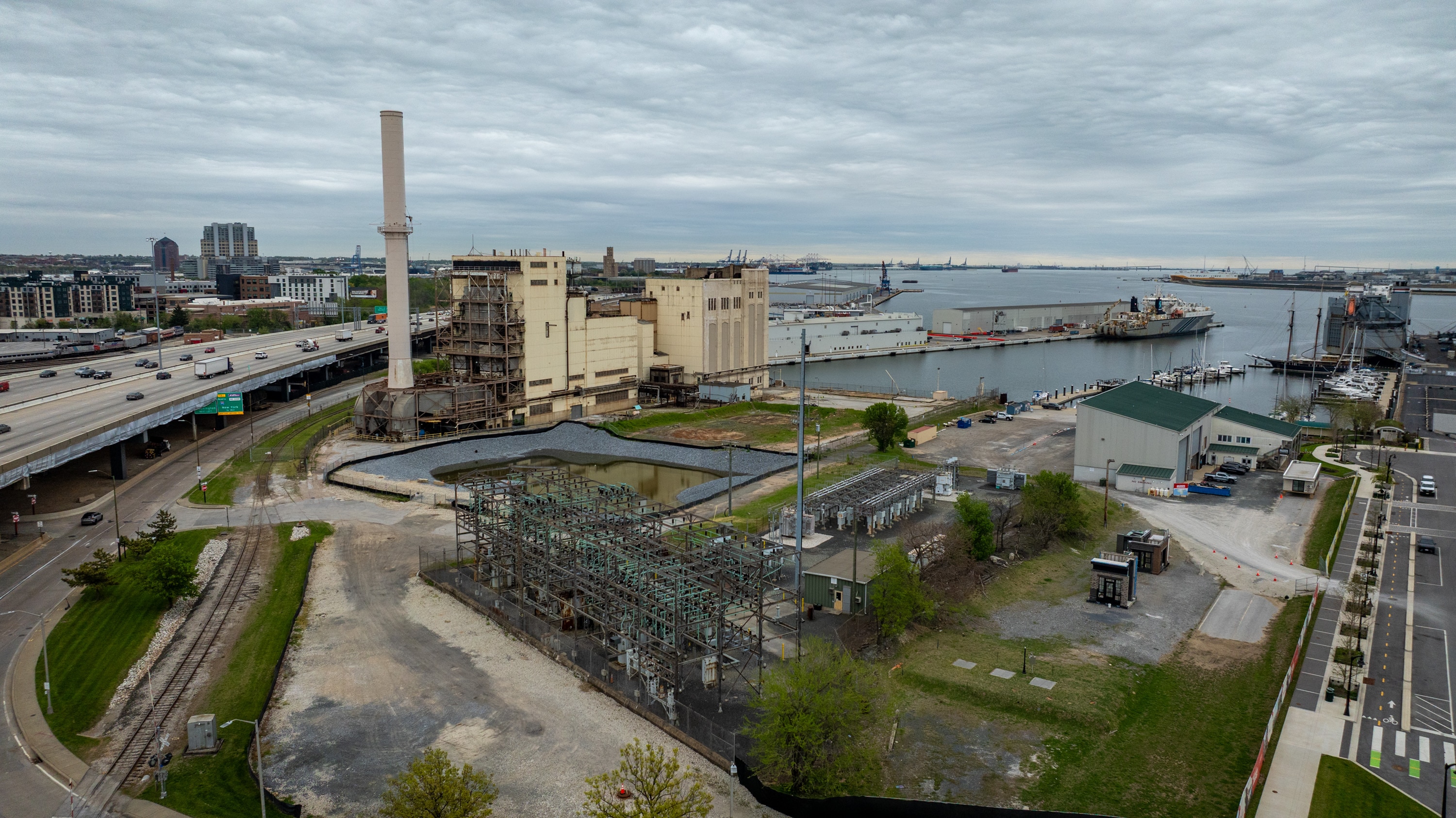
Maryland’s ratepayer advocate and its Senate president want to know: How much electricity does South Baltimore really need?
For the past decade, Baltimore Gas and Electric Company has been planning a massive electrical infrastructure build-out to prepare for the redevelopment of Baltimore Peninsula. Only a tenth of that redevelopment ― formerly known as Port Covington — has been completed, with the rest in limbo.
Yet BGE is putting on its hard hat and powering up its calculator. A recent cost revision shows the private utility expects to spend at least $537 million building transmission lines, substations and other infrastructure that will factor into customers’ bills for decades.
David Lapp, who leads the Maryland Office of People’s Counsel, the state’s ratepayer advocate, said customers could wind up paying BGE billions of dollars to finance that infrastructure spending. They deserve to know exactly what they’re paying for, Lapp said, and whether it’s actually necessary.
Lapp’s office filed a petition Tuesday with the Maryland Public Service Commission, citing several articles from The Banner and asking state regulators to open an investigation into BGE’s spending related to Baltimore Peninsula.
BGE did not immediately respond to a request for comment.
Under Armour founder and CEO Kevin Plank was inspired by a 2013 visit to Dubai to redevelop the former industrial site in South Baltimore. With just one phase complete, Plank said in December that he was stepping back from future development at Baltimore Peninsula.
Plank left the remainder of the project in the hands of an Arkansas-based bank lender. In January, Bank OZK disclosed in a January filing that it was in talks with a potential buyer.
Before parting ways last year, the former lead developer of Baltimore Peninsula said the site was garnering “a lot of data center interest.”
However, it remains unclear who might buy the remaining undeveloped land there — and what they’ll do with it.
“Customers face paying billions of dollars in their utility bills over the coming decades for all the costs related to BGE’s Baltimore Peninsula investment plans,” Lapp said in a statement. “But BGE based its plans on development that is not happening as anticipated, and BGE has not identified any other customer growth to justify its level of spending.”
The Office of People’s Counsel said BGE has already spent some of that money, though it’s difficult to track exactly how much. Totals are scattered throughout several different regulatory filings, the ratepayer advocate said, and the numbers often change.
BGE has been meeting with residents ahead of transmission work that will tear up streets and disrupt traffic in South Baltimore, but the private utility would not allow Lapp and his staff to participate in one of those meetings last month, the petition said.
Instead, the private utility offered to meet separately with the Office of People’s Counsel, then canceled that appointment, according to the petition.
A formal investigation by the Public Service Commission would force BGE to answer questions about spending at Baltimore Peninsula, the petition said.
Meanwhile, lawmakers are also expected to scrutinize BGE’s spending for Baltimore Peninsula at a hearing next week.
Citing The Banner’s reporting, Sen. President Bill Ferguson, whose district includes the development site, said in a social media post that BGE’s spending for Baltimore Peninsula “demands increased oversight to determine if it is truly needed for reliability.”
Part of the problem, according to both Ferguson and Lapp, is that more than $400 million of BGE’s estimated spending is for a “local” transmission system and is considered a “supplemental project.” That kind of project falls into a regulatory gap, they say, where BGE can largely avoid government regulation.
“Unfortunately, it is one of many ‘supplemental projects’ Maryland utilities are advancing that exploit federal loopholes to get a higher rate of return and avoid local approval,” Ferguson wrote in a social media post.
He said lawmakers are working on legislation that would close the loophole and give more oversight power to state regulators.





Comments
Welcome to The Banner's subscriber-only commenting community. Please review our community guidelines.