
Baltimore Gas and Electric Co. wants to offer customers a new way to pay their utility bills — and consumer advocates are not happy about it.
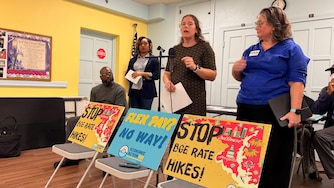
Advocates and community members gathered Tuesday at the Epiphany Lutheran Church of Baltimore with a message for state lawmakers and the Maryland Public Service Commission: No way to FlexPay.
BGE is seeking the Public Service Commission’s approval to offer FlexPay, a system that would allow customers to pay their gas and electric bills in advance. Advocates are asking the commission to deny the request, saying FlexPay will strip consumer protections and make it easier for BGE to cut power.
According to BGE, here’s how it would work: Customers would no longer get monthly bills. Instead, they would put money into an account up front. BGE would send them notifications updating them on their account balance and how many days of power they have left.
Customers would have to opt into the system and begin with a minimum $40 prepayment. Part of the prepayment would go toward power usage, while a smaller amount would be applied to the deferred balance.
Letting an account dip below $0 would result in a near-immediate shut-off of power. Turning it back on would require a minimum payment of $15.
Read More
Anyone who is more than $600 behind on their bill would be excluded from enrolling in the program until they pay down their debt. Households relying on life-sustaining or medical equipment would not be eligible.
BGE sister companies have enacted the prepay program in several other states. Exelon, BGE’s parent company, has marketed the prepay system as an affordability measure that can help people manage overdue bills.
But local residents and advocates disagree.
“FlexPay is not a solution to the affordability crisis,” said Jennifer Bevan-Dangel, deputy director of the nonpartisan nonprofit Economic Action Maryland Fund. “It is the equivalent of Scrooge handing out single lumps of coal to Mr. Cratchit to keep him just warm enough just long enough to keep putting in the work.”
Maryland legislation requires utility giants to give customers 14 days’ notice before disconnecting power. Advocates say the FlexPay model would negate that.
Jane Ballentine, a spokesperson for BGE, said FlexPay can be an added safeguard for customers who want to avoid getting behind on their bill.
“The benefits are clear, and we will continue to advocate for customer-focused solutions to Maryland’s energy affordability challenges,” she said.
Gas and electric bills have been a major pain point statewide. For some, paying a utility bill could mean going without groceries or medication.
BGE said approximately 300,000 customers were behind on their bills in late August, according to reports from local outlets.
Meanwhile, BGE’s profits have soared, and the utility giant is seeking approval for a $156 million rate hike.
For Tyrone Moore, 60, another rate hike would be untenable.
Moore, who has a disability and lives on a fixed income, said he has been a “hostage” of BGE since he started falling behind on his bill in 2019. He owes more than $2,000. He said he has spent years looking into programs that would assist him, but nothing has helped.
“We need all of our leaders to stand up to BG&E and focus on restoring utility fiscal accountability to rein in escalating rates,” said Emily Scarr, a senior adviser for Maryland PIRG, a consumer advocacy group. “We need our utility to be a partner, not an opponent. The PSC should reject BGE’s rate hike and lower the profit rate.”



Comments
Welcome to The Banner's subscriber-only commenting community. Please review our community guidelines.