
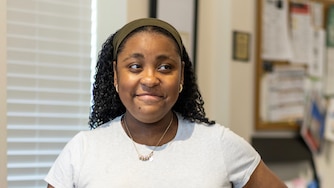
A big part of Naomi Boldon’s identity is having no reservations about wearing her natural, textured hair in public — but that wasn’t always the case. For years, the 17-year-old was “overcritical” about how her hair looked.
“It’s really hard to love something that you don’t know how to care for,” said Boldon, who graduated from Baltimore City College in June.
Everything changed after she started experimenting with hairstyles during the COVID-19 pandemic. As she became more confident with her hair, she realized that many of the Black women around her still struggled.
In 2025, she launched Embold, an initiative to help Black girls embrace their natural hair by providing resources and textured hair education.
“You can really translate your own experience and your own challenges into tools and programs and spaces that empower other people who might go through those challenges,” Boldon said.
Read More
Natural hair has long been used to fuel racial bias against Black women, something Boldon hopes her work can combat. Black women with coily or textured hair are twice as likely to experience microaggressions in the workplace as Black women with straighter hair, according to a 2023 workplace research study from Dove and LinkedIn.
In 2020, Maryland became one of 27 states to adopt The CROWN Act, legislation that prohibits discrimination based on natural hair texture and protective hairstyles.
Boldon spoke to The Banner about Embold and the new wave of young leaders in Baltimore.
This interview has been edited for clarity and concision.
What are some misconceptions about natural hair that you’re hoping to correct through your work?
I think the biggest thing we’re trying to correct is this whole idea that Black women don’t love their natural hair.
[There’s] this event that we did called ProFro: This ’Fro Means Business, and we did it with Johns Hopkins University. It was a whole night challenging the idea that natural hair is unprofessional. Girls had a chance to do professional hairstyles on dolls, and then they did mock interviews. It’s about getting the tools for women to embrace their hair and then making sure that when they do embrace their hair, they feel comfortable and confident in every environment they walk into, including the workplace or schools.
Some might say, “It’s just hair — it doesn’t matter that much.” Why do you think it does?
I think there’s a lot of deeply rooted history within Black hair. A lot of people have this idea that Black hair is really hard to manage and just too difficult to wear. I really think that if we just provided more resources, people would better understand the different ways that natural hair can be quote-unquote easy and manageable.

You started this project when you were 16. Now you’re 17 and have just graduated from high school. How has your age impacted your journey with Embold? Have there been any difficulties because you’re young?
I think there could be a lot more funding for young people with big ideas. I came into a lot of financially related obstacles. I had these big visions, and I had all of these aspirations, but there were too many requirements for the funding that I found. It just wasn’t accessible for a 16-year-old. I think that if Baltimore wants more young leaders, there needs to be more opportunities for us to create and build and experiment and fail.
Do you think that’s because the city isn’t ready for young leaders? How do you think we can see more representation?
I think the city is definitely ready for young leaders. I could give you 10 different teenagers right now who are doing amazing things in Baltimore. I think people have gotten comfortable with all these negative perceptions of Baltimore teenagers. People aren’t really looking for that positivity. I think older leaders can do a better job at identifying and intentionally searching for young leaders in Baltimore.

Can you tell me why it’s important to collaborate with local businesses and your community?
I want to collaborate with small businesses and Black-owned businesses because those were all of the resources and spaces that I was in as a girl who had a tough journey with confidence. I’m taking from my own experience and kind of applying that through Embold. I think it’s important to think locally and act locally before we try to go global with things.
Is there a standout moment when you’ve seen your work show up in a really meaningful way in someone’s life?
[ProFro] was my first event that I fully organized, so I was really nervous about it. After the event, I got an email from a mother [whose] daughter attended, and she was the only Black daughter in their family — they adopted her. In the email, she was telling me that she was looking for these types of programs to help her [daughter] feel confident as a Black girl. It was really affirming because I hadn’t really thought about that space of how natural hair programming can help foster kids and adoptive families.

What goals do you have for Embold?
One of the [programs] we have is called the CROWN Commitment, and that’s our attendance incentive program. So, we’ll partner with a school, and students who get 90% or higher attendance for that school semester will be invited to a celebration with free hairstyling and manicures and yoga, and just a whole wellness, self-care day. I really want to get that into more schools and partner with more Baltimore City public schools.
Outside of Baltimore, I really hope to create a video curriculum about natural hair care for teenagers, preteens, young girls — a really comprehensive video curriculum that I wish I had when I was younger.




Comments
Welcome to The Banner's subscriber-only commenting community. Please review our community guidelines.