
Houston Murphy remembers a time when the old Greenbury Howard House was a crumbling building in the Patuxent River State Park where he and his friends would go to play gin rummy on the back porch.
Now, it’s the pièce de résistance of Maryland’s newest state park.
Freedman’s State Historical Park in Gaithersburg aims to be both a gathering spot for locals to enjoy nature and a historical monument to a family that rose in a single generation from enslavement to build successful local businesses and community hubs.
“It just makes me feel emotional,” said Murphy, a descendant of the Howard family. “I’ve got fond memories of this place. ... I’m happy there’s been a turnaround in the state, where instead of being sneered at, we’re being lifted up and celebrated. The state has not always been friendly to Black people.”
Led by Angela Crenshaw, the first Black woman to become director of the Maryland Park Service, the state is trying to make amends by paying homage to one of the most influential Black families in Montgomery County’s history.
“It’s very moving to have this as part of the Maryland Park Service’s portfolio,” Crenshaw said. “I think it’s a lovely jewel in our crown.”

Dedicated to the Howard family’s legacy
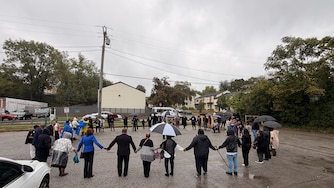
At a dedication ceremony for the park on Friday, local lawmakers, Maryland Park Service staff, community members and Howard descendants gathered to remember and amplify the family’s history.
“The story of America is incomplete unless we tell the story of the people who built it,” said Chichi Nyagah-Nash, deputy chief of staff to Gov. Wes Moore, one of several speakers at the dedication.
It’s quite the story. Enoch George Howard was born into slavery in 1814 in Montgomery County, where he grew up to be a gifted farmer who convinced his enslaver to let him grow and sell his own crops.
Those sales would eventually allow Howard to purchase his and his family’s freedom. And amid the Civil War, he paid $3,000 to purchase Locust Villa, the Gaither family plantation house in which the family had been enslaved, along with the surrounding 290 acres.
Later purchases of nearby land went toward opening a chapel for local Black residents and one of the area’s first schools for Black children. Howard’s daughter, Martha Howard, and her husband, Sergeant John H. Murphy, later launched the highly influential AFRO-American newspaper chain, known affectionately as “The Afro.”


According to Howard family lore, the land was also part of the Underground Railroad — Crenshaw, previously assistant manager at the Harriet Tubman Underground Railroad State Park, says they’re still searching for documents for official confirmation, but the team believes it was.
Today, the remains of Locust Villa, Greenbury Howard House (named after Howard’s son) and the family’s burial grounds make up the new park.
‘The full truth’
The Great Maryland Outdoors Act in 2022 had a major hand in the park’s development, allocating funds and staff to create Freedman’s State Park as part of a much larger, COVID-era initiative to update and improve Maryland state parks.
Those who advocated for the park’s installment, including the Sandy Spring Slave Museum, Preservation Maryland and former Maryland House of Delegates Majority Leader Eric Luedtke, insisted that the state take this step to preserve neglected history and help right some of its past wrongs.
“This is an opportunity, when stories like this are being suppressed, to tell them loudly,” said Joshua Kurtz, secretary of the Maryland Department of Natural Resources.
The park is now open to the public, though Crenshaw recommends contacting the park for a guided tour while the department continues construction to stabilize the Greenbury House and install interpretive signage around the park over the next two months.


Parking is located on Elton Farm Road, from which visitors can hike about a mile to reach the house. The parks department is also working on a website to share more information with guests.
“The ultimate goal — at least, my goal — is to bring school groups here once we develop it and have them hike in and learn the story," said Park Manager Shea Niemann.
Savannah Wood, Howard’s great-great-great-granddaughter, serves as executive director of Afro Charities, which preserves and shares archives from The Afro’s more than century-long history.
The unveiling of Freedman’s State Park grows another branch of the Howard family’s lasting legacy on Montgomery County, Wood noted.
“Freedom is not just the absence of chains,” she said. “Too often, Black history is reduced to suffering alone. At this site, you can see it also encompasses ingenuity, family strategy, stewardship, institution building, faith and endurance. This park aims to honor the full truth of that legacy.”



Comments
Welcome to The Banner's subscriber-only commenting community. Please review our community guidelines.