
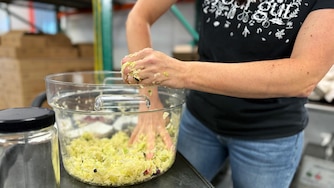
Meaghan Carpenter dug her bare hands into a clear bin of shredded cabbage, sea salt and a handful of seasonings, massaging the ingredients throughout. That’s all it takes to make a dish that’s sustained populations the world over through the winter months for thousands of years: cabbage and salt.
But in Baltimore, sauerkraut has a special role. It’s served alongside turkey at Thanksgiving dinner — and has been since anyone can remember.
“My mom cooks it every Thanksgiving and Christmas,” said Tracy Douglass. “It’s been a tradition in our family since I was a kid.” Tracy Douglass, with her sister, Wendy Douglass, was among the participants at a sold-out workshop from Hex Ferments in North Baltimore. While most home cooks use kraut purchased in pouches at the grocery store, at Hex Ferments, Carpenter was teaching participants how to make their own stinky stuff from scratch, just in time for the holidays.
It’s a ritual with deep history across the world. For centuries, in villages and towns from Europe through China, preserving cabbage in the fall was an annual event as people stocked up their pantries for the winter. “All these foodstuffs that keep in a cellar are what our ancestors ate in times of scarcity,” Carpenter said. It was often a communal activity, with people sharing in the laborious process of shredding up cabbage, perhaps one of the more underrated and nutrient-dense veggies that exists.
The popularity of sauerkraut in Baltimore seems to stem from the history of German immigration here. After all, in the late 1800s, around one-quarter of the city was made up of native German speakers. But it’s unclear how the dish became associated with Thanksgiving here, yet not in other U.S. cities with large German and Eastern European populations. I have one theory, which I’ll get to.

“Baltimore seems to be a little special in terms of serving sauerkraut at Thanksgiving,” said Carpenter, a Minnesota native who cofounded Hex Ferments with her husband. When they started their business in Baltimore making sauerkraut, kimchi and kombucha, they weren’t even aware of the tradition. Now, they lean into it. This is their third year hosting a sauerkraut-making workshop at their production facility, which is attached to a gift shop and cafe. Two more workshops are set for later this month.
Read More
Within minutes, Carpenter’s pale greenish-yellow mixture started to froth slightly, a sure sign that fermentation magic had begun. She scooped it into a jar, using a fist to press down the mixture. “Air is the enemy,“ Carpenter told attendees, who each stood before their own bowls of shredded cabbage inside the Hex Ferments production kitchen. They would each leave with jars of salted cabbage. A few days on the counter would turn it into sauerkraut.
“All the prep work is done, this is how I wanna make my kraut,” said Radnor-Winston resident Jed Gaylin, a participant in the workshop, as he walked inside. Though he’s tried to make sauerkraut at home in the past, he said, “It made me a little nervous.”
Carpenter was ready to allay any fears. Lactofermentation, the process by which cabbage becomes sauerkraut, is “the safest form of food preservation on the planet,” she said. Participants could wash their hands, or not. “Your ancestors didn’t have gloves. They didn’t have soap,” Carpenter told them. “They just used their hands or a baseball bat pulled from the garage.” Her grandmother used the latter back in Minnesota.
The glory of lactofermentation, after all, is its ability to harness the power of beneficial bacteria for good. “We need to eat fermented foods to keep our gut microbiome in check,“ she said. And just a tablespoon of kraut contains billions of living bacteria. Leave it a few days, weeks or months, and it will still taste good. “My grandmother would say sauerkraut is still slaw until it’s 9 months old,” Carpenter said.
Which brings me back to my theory on how sauerkraut at Thanksgiving became a Baltimore thing. Many other U.S. cities with large German populations are to the north, meaning that their fall cabbage harvests could come later in the season than in Maryland. To home cooks like Carpenter’s Minnesota grandmother, who believed in leaving sauerkraut to get funky for months before opening, there might simply not have been enough time between jarring and feasting.

Interestingly, the first-ever mention of sauerkraut in the Baltimore Sun archives came in 1843, when William Boddmann’s pickling house and vinegar depot on Howard Street placed an ad for “a superior article of SAUER-KRAUT.” The date was Nov. 13, just in time for Maryland’s Thanksgiving.
And Maryland, as it happens, was an early adopter of Thanksgiving, making it a statewide holiday decades before the Civil War. Perhaps German-Americans living here felt more compelled to celebrate the day with their own cherished foods from back home.
But there is such a problem as too much of a good thing. Eating more than a spoonful or two can upset your stomach. “You don’t wanna eat the whole jar,” Carpenter said.
At least, not in one sitting.



Comments
Welcome to The Banner's subscriber-only commenting community. Please review our community guidelines.