
What is the true cost of luxury, the toll that can’t be seen on a price tag?
“Luxury & Loss,” an exhibition opening at the Walters Art Museum on Saturday, explores this question through specific animal materials highly sought by humans for generations: kingfisher feather, tortoiseshell, elephant ivory and rhinoceros horn.
“I chose these four to focus on because they were, historically, very appealing to consumers,” Dany Chan, the Mount Vernon museum’s associate curator of Asian art, said during a recent walk-through of the exhibit. “However, the hunting of these animals led to either their endangerment or extinction.”
Chan isn’t looking to win points with People for the Ethical Treatment of Animals, but her goal is to remind visitors that the natural goods and artwork we covet come with a price.
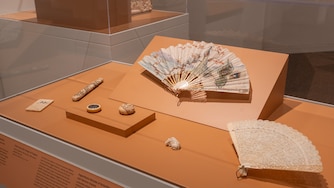
Many of the ornate objects in “Luxury & Loss,” which runs through Jan. 24, are stunning in person. They include the devotional “Standing Figure of a Male Dignitary,” carved in Egypt from elephant ivory nearly 4,000 years ago, and a 17th century Chinese cup made of rhinoceros horn.
Critics could argue the exhibit perpetuates the materials’ desirability. But Chan said it’s important to put these items front and center to facilitate conversation.
Read More
“We know, if you hide history away, it can be forgotten and we don’t learn anything and we repeat the cycle,” she said.
Three years in the making, “Luxury & Loss” is an example of the Walters giving supporters more of what they want, according to Chan. When past exhibits featured items made from elephant ivory, visitors told her they wanted to know about the material and its history.
The exhibit is also an opportunity to show off the free museum’s rich collection of historical art — a change of pace after the Walters recently hosted traveling exhibitions such as “Douriean Fletcher: Jewelry of the Afrofuture” and “Soulful Creatures: Animal Mummies in Ancient Egypt.”
For Chan, it was imperative in “Luxury & Loss” to present venerable items next to contemporary art, so each section features a recent work that bridges the exhibit’s themes from the past to today.
Baltimore abstract artist Amy Boone-McCreesh made the large installation, 2026’s “Scarcity and Surplus,” for the tortoiseshell area. The distinctly patterned material was used in luxury goods, fashion accessories and furniture until most countries banned its trade in the 1970s.

Over 10 months, she handpainted tortoiseshell designs on paper cutouts that hang vertically from the ceiling “like seaweed,“ a nod to the sea turtles’ oceanic home, Boone-McCreesh said.
She holds a mirror up to the viewer — in the form of a sheet of mirrored acrylic on the installation’s pedestal.
“Ideally, in my mind, it causes you to think about this never-ending cycle of human greed, which is kind of mining nature for our own good,” said Boone-McCreesh, who earned her master’s degree in studio art at Towson University.
Self-reflection is a focal point of “Luxury & Loss.” At the end, visitors can pick up rotary phones to hear recorded messages from local wildlife conservationists including Joe Corcoran of the Baltimore Bird Club and the Oyster Recovery Partnership’s Sarah Greenberg. They share their stories of how they got involved in preserving nature.

The exhibition’s themes can be unsettling, so the museum wanted to end on an optimistic note.
“We wanted visitors to leave the exhibition with at least a little hope, a little inspiration and concrete examples of how an individual can be part of the solution of this bigger problem,” Chan said.
Certainly, there’s plenty to chew on. For example, “My Ailing Beliefs Can Cure Your Wretched Desires,” a 2017 video installation by MacArthur “Genius Grant” recipient Tuan Andrew Nguyen, imagines the story of the final Javan rhino to be poached in Vietnam.
Boone-McCreesh was blown away by the craftsmanship of the “Articulated Spiny Lobster,” a detailed, 19th century Japanese sculpture whose individual body parts all move and behave like a real crustacean. “I mean, it’s insane,” she said.
Chan hopes there are more discussions around “Luxury & Loss” to come. On Saturday, she’ll moderate a free conversation with Boone-McCreesh and fellow Baltimore artist Luci Jockel, along with an audience Q&A, from 3-4 p.m. inside the Walters’ Graham Auditorium. Chan will then host a virtual presentation of the exhibit Nov. 18.
Chan anticipates “Luxury & Loss” will generate polarizing opinions about wildlife conservation and human consumption. She’s more interested in curiosity and open-mindedness.
“I’m not hoping to tell people how to think or what to think,” she said. “I would be very happy if this exhibition made them think.”




Comments
Welcome to The Banner's subscriber-only commenting community. Please review our community guidelines.