
Abolitionist Frederick Douglass’ first-known portrait. Martin Luther King Jr. shaking hands with Baltimoreans. Tension-filled frontline photos from city streets during 2015’s Uprising protests.
They’re all now on display at the Baltimore Museum of Art — along with much, much more — inside “Flashback: Two Centuries of Baltimore Photography,” the first major exhibition to explore the city’s deep history and stylistic evolution of documentation through a camera lens, said BMA department head Leslie Cozzi.
Somehow, Baltimore’s rich, sprawling history of must-see photography has never received a proper survey from a museum — until now.
Anyone from, or interested in, Baltimore “will recognize themselves in this show in a way that’s different from probably any other museum exhibition,” according to Cozzi, who co-curated the exhibit with Antoinette Roberts.
The low-lit exhibition, which runs through Feb. 21, largely tells a chronological journey across 185 years. Visitors begin with the earliest known portraits of former Baltimore residents Edgar Allan Poe and Douglass, who posed for a photograph just three years after escaping bondage, according to the museum.
Attendees will then walk through sections like the labor-focused “Urban Fabric” and “Performance,” snapshots from the city’s wonderfully off-kilter arts scene.
Read More
These memories — shown both in color and stark black and white — tell Baltimore’s ineffable story across a wide range of 200-plus images, from a faded 1853 landscape of the Inner Harbor to Devin Allen’s famous photo of the Uprising protests after Freddie Gray’s death, which covered Time magazine in May 2015.
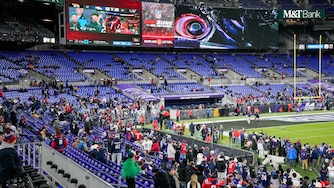
While the exhibit documents significant history, it also spotlights the everyday moments that enrich Baltimore life, such as football games, underground arts performances and crabs laid out on newsprint.
Cozzi hopes future scholars will use “Flashback” as a resource to further study Baltimore’s history. It also captures a time before cellphones became our go-to form of preservation.
“We’re all now walking around with cameras in our pockets as amateur photographers, but it really took a long, historical development to get us there. This exhibition really traces that,” Cozzi said.
I caught up with three “Flashback” photographers to discuss their work now featured on the BMA’s hallowed walls.
‘Pete,’ Joseph Mario Giordano (2004)

Joseph Giordano, a veteran Baltimore photographer and previous Banner contributor, has several photos in “Flashback,” but this evocative snapshot of a retired Bethlehem Steel worker is his favorite.
“That’s one of my best portraits,” Giordano recently said inside the exhibit.
He loves the little details, from the backdrop’s patterned curtain to the portrait-within-a-portrait of an unnamed man in the top left corner.
Admirers often ask Giordano if both men are the same person but he refuses to reveal the answer. To him, the photo is simply about the passage of time.
“I got him right before the big smile,” Giordano said of snapping the picture. “He’d just started thinking and he just kind of drifted off.”
The man named Pete never saw the photograph. He died about six months after it was taken, Giordano said.
‘Abdu Ali at the Crown,’ Audrey Gatewood (2015)

No “Flashback” photograph encapsulates Baltimore’s thriving, do-it-yourself music and arts in the 2010s like this one.
Back then, the Crown on North Charles Street operated as the city’s inclusive epicenter for DIY live performances and rising artists, including Baltimore native Abdu Ali, who threw regular dance parties called KAHLON at the Station North venue.
The Crown’s closing in August 2024 ended an era for Baltimore’s arts scene, leaving a void that still hasn’t been filled.
But the next best thing is Audrey Gatewood’s mid-performance photograph of Ali at KAHLON — a shot so visceral and sweaty that I swore I could smell the Crown again through the print’s ink.
Gatewood, a Baltimore School for the Arts alum, said she wanted to capture Ali’s sensual “transcendence and repose that I saw even in this chaotic, loud environment.”
These days, Gatewood still takes photos but is focused on her career as a social worker. Meanwhile, Ali was recently the BMA’s inaugural composer in residence and launched a literary journal called Twurl.
But the “Flashback” representation of the Crown era remains important to Gatewood, who described the parties as “very hopeful, experimental, socially alive.” The events were more than just social gatherings to her and her friends.
“I mean ‘party’ in the most meaningful sense of the word,“ Gatewood said, “like people coming together, becoming part of a temporary collective to express something [and] being open to being changed by the experience and by others.”
‘The Get Together,’ Bria Sterling-Wilson (2025)


Not every “Flashback” entry is a standalone photograph.
“The Get Together” is by Bria Sterling-Wilson, a Towson University alum who’s creating powerful collage work from a Highlandtown studio. It combines her grandmother’s vintage family photos with old cutouts from Black-focused magazines like Jet and Ebony.
Sterling-Wilson, who’s also deputy director of the Mayor’s Office of Arts, Culture and Entertainment, said “The Get Together” celebrates “the importance of Black joy and being together in a space.”
To see her work inside the BMA and the renowned Phillips Collection in Washington, which recently acquired “The Get Together,” is not only a dream come true for Sterling-Wilson. It’s the fulfillment of a promise.
“I always told my grandmother when I started incorporating our family archives that I intend for her to be in these spaces that I’m sure she never would have imagined being on the walls,” she said.



Comments
Welcome to The Banner's subscriber-only commenting community. Please review our community guidelines.