
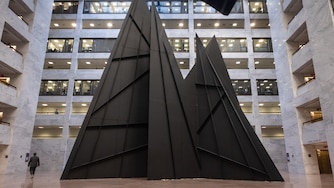
A 51-foot-tall steel behemoth — the last work of one of America’s most renowned modern sculptors — towers within a power center of D.C.
Thanks to an unusual team-up, the black paint that absorbs viewers into “Mountains and Clouds,” with its curving arcs and floating panels that hang overhead, contains shades of Prince George’s County.
“This paint does stick with you,” U.S. Sen. Angela Alsobrooks said on a recent weekday as she gazed up at the Hart Senate Office atrium. “It stands out. I think it’s bold and beautiful.”
The paint that prompted Alsobrooks and many other passersby to pause and look skyward was Calder black. The elusive hue of matte black was an essential color for its namesake, Alexander Calder, whose sculptures and artworks are on display around the world.
But, after his death in the mid-1970s, the specific shade of black fell out of distribution. This presented a problem for the Calder Foundation, a nonprofit founded by the late artist’s family dedicated to preserving his legacy and works.
Through talks with prominent Calder collectors, the foundation connected with Alsobrooks in 2024 as she was vacating Prince George’s County’s executive office to join the Senate.

Calder experts had reason to believe that, because of efforts with artists foundations dating to 2004, the U.S. Army Research Lab, headquartered in Adelphi, possessed the capabilities and instrumentation to bring Calder black to life again.
That was news to the senator.
“The Calder paint, to be honest with you, I never heard of it,” Alsobrooks said, “didn’t realize how rare it was, but I’m totally ecstatic to learn that this paint could be produced in Prince George’s County.”
Once Alsobrooks connected the foundation with the Army Research Lab, the researchers and Calder experts had to perfect the hue.
John Escarsega spent 41 years with the lab as a research chemist before semiretiring — he’s still a contractor for ARL through a private firm. He has become the de facto expert on exhaustive experimentation and field tests of paints that he and his team formulated, alongside foundation officials, that would become Calder black.

During a video call late last month with The Banner, Escarsega talked in rich, exacting detail about his expertise and career developing matte black paints for camouflaging purposes.
Even though he has spent countless hours thinking about the specifications of low-gloss coatings, xenon chambers and other necessities of his trade, Escarsega seemed most serene when talking about his fondness for art.
“Looking at a monumental Alexander Calder or a Tony Smith piece, they’re very moving, and moving in the sense that it just creates a ...,” Escarsega, 66, trailed off for a second before regrouping.
“You feel more present and more alive,” he said. “I think it’s just that essence of creativity that you’re witnessing.”
It was 1975 when Calder answered a callout from the Architect of the Capitol, which operates and maintains the governmental buildings on Capitol Hill. His design was selected.
On Nov. 10, 1976, Calder brought a maquette, a small-scale model, and plan for “Mountains and Clouds” to D.C. The next day, he died of a heart attack in New York City.

The sculpture has been through decades of public and private debates about funding before and after its official completion in November 1986.
The latest senatorial squabble centered on how and whether to raise the four panels that make up the titular clouds. The sculpture has been merely mountains since 2014 because of concerns over the structural integrity of the clouds, which required them to be lowered.
In the 12 years since the clouds went away, private donors stepped in and funded the $12 million renovation, according to a report from the New York Times. The Architect of the Capitol and lawmakers dragged their feet on the project that included reviving Calder black, painting the new carbon-fiber clouds (which were previously aluminum) and adding a motor mechanism so the clouds could rotate overhead as Calder imagined.
Alexis Marotta, director of archives at the Calder Foundation, has spent her entire 25-year career ensuring the lasting power of Calder’s works that appear in private collections and publicly accessible spaces, including “Mountains and Clouds.”


“It’s not so much preserving kind of the history of that age of the sculpture but really preserving what Calder intended the experience with each viewer [to be],” Marotta said.
Some viewers on that recent weekday in the Hart Building could feel that intention.
The Calder black hummed within the stark white marble of the building’s nine-story atrium. Some wooden and metal scaffolding obscures the skylight above “Mountains and Clouds.”
An official unveiling is scheduled for Wednesday, according to a spokesperson for Alsobrooks.
In a video call with The Banner, Marotta referenced a quote from Calder’s grandson, Alexander S.C. Rower, founder and president of the Calder Foundation.

“Black was by far Calder’s most used color,” Rower wrote. “He relied on its light-absorbing qualities to delineate where the material meets the immaterial, where metal meets the air.”
The immaterial was not far from Alsobrooks’ mind when discussing the work.
She said she was in disbelief that Prince George’s County was “the only place literally in the world” that could provide this paint. She was proud of the collaborative effort it took to build something in D.C. that she expects will last beyond Senate terms.
“I think the most amazing part to all of this is this will live, I’m sure, beyond me and beyond all of us who contributed,” Alsobrooks said.
“So Maryland would have played an outsized role in this exhibit, the ‘Mountains and Clouds,’ that will live on in the Hart Building probably long after I’m gone.”

Have a tip for our Prince George’s County reporters? Tell us here.



Comments
Welcome to The Banner's subscriber-only commenting community. Please review our community guidelines.