
Martina Dodd knew 2026 would be an important year for the Banneker-Douglass-Tubman Museum in downtown Annapolis.
As America celebrated its 250th birthday, Annapolis would surely be part of the conversation: Maryland’s capital played several roles in the country’s founding and early history.
For example, it’s where Gen. George Washington famously resigned his commission as commander in chief. But the riverside city is also where, for years, enslaved people were sold and traded.
There have been celebrations and conversations about 250 years of U.S. history at the national, state and local level this year.
“We were really considering how or if we wanted to participate in those celebrations,” said Dodd, the museum’s curator of collections and exhibitions.
And if those conversations about American history were going to happen regardless, “Black people’s contributions should be considered,” she said.
Read More
That’s the idea behind the “She Speaks: Black Women Artists and the Power of Historical Memory” exhibit, which is on display at the museum until January. A free public symposium at the museum and at Bowie State University from Thursday to Saturday will give visitors another chance to engage with the exhibit, too.
“She Speaks” includes some historic works and more contemporary pieces. It features photography, textile arts, collage, painting and more — all from Black women artists.
The exhibit “acknowledges Black women as active participants in the making of this country rather than passive bystanders, highlighting artists who operate as historians, archivists, and scholars to tell their stories,” according to the museum website.
“She Speaks,” Dodd said, is “in conversation with” other celebrations and exhibits tied to America 250, but she does not consider it an America 250 exhibit by itself.

The symposium “Aesthetic Inheritance” will open with a presentation at the museum, with three artists discussing their works displayed as part of “She Speaks.”
The Banneker-Douglass-Tubman Museum opened in 1984 as Maryland’s official museum of African American heritage. It sits on land once owned by Charity Folks, a formerly enslaved woman who gained her freedom.
Part of the museum is inside the still-standing Mount Moriah AME Church, which was built in Annapolis by free African Americans in 1874.
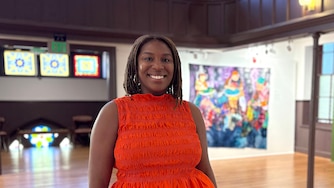
The former church building houses most of the “She Speaks” exhibit. Spread across two floors, the collection has more than a dozen pieces from Black women artists, many with connections to Maryland.
With large stained-glass windows, the brightly lit room makes it easy to inspect the art’s details. The room was not originally the church’s sanctuary, but has a quiet, contemplative feel.
In one corner of the exhibit, quilting panels from around 1820 sit behind protective glass. Signage next to the hexagonal mosaics explains that they were made by “Grandmother Bishop,” a member of the wealthy Bishop family in Annapolis at the time.

On an upstairs wall, three linocut prints from 1947 show historic figures, including Sojourner Truth.
And there are more modern pieces, too. That includes photos featuring Ada Pinkston, a multimedia artist, standing atop plinths in Baltimore that once held Confederate monuments.
The photos are part of an art project she completed that “reconsiders and reimagines what public memory is in the context of contemporary monument landscapes,” Pinkston said in an email.
She said she was honored to be included in the exhibition, which she called “momentous.”
The showing “matters that much more” in 2026 and in the face of attacks on Black history and diversity initiatives from the federal level, she said.
“The story of the United States would not be complete without African American people,” Pinkston said.
Dodd said she hopes visitors to “She Speaks” leave having learned something about Black Maryland history and are “confronted with new information or a new perspective.”

The museum has a reading list available for visitors who come to the exhibit and want to learn more, Dodd said. That way, if a person is inspired or wants to do their own research, they’ll have a jumping-off point.
“That was important for us,” she said.
“She Speaks” is open to the public until Jan. 16, 2027. The Banneker-Douglass-Tubman museum is open Tuesday through Saturday, from 10 a.m.-4 p.m. Admission is free.


Comments
Welcome to The Banner's subscriber-only commenting community. Please review our community guidelines.