
WASHINGTON — Airlines across the U.S. worked Saturday to recover from the longest nationwide ground stop in 25 years that canceled more than 2,000 flights, spread ripple effects around the world, stranded passengers and forced professional and college sports teams to scramble for alternate transportation.
Trump administration officials said new technology being added to the nation’s air traffic control system overloaded antiquated equipment and caused “intermittent” communications and radar gaps, leading to the flight shutdown of more than four hours.
A limited number of domestic flights departed after the stop was lifted around 8:15 p.m. Friday. But the effects could be felt for days, with officials saying the system would likely return to normal in time to handle the Thanksgiving travel rush.
The nationwide stop was the first since January 2023, when another key Federal Aviation Administration computer system that sends notices to pilots malfunctioned, and the second since the Sept. 11, 2001, attacks.
Thousands of flights delayed and canceled
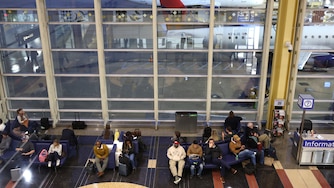
At airports across the U.S., passengers stared at screens showing delays or rushed to find buses or trains to their destinations, including the Baltimore-Washington, D.C. region. Officials with Baltimore-Washington International Thurgood Marshall Airport, Dulles International and Reagan National airports are advising travelers to check with their airlines about their flight status. According to Flightaware.com, there are only a few dozen delays and cancellations at these airports as of Saturday morning.
Jennifer Angarita, 38, was in the air from Denver headed to BWI on Friday when a flight attendant alerted her and other travelers of the stoppage. The flight attendant assured travelers they were unaffected because they were already in flight but couldn’t say the same for those on connecting flights, Angarita said.
Read More
“When everyone landed, people clapped,” she said.
While others had to figure out their connecting flights, Angarita was relieved to be home, or at least closer to her home in Rockville. What outraged her were the Uber prices that were upward of $160, she said. Luckily, she found an $80 Lyft.
“I just wanted to get home to my babies,” said Angarita, a mom of two young kids.

For Zach Tolle, Friday’s 3:30 p.m. flight from Salt Lake City to BWI was the only nonstop option for getting him back to Anne Arundel County, so he booked it. But just five minutes before his scheduled departure, officials noticed instability in the system that prompted a nationwide ground stop.
Tolle had arrived at the airport around 1:30 p.m. local time. By 7:30 p.m., he was still there, watching his departure time get pushed back. The flight hadn’t been canceled, so he held onto hope that he would make it home to Maryland.
He passed the time checking in with family, watching the latest season of “Dexter: Resurrection” and catching up on football news. His favorite team, the Ravens, weren’t having a particularly good day either.
He also looked into renting a car and driving east if the ground stop continued. The trip would have taken about 30 hours, but he was willing to consider anything that would get him back to his Anne Arundel County home and to his wife and two young sons.
After watching federal officials’ news conference, Tolle said he believes improvements to the system are necessary.
“It makes me surprised it doesn’t happen more often,” he said of the system failure.
Being stranded in a city he was visiting for the first time, with no clear idea of when he would get back to Anne Arundel County, had been stressful, he said.
The good news of the ground stop being lifted was short-lived. Tolle’s flight was ultimately canceled, leaving him still stranded in Salt Lake City and unsure when he would make it back to Maryland to see his wife and two young sons.
Sports teams scheduled to play this weekend adjusted game start times, searched for hotel rooms, rescheduled flights and chartered buses.
Auburn University’s football team opted to take a bus to Mississippi State and the Saturday start time was pushed from noon to 4:15 p.m. Other universities affected by the stoppage included Baylor, Washington, Kansas State, Minnesota and No. 19 Ole Miss, which did not plan to fly until Saturday morning for its game against Oklahoma.
Secretary of Transportation Sean Duffy encouraged NCAA football teams to reach out to the FAA so the agency can prioritize flights for Saturday games.
Officials say no one was in danger during ground stop
Secretary of Homeland Security Markwayne Mullin told reporters at the White House that no one was in any danger as more than 3,000 flights were safely landed Friday.
Duffy blamed Congress for failing to approve more funding for new technology, while downplaying the fact that trying to implement new fixes overtaxed the system. He suggested more disruptions might occur.
“We didn’t think we would have this kind of outage. We did,” he said. “We were able to review what went wrong, and then reboot the system and go. But, you will have more of these.”
Duffy said the problems were not linked to the FAA’s new AI-powered system the agency is rolling out to help predict problems in the sky because that isn’t connected to Friday’s failure.
“This is all the old legacy equipment. All of the new equipment that’s been deployed did not go down,” Duffy said.
The FAA has already replaced thousands of old copper wires with fiber optic lines and upgraded hundreds of radio systems as part of the overhaul that began last year after Congress approved $12.5 billion of funding. Duffy and the White House are pushing for $30 billion more to complete the work.
Past problems have been linked to equipment failures
The problem appeared similar to a regional air traffic control communication outage in September that snarled hundreds of flights across the Northeast, although that disruption was linked to a construction crew cutting a fiber optic line. Aging equipment was also blamed for the brief radar outages last year that disrupted Newark airport.
Aviation safety expert Steve Arroyo said the difference this time is it happened on a nationwide scale that left controllers unable to reliably talk to pilots.
“If you don’t have that ability, whether it’s because the old wires that they have are just run down or for whatever reason, you’ve got to stop airplanes on the ground and not put them in the air, where you’re going to risk not being able to communicate with them,” said Arroyo, a former United Airlines pilot.
Friday’s ground stop also was different from the one after 9/11 because planes were not being told to land immediately and pilots likely were able to communicate with ground controllers at airports, Arroyo said.
Banner reporter Darreonna Davis contributed to this story.


Comments
Welcome to The Banner's subscriber-only commenting community. Please review our community guidelines.