
This story was supported by the Pulitzer Center.
HO CHI MINH CITY, Vietnam — Rising to her toes at the window of an airport waiting room, Melissa Tran peered down to baggage claim and searched for her family.
The U.S. had deported the 44-year-old Hagerstown resident eight months earlier to Vietnam, a place she last set foot in as a child.
Without the home, family and nail salon business she built over decades in Western Maryland, Melissa had been adrift. She spent most of her time alone in her bedroom. She had no job and few friends. She would lie awake at night counting the days since she last held her children.
On Day 255, they arrived.
Read More
She scanned the crowd and spotted them. Her husband, Danny Hoang, pulled cellophane-wrapped boxes of clothes, shoes and toys from the baggage carousel. Jacob, their 11-year-old, dressed in a red Super Mario shirt, and Riley, 8, in pink Hello Kitty sneakers, scurried around him.
Their two older children, ages 21 and 19, would visit soon, and for a precious few weeks in August, the family would be whole again. Then, a painful new split: Danny and the eldest children would return to live in Maryland. The two youngest would stay behind to live with Melissa.
Melissa is one of thousands of immigrants who formed communities, started businesses, bought homes and raised children in the United States, before President Donald Trump’s mass deportation campaign forced them to start over in countries they left long ago and now barely recognize.
The effect has been particularly destabilizing for mixed-status families, those in which immigrants have married U.S. citizens or raised U.S.-born children. Though the precise number of family separations is unknown, a recent estimate found that 145,000 U.S.-citizen children have had an immigrant parent detained under the Trump administration. More than 70% of those children are under 12.
Melissa’s youngest are among them. Her deportation last year, for a nonviolent crime she committed as a teenager, led to an agonizing choice: stay separated from her children or uproot them from the only home they’ve ever known.
At the airport, Melissa waved through the glass with both arms, trying frantically to catch her family’s attention. At last, the kids looked up to the gallery and waved back.
“They saw me! They saw me!” she yelled.

She broke into a sprint, down the stairs and into the glittering Ho Chi Minh City night, weaving around throngs of waiting family members, pushing toward the terminal’s glass doors, where her family emerged.
She lifted Riley off the ground, kissed her cheek and rubbed her back. She pulled Jacob into a hug. Tears fell behind his glasses.
“You’re so tall,” Melissa said.
Melissa understands the upheaval her children face. She was around Jacob’s age the first time she left everything familiar to grow up in a new country.

Becoming American
Melissa, at age 11, joined more than 1 million Southeast Asians who immigrated to the United States in the decades after the Vietnam War, part of the largest refugee resettlement in American history.
When her parents fled Vietnam’s economic collapse in 1993, they sold everything they owned: their mud hut on a dirt road, their pho restaurant, the small plot of farmland where they grew vegetables to sell at open-air markets.
Melissa, who then went by her Vietnamese name, Mong, had just started fifth grade. She spoke barely any English and knew little of the world outside her home, elementary school and Catholic church.
The family arrived in the United States on green cards and moved into a subsidized apartment in Fairfax, Virginia. Melissa’s parents were too old to work and depended on government assistance. Still, Melissa graduated high school and was on track to join the first generation of her family to earn college degrees.


At 19, she was in an on-again, off-again relationship with a man her attorneys described in court records as “abusive and manipulative.” In need of money for a new car, he pressured Melissa into stealing almost $30,000 from a Virginia doctor’s office where she worked as a receptionist, her attorneys said.
Melissa called her employer to confess and turned herself in. She pleaded guilty in 2001 to forgery and larceny, paid full restitution and served four months in jail.
Her conviction meant she could be deported, but at the time Vietnam was refusing to accept U.S. deportees. Even when that policy changed, the country continued to turn away those, like Melissa, who arrived in America before July 1995. Instead, she was allowed to remain in the U.S. and required to check in periodically with Immigration and Customs Enforcement.
Court records show she stayed out of legal trouble and complied with her ICE appointments for the next two decades.
Soon after her release from jail, Melissa began working at a nail salon in Southern Maryland, where she met Danny, a fellow Vietnamese refugee who had been assigned to train her.

They fell in love, married and moved to Hagerstown, a majority-white, working-class city in Western Maryland’s Appalachian foothills. They bought a red brick house on a quiet, tree-lined street. They opened their own nail salon, tucked in a large shopping center between a pizzeria and an Amish market. Many of their customers became close friends.
Melissa’s life revolved around her four children. She rose with them in the mornings, packing their lunches and dropping them off at school. She chaperoned their field trips, volunteered at their book fairs and cheered at their swim meets. After school, she’d slip into a back room at the salon and help them with their homework.
Melissa was the one who best understood Jacob, who has autism, knowing which foods he would eat, which clothes he could tolerate and which noises would overwhelm him.
“They are my everything,” Melissa says of her children.
She never became fully American. Her criminal record meant she couldn’t receive citizenship, couldn’t vote, couldn’t get a passport.
About once a year, she’d have to drive to the immigration field office in Baltimore and show her identification. The visits became routine. Usually, they were over in minutes.
When the Trump administration launched an immigration crackdown in 2025, it intensified pressure on Vietnam and other countries to accept more deportees, threatening tariffs, third-country deportations and travel restrictions. Hundreds of pre-1995 Vietnamese immigrants, once protected from removal, were suddenly getting arrested.
Deportation forces agonizing choice
“He kept talking about ‘the worst of the worst’ — the murderers or the rapists,” Melissa says of Trump. “So in my mind, I was like, ‘I should be OK.’”
Last year, the day after Mother’s Day, Melissa showed up in Baltimore for her regular check-in. ICE took her into custody.
She waged a lengthy fight to stay in the country, until the U.S. deported her a week before Thanksgiving.
A stranger
The deportation flight set off in the dead of night, stopping in Romania, India, Nepal and, finally, Hanoi, Vietnam’s capital.
Melissa endured the 34-hour journey shackled at her hands and feet. She stepped off the plane with the clothes on her back and a couple hundred dollars in her pocket.
“Ma’am, I’m going to pray for you,” Melissa recalls an ICE agent telling her.


In Hanoi, a local immigration officer offered her a meal and his phone to call her family. A fellow deportee helped her complete the arrival forms, printed in a language that had long faded from her memory.
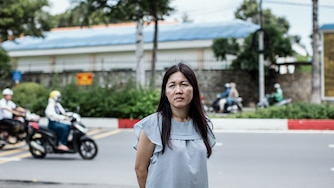
Melissa used her money to travel 1,000 miles south to her childhood hometown of Bien Hoa, where she moved into a concrete house with distant relatives. Some she hadn’t seen in decades. Others, she’d never met at all.
In her first days back, Melissa toured her old neighborhood. Her childhood home, the mud hut, was gone. In its place stood a tall shop house with a tiled facade, a corrugated roof and a new number out front. Its weathered exterior gave the impression it had been there for years, that what existed there before had disappeared long ago.

The agrarian neighborhood she grew up in had become a dense industrial district, where the rumble of flatbed trucks, the whir of passing trains and the screech of metal machinery filled the air.
“It was completely different from what I remember,” Melissa says. “I felt like I was a stranger.”
She soon settled into a lonely routine, spending most days in an attic that her relatives converted into a makeshift, fluorescent-lit bedroom.
To fill time, she listened to books on tape by American authors such as James Patterson and Freida McFadden. She studied for her English teacher certification and video-called her former customers. She assembled jigsaw puzzles, a hobby she picked up over months in ICE detention.
Her appetite was diminished, and she rarely slept through the night. She began seeing a therapist to cope with the agony, guilt and shame she felt over being forced from her home.


She took lessons to drive a motorbike, attempting to learn a ritual of modern Vietnamese life, but gave up after the heavy traffic proved unnerving.
She tried growing succulents, hoping to re-create a piece of the garden she raised in Western Maryland. But the plants browned and withered in the unforgiving Vietnamese heat.
9,000 miles apart
For much of the year, Melissa would awake around 3 a.m., just as her kids in Maryland were coming home from school.
She video-called to make sure they’d completed their homework. She called again a few hours later, so they heard her voice before bed. Again the next morning to wish them a good day at school. Throughout the day, she called her two oldest children, Jackson and Rachel, with lists of directives: Cut the grass. Clean the house. Go to the store.


From 9,000 miles away, she still placed the family’s Amazon orders. Still required the kids to check in with her when they came home. Still tracked their location on a GPS app.
She yearned for more than these fragments of motherhood.
“It’s not the same,” Melissa says. “I’m used to making them breakfast every morning before they go to school, making sure they have their lunch, their homework. Changing them, dressing them. Giving them a hug, a kiss goodnight every night. I don’t get that anymore.”
As Melissa and Danny weighed the family’s path forward, they considered how the separation strained each of them.
Danny, now the family’s sole breadwinner, had plunged himself into work, putting in 13-hour days at the salon.
The oldest kids had moved back home, juggling college and jobs with their younger siblings’ doctor appointments, swim practices and school pickups.

“Me and Jackson had to step into my mom’s shoes,” Rachel says, “but we both didn’t seem to fill how big they were.”
Jacob and Riley began sleeping in their father’s room. They felt their mother’s absence on field trips, birthdays, Christmas. Melissa watched Jacob’s fifth grade graduation on Zoom.
Melissa and Danny came to agree the young kids needed their mother. And that Melissa needed her kids.
The decision filled her with guilt.
“It wasn’t easy to be in a new country and learn a new language,” she says, reflecting on her childhood. “For my kids to have to experience that, I feel for them.”
Danny, 56, would stay behind. He and his family fled Vietnam as refugees 25 years ago. Five years after that, he became a U.S. citizen. His job, his community, his dreams were in America.


The family needed Danny to run the business and provide an income. They needed him to preserve a home for Jackson and Rachel, to hold together the life he and Melissa built.
Jacob and Riley had visited Vietnam once for a family wedding but remembered little about it. It took many delicate conversations before the kids understood that, this time, they would stay.
They both protested. Jacob worried about missing middle school. Riley was sad to leave her friends.
Reunion
The family called Melissa on Jacob and Riley’s last night in Hagerstown, a late July morning in Bien Hoa.

Melissa answered the phone in a narrow alley, where shops were rolling up their metal doors for the day, sending wafts of coffee, fish and freshly carved wood into the street. Eyes fixed on the screen, Melissa hardly noticed the motorbikes zipping perilously close to her.
Bring your passports, she reminded her family. Print your itineraries. Eat something on the plane.
In Jacob’s room, the bed was stripped, the dresser drawers were cleared out, and clothes were folded neatly into plastic bins. Left behind on the walls, alongside decals of Mario and Luigi, were wooden letters spelling his name.
“See you soon,” Melissa told her family. “I love you.”
After two flights spanning nearly 24 hours, the kids moved into Melissa’s room in Bien Hoa. The foyer, where an altar of Jesus, Mary and Joseph watched over them, became their play area, quickly overrun with half-built Lego creations, craft supplies and Squishmallows. The living room became their homeschool, and Melissa became their teacher.

Women in conical straw hats, men crafting furniture in their workshops and roosters crowing from gated patios became their neighbors. Relatives they barely knew, whose language they didn’t speak, became their social circle.
The kids tried to make sense of their new reality. Why are there so many mosquitoes? Does it rain every day? Why is Dad going back to America? Why are we staying here?
They found comfort in the rituals of being a family again.

On one of their first outings, the kids and their mother walked hand in hand through a downtown Bien Hoa mall, a large, air-conditioned place that smelled of perfume and hosted brands such as Levi’s and Valentino. They stopped at a hot-food counter in the mall’s supermarket, where Melissa translated Riley’s request for a fried chicken drumstick.
For a moment, as they gathered around a table, watching Riley devour every last scrap of meat, laughing as crumbs covered her face and fingers, they felt normal again.
“Everything OK,” Danny said, pulling his wife close. His eyes welled with emotion.

Jacob and Riley had their mother back. When there was a bug bite to nurse, a petty fight to settle, a missing toy to find, a fit of exhaustion to soothe, the person they’d always turned to was there.
Jackson and Rachel arrived the next week. From the airport waiting area, Melissa recorded them descending the escalator to baggage claim. She headed outside and shrieked with joy as they walked through the glass exit doors.
More hugs, more tears. The family of six, together at last, smiled for a photo.

They spent their first night sightseeing in Ho Chi Minh City, the shimmering South Vietnamese metropolis southwest of Bien Hoa, which Melissa and Danny knew as Saigon.
Their red double-decker tour bus looped around a bustling pedestrian square, lined with luxury hotels, late-night cafés and boutique stores such as Burberry and Rolex. It rolled by towering glass skyscrapers and a sweeping cable-stayed bridge, aglow in sparkling neon lights.
Melissa’s head turned from left to right, her eyes tracing the height of the skyscrapers.

“I can pass through all these beautiful buildings,” Melissa says, “but I don’t feel it. I don’t feel that that’s my home.”
Over the next couple of weeks, as the family visited Danny’s relatives in the mountains and then the Vietnamese beaches, a ticking clock followed them. Each passing day brought them closer to another searing goodbye, a prolonged and anguished separation.
When the moment at the airport came, as the family clung to final hugs and the young children wailed, a desperate but futile longing gripped Melissa. She wanted nothing more than to be on a plane, returning home to Hagerstown with her family.

For many deportees, the legal paths back to the United States are limited and fraught, requiring years of waiting, extensive paperwork and hope that often leads nowhere. Still, Melissa thinks, maybe sharing her story will move someone who can make a difference. Maybe there’s some legal maneuver left to try.
Until then, her life remains scattered across two distant lands.




Comments
Welcome to The Banner's subscriber-only commenting community. Please review our community guidelines.