
As exits go, Baltimore City Council member Mark Conway’s was dramatic.
Last month, the two-term council member was ousted as chair of the influential Public Safety Committee in favor of council member John Bullock. Council President Zeke Cohen made the call, citing Conway’s poor attendance record and what he described as an inability to legislate effectively.
On his way out, Conway spared few feelings, calling his colleagues shameless and accusing them of cowering from Mayor Brandon Scott.
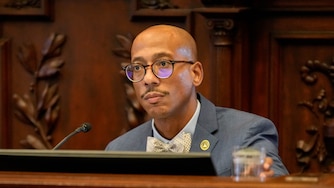
Into the fire steps Bullock. The West Baltimore representative, who moonlights as a college professor, has done stints leading committees on housing, finance and education during his 10-year tenure on the council, but this is his first time shepherding the Public Safety Committee.
The Banner sat down with Bullock to talk about his priorities and approach as he takes the reins of one of the council’s most visible committees.
Making the committee his own
Bullock, who has built a reputation as affable and conflict-averse among his colleagues, said Baltimoreans should expect to see an immediate shift in the way he talks about topics on the committee. As chair, Conway used the post to press the administration for plans to address opioid abuse and “open-air drug markets.”
Read More
Bullock said he finds the latter term to be loaded and offensive as it “harkens back” to days when police cleared street corners for little to no reason, a practice decried by federal consent decree regulators. The term “open-air drug markets” was removed from the agenda for the committee’s first meeting after Bullock’s promotion, although the issue was still discussed.
“That terminology, you’ll probably never hear it come out of my mouth,” Bullock said. “I think it’s important to be careful about the language that we use.”
Bullock said the shift shouldn’t be construed as him having conflict with Conway. He said he reached out to Conway immediately after Cohen informed Conway of the decision in a private meeting.
During a council meeting, Conway repeated what he told Bullock in private. “Your success is my success, is our success as a city,” he said.
Bullock said he was pleased that Conway remained a member of the Public Safety Committee. He noted that they held joint hearings together in the past.
“He’s taken a deep dive on a number of these issues,” Bullock said. “Our approach may be different in terms of how we ... drill down on certain topics, but I think having him on the committee is a good thing.”
A holistic approach to public safety
Bullock said he doesn’t think about one city issue without considering a spiderweb of related problems, and he plans to broaden the scope of public safety conversations that often focus on policing.
Take vacant properties. Bullock said he thinks about the perennial Baltimore problem in terms of neighborhood blight. And drug activity and crime. And the correlation between abandoned buildings and fires and how difficult those blazes are for investigators to solve.
“All these things are layered, but they’re intersected, too,” Bullock said.
Because of that, he said he’d bring a more “holistic” approach to public safety.
“You could take an approach and say we’re just going to focus on this one issue, but every issue is attached to something else,” Bullock said.
Bullock said he also plans to welcome more community leaders to testify at hearings. He will achieve that, he said, by better publicizing meetings ahead of time and specifically inviting leaders of communities and groups impacted by particular issues.
“That’s where we’re going to get real insight into what people are dealing with,” he said.
The forgotten Fire Department
Bullock represents the city’s 9th District, which includes neighborhoods like Mount Clare, Carrollton Ridge and Sandtown-Winchester. It’s been ground zero for the city’s struggle to fight fires in vacant buildings.
In 2022, three city firefighters were killed when a vacant building in the district collapsed as fire crews battled a blaze inside. The deaths sparked reform within the Fire Department, including the ouster of its chief and the reimplementation of a program to mark structurally compromised vacant buildings with placards.
As chair of the Public Safety Committee, Bullock said he would like to strengthen the focus on the department, which is at times overlooked as the city buckles down on the fight against violent crime.
He said he supports expansion of the city’s clear boarding initiative, which seals vacant homes with a durable translucent material rather than plywood.
Bullock said he would also like to focus on improving conditions in the city’s aging firehouses and push for more mental health resources for city firefighters.
“I want to make sure we’re keeping them in the conversation,” he said.
Independent police accountability
A pair of police oversight leaders rejoiced when Bullock was tapped to lead the committee.
Jamal Turner, chair of Baltimore’s Police Accountability Board, and community activist Aaron Maybin, a former National Football League linebacker who later chaired the city’s since-disbanded Civilian Review Board, called a news conference last week to express optimism about Bullock’s leadership and share their hopes of installing an independent police oversight body.
Unlike the Civilian Review Board, the Police Accountability Board is part of city government and answers to the Department of Law, which is responsible for defending police. Critics say the setup leaves civilian police oversight toothless and hampers community trust in current accountability efforts.
Turner and Maybin want independent police accountability. Though neither had spoken to Bullock before addressing reporters, they said they hoped to make progress on their goal with the West Baltimore council member chairing the influential committee.
Bullock told The Banner he was “open to the conversation” about independent police oversight, highlighting that he knew Turner and Maybin well. He said he didn’t know everything about the issue and wouldn’t take a position.
But Bullock said there was “validity” in Turner and Maybin’s standpoint: “That’s part of the concern folks have. If you’re going to have accountability, it has to be independence.”

Comments
Welcome to The Banner's subscriber-only commenting community. Please review our community guidelines.