
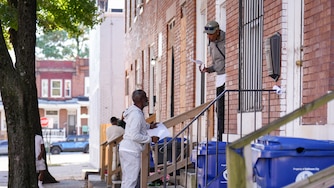
In a matter of minutes, workers popped off the vacant home’s graffiti-coated plywood and replaced it with a see-through material tougher than glass. A few quick blasts of the drill, and they sealed it shut.
This is clear boarding.
Other U.S. cities have been using near-impenetrable polycarbonate panels for years, but Baltimore officials are embracing them now as they address the vacant housing crisis with renewed urgency. City officials hope clear boarding will catch on and become the norm.
Baltimore is starting small, with just a few West Baltimore neighborhoods and a little more than 300 of the roughly 12,000 homes the city has identified as vacant. If all goes well, the use of the material could expand.
But as with all matters related to Baltimore’s vacant housing epidemic, nothing is simple. And everything has a cost.
Clear boards, each about a quarter-inch thick and about 10 times stronger than plate glass, are expensive — around three times as much as traditional materials. Due to legal limitations, the city is only boarding vacants it owns. And as city government is learning, many are illegally occupied.

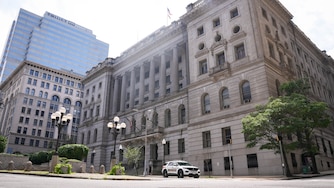
Clear boarding is a project of the Baltimore City Innovation Team, employees funded by Bloomberg Philanthropies and embedded in City Hall to help tackle vacant housing and other city challenges.
The Innovation Team has spent the last few years collecting data, meeting with neighborhood leaders and working to understand the root causes of Baltimore’s vacant housing epidemic.
Bloomberg contributed about $1 million that the city is using to support the project. About $500,000 of that has been spent on materials, tools and installation supplies.
Clear boarding can lessen fire risks by making it harder to break into homes, said Lorenna Smith, the Innovation Team’s project coordinator.
In a recent presentation to Carrollton Ridge community members, Smith said fire injuries and damage could be reduced if vacant homes were less accessible. And the clear boards might spur more action from the city as they offer a literal open window into homes’ dilapidated interior, she said.
The team is coordinating the clear boarding pilot, though the Baltimore City Fire Department, eager to prevent more deadly blazes, is formally taking the lead.

Deputy Fire Chief Khalilah N. Yancey said clear boards improve visibility for firefighters and may assist in earlier detection of smoke, flames or other unsafe conditions. It also provides better building ventilation.
Mayor Brandon Scott endorsed the project at a State of the City address in March, saying that while the number of vacants has declined, they still pose problems — including for the workers tasked with securing them.
Much of their efforts tend to be easily and immediately undone, Scott said.
That’s why clear boarding makes sense, Scott said, adding that it also “looks much better than plywood.”
The National Asset Management & Field Services, a trade association that works on behalf of mortgage companies, has endorsed clear boarding as a way to increase safety and protect property values. Unlike plywood, it does not “signal vacancy” to outsiders, and it’s more weather-resistant and cost-effective.

Preservation Maryland, a nonprofit that advocates for historic rehabilitation, also supports clear boarding, saying in a statement that it can prevent moisture, intrusion and rot.
Cities including Cleveland, Louisville and Mobile, Alabama, adopted clear boarding earlier. Terrance Smith, who leads the Bloomberg team, got his start in Mobile.
It quickly made a difference there, said Smith, and took about six weeks to put into practice. In Baltimore, it has taken about a year.

That’s because Baltimore is aesthetically different from Mobile, with its tightly packed, and highly flammable, older rowhouses. Then there’s the sheer volume and expense of them, unique to Baltimore compared with most other cities in the nation.
And, Smith said, the unauthorized occupants of the vacant homes often have complex needs that make evicting them difficult.
Some households might have children, Smith said, and accidentally set fires trying to keep them warm. Others might need addiction treatment.
“We have to be very careful about what does it mean to scale through the entire city,” he said, “because you are going to learn things that you did not know were happening inside of this city.”
If clear boarding crews come across occupants in a house, they pause the work and allow time for city agencies to try to find them new placements. So far, out of about 45 homes clear-boarded, the city has handled about three such cases, Smith said.
The Bloomberg team leaned on data and predictive analytics to decide which neighborhoods warranted prioritization for the pilot.
That meant combing through 311 requests, vacant building notices, fire records, utility bills and anecdotal evidence. Combined, it pointed them toward Carrollton Ridge, along with Harlem Park and Sandtown-Winchester, as the most likely to experience fires.

With each house boarded, workers are refining the process.
In Carrollton Ridge, for example, when some community members expressed concerns about limiting the boarding to first-level entry points, the Bloomberg group added second-floor windows.
They’ve also increased their outreach work after hearing from one neighbor who said she wished she had been looped in earlier about the goings-on next door. And they’re doing some extra work to the homes while they’re there, including removing debris from doorways.
The mayor, clad in a blue work uniform and gloves, joined the workers for one assignment in Northeast Baltimore on a boiling afternoon in April.

Some residents, while skeptical the pilot program would make much of a difference, said clear boarding might be worth a try.
Derwin Hannah, a longtime West Baltimore neighborhood advocate and newly elected president of the Carrollton Ridge Community Association, said he doubts the program’s cost is worth it — but that he’s not in a position to turn free resources away.
He said he wants to know what will happen to Carrollton Ridge long-term, and what other plans the city has to make it more habitable.
“The next question is,” Hannah said, “what is the next step?”



Comments
Welcome to The Banner's subscriber-only commenting community. Please review our community guidelines.