
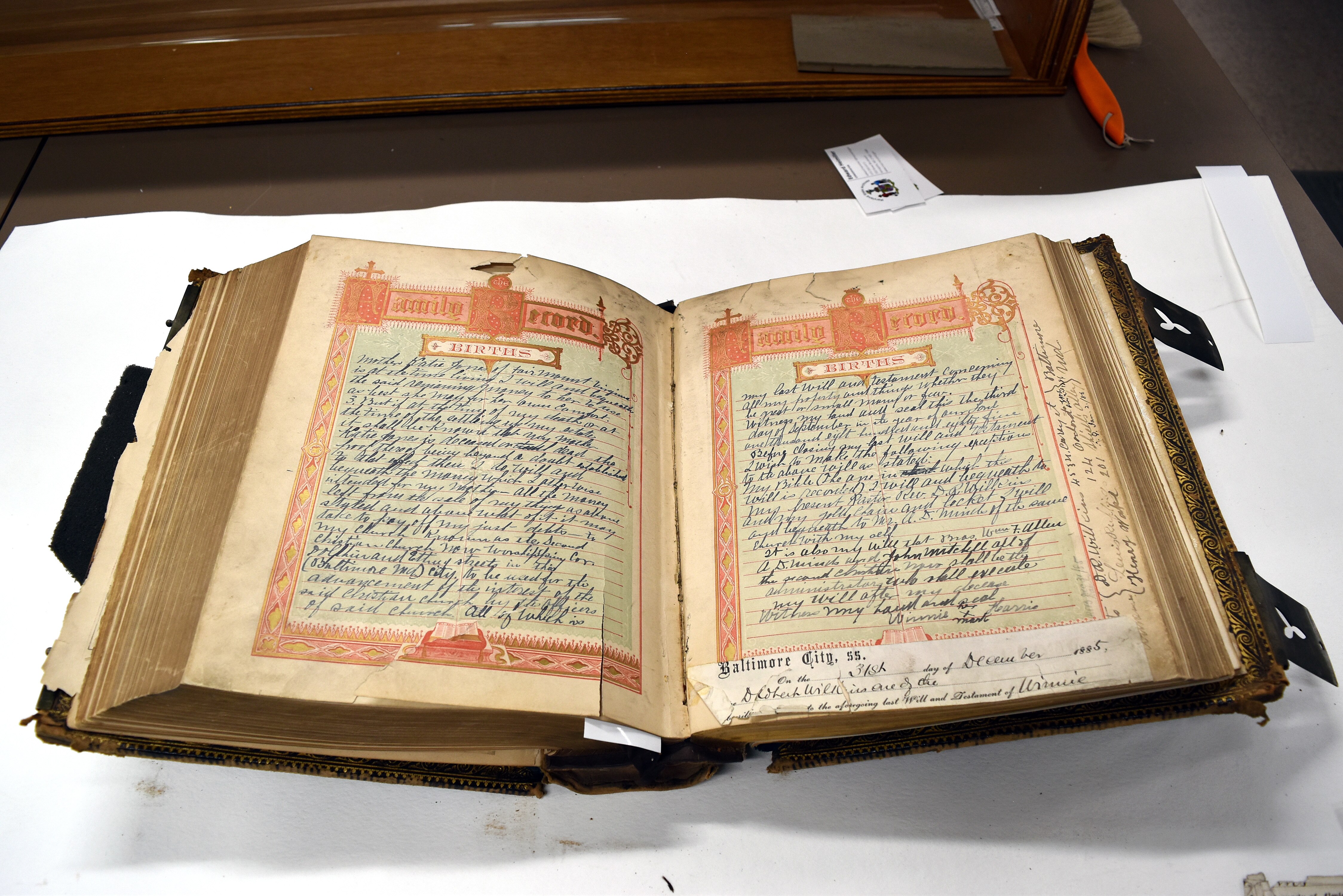
In September 1885, Winnie Harris wrote her last will and testament in the pages of a gilded, leather-bound Bible.
About 140 years later, that Bible, now an official government record, was rediscovered in a cardboard box in the Maryland State Archives in Annapolis.
“Things turn up in weird places,” said Edward Heimiller, a conservator with the archives.
The Harris will, discovered last year and made public by archivists for Black History Month, was admitted to probate in Baltimore in late December 1885, according to The Baltimore Sun.
But who was Winnie Harris? Today, her old Bible remains catalogued in the State Archives building with other books that have wills written inside. And the pages of her Bible provide insight into the lives of Black Marylanders shortly after emancipation — and hold rich potential for further research.
Read More
The gilded pages
The Harris family Bible appears to have been printed by a man named John Melia at 83 N. Howard St. in Baltimore. The pages are bound in a cover of thick paper, similar to cardboard, potentially with a wooden core inside, Heimiller said.
The front of the hefty book is covered in thin, dark leather gilded with gold leaf in intricate designs of Christ and other biblical figures. It can be held shut by silver-plated bronze clasps.
Inside, there are rich illustrations and maps depicting biblical scenes and locations.
And, though there were no written family records in the book’s pages, there were six photographs. They were not labeled, but researchers at the archives said they thought the photos were of Harris and her husband. One photo has traces of color.
Some pages have fallen out of the binding, and the cover is damaged.
Inside, between the Old and New Testaments, Winnie Harris wrote her will on pages usually reserved for family records, including births and deaths.


It was found by happenstance, said Rachel Frazier, the State Archives’ director of reference services. Someone was researching their own genealogical history and found the Bible in a cardboard box that held other unusual, original records of wills.
Such serendipitous discoveries of unorthodox but beautiful records deep in the archives happen occasionally, Frazier said.
“Even the boring-looking records can add context and richness to the human story,” she said.
But Frazier said the discovery of Harris’ Bible is “another level.”
”This is a truly beautiful Bible, with these really moving photographs,” she said. “It was a deeply touching discovery, because it’s so personal.”

Maryland has one of the oldest and largest state archives, Frazier said, in part because of the state’s age. (Founded in 1634, it became a state in April 1788).
The oldest record discovered in the Maryland State Archives is an entry from “Liber Z,” a record book kept by John Lewger, who was “Keeper of the Records” for Maryland during the colonial era.
It’s “a basic governmental record” describing the proceedings of a meeting, Frazier said, exceptional only because it dates to 1637.
Who was Winnie Harris?
William Kelly, a research archivist with the Legacy of Slavery in Maryland project, said Harris’ bible “offers more questions than answers.”
That makes it a “great launching point” for research, he said.

When Kelly talks to other people about how to research someone from history, he tells them to “start at the end.” In the case of Harris, researchers have access to her will and, they believe, a death certificate.
Her will was dated Sept. 3, 1885, and submitted to the probate court on Dec. 31. A death certificate for a married Black woman named Winnie Harris, dated Dec. 10, 1885, could be a match. Her cause of death is listed as “Cancer.”
The death certificate notes she was born in Virginia — and in her will Harris listed Katie Jones of West Virginia as her mother. (West Virginia wasn’t recognized as a state until 1863, which would have been after Harris, who was 40 at the time of her death, was born.)
She also was born before emancipation in Maryland — 1864.
“We don’t know if she’s born enslaved or born free. But she’s born into a nation where slavery still exists,” Kelly said. “One of the main points of chattel slavery is to erase identity and the lineage of enslaved people. That puts more weight on documents like this Bible.”

The details that Harris wrote in her will — including the names of her mother and her church — could offer more avenues for researchers. What’s written in the will, and snippets from the death certificate, also provide clues as to the kind of life Harris lived.
Such research is important, Kelly said, because it illustrates the human lives that make up the breadth of history.
“Not all Black history is enslaved history. [The Bible] sheds a light into Black life nearing the Gilded Age,” he said.
The photos of the man and woman who might be Harris and her husband were professionally made. There are two photos of the woman and four of the man; they are well dressed in all.
Her death certificate says Harris was a “servant,” and her will references her owning a sewing machine, which, along with her other belongings, she wanted sold to pay her debts and funeral expenses before providing for her mother.

The transcribed will, photographs and death certificate provide a glimpse into Harris’ life, Kelly said, and the Black working-class experience in Baltimore at the time.
“Winnie Harris touched this. She valued it so much that she wrote her last will and testament in there,” he said. “It brings home the human dimension of history.”
In her will, Harris said she was “considering the uncertainty of this mortal life,” perhaps referencing the cancer that ultimately killed her. Among her bequests was the Bible itself, which she wanted to go to the pastor of her church.
Because her will was written in the Bible, however, the book became a government record.
And, now that it has moved from a Baltimore court building to the State Archives in Annapolis, the state will preserve it for as long as it holds all its records.
In perpetuity.





Comments
Welcome to The Banner's subscriber-only commenting community. Please review our community guidelines.