
Kayla Hensley remembers watching the trial of a former Minneapolis Police officer charged in the death of George Floyd, turning to her husband and remarking, “This seems a lot like what happened to my dad.”
Twenty years ago, her father, Theodore Rosenberry, 35, died after Washington County sheriff’s deputies used a Taser to restrain him. But Maryland’s chief medical examiner office under Dr. David Fowler ruled his manner of death could not be determined.
Fowler’s testimony more than 15 years later that Floyd’s death should have also been ruled undetermined outraged medical professionals across the United States and caused them to question how his office handled cases in which people died in police custody.
In May 2025, Maryland Attorney General Anthony Brown at a news conference with Gov. Wes Moore released a report that found the deaths of 36 people at the hands of police should have been ruled homicides instead of undetermined or accidental. A likely reason, the audit concluded, was racial and pro-police bias.
Among them was Rosenberry.
“In that time, we didn’t question what the authorities said. We took everything at face value,” said Hensley, 34, a stay-at-home mother who lives in Clear Spring. “I hope that other families, whether they’re in this situation or others, if they feel that something is wrong, they investigate it more. They question it more.”

Moore directed Brown to work with state’s attorneys to determine whether cases should be reopened for investigation.
Publicly, not much has changed.
One year after the release of the audit sparked a reckoning over deaths in police custody in Maryland, no one has faced criminal charges in the mislabeled cases. And the medical examiner’s office has not changed any of its determinations.
The state defended its work in the year since the audit was released.
“Maryland is the first state in the country to undertake a review of this kind, and we are committed to doing it thoroughly and deliberately,” Aleithea Warmack, a spokesperson for the Maryland Office of the Attorney General, said in a statement.
“It is important to note that a manner-of-death classification of homicide does not automatically indicate criminal culpability,” she added. “It does mean that each case warrants careful, independent review, and that is exactly what the OAG is doing.”
Amanda Hils, a spokesperson for the Maryland Department of Health, said in a statement that the medical examiner’s office has not changed any of the death classifications because the attorney general is still reviewing the cases.
A comprehensive report is due at the end of this year, Hils said.
Cary Hansel, a civil rights attorney in Baltimore whose firm represents 12 of the families, expressed “grave disappointment” in what he called the state’s failure to bring closure or justice in these cases.
Hansel said his office has reached out on behalf of the families to put the state on notice about potential lawsuits but heard nothing.
”The state recognized its wrongdoing, promised to make things right and, a year later, has taken no steps in that direction,” Hansel said. “To us, it’s just appalling. And it begins to make the state’s work in this case look like a PR stunt.”

Questions over how the state handled deaths in police custody arose after Fowler testified as an expert for ex-Minneapolis Police Officer Derek Chauvin in the Floyd case. Chauvin pressed his knee into Floyd’s neck for more than nine minutes while the 46-year-old Black man was handcuffed and repeatedly cried out, “I can’t breathe.”
Fowler told jurors Floyd’s death should have been ruled undetermined because it was largely due to heart problems, with fentanyl and methamphetamine, and possibly car exhaust, as contributing factors.
After calls for a systematic review of Fowler’s work in Maryland, Jeff Kukucka, a Towson University professor and legal psychologist who specializes in wrongful convictions, oversaw a sweeping audit. He described its release as momentous, saying he hoped the findings would correct past injustices and prevent future ones.
“The death of George Floyd was obviously a tragic event,” he said. “But it begs the question of how many other George Floyds were out there that weren’t captured on cellphone camera, that didn’t get the same amount of scrutiny?”

He and other audit leaders were clear that their work was never meant to guarantee police officers are charged, but he is adamant the cases “should be looked at extremely carefully to see if anyone should be held responsible.”
“The families deserve to be kept up to date on the degree to which their loved one’s case is being reexamined and, in the event a decision is made in any direction, I think they deserve a very clear rationale for why that decision was made,” Kukucka said.
In interviews, family members recalled in vivid detail the shock of learning their loved ones died at the hands of police. Then, relatives said, there was the added insult of them not being ruled homicides.
Police officers in 2018 chased 19-year-old Anton Black in the tiny Eastern Shore town of Greensboro, stunned him with a Taser and restrained him face down on the ground for six minutes. Five years earlier, in Baltimore, a dozen police officers punched, pepper-sprayed and pinned 44-year-old Tyrone West to the ground — and after he’d given up, records show.
The medical examiner’s office ruled Black’s death accidental and West’s undetermined.
But the audit years later validated what their families always believed: Their loved ones were killed.
“We knew what happened. We’ve known it since day one. But we never felt like they would publicly acknowledge it. So that part was shocking,” said Black’s sister, Monique Sorrell. She described her brother as goofy, funny, athletic and family-oriented, saying his killing left relatives broken.
Sorrell said she hasn’t heard from authorities. Her initial hope that the report would lead to accountability is now fleeting.
“Am I doubtful at this point? I’m very doubtful. I feel like the system failed Anton. So I don’t expect much,” Sorrell said, adding that she’s “left it in God’s hands.”
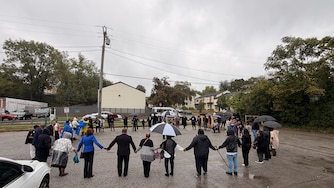
Tawanda Jones, who has held weekly protests since her brother’s death, said the audit gave her “so much hope” that an investigation, charges and prosecution would follow. But not having heard anything from authorities since its release brings back pain.
“It just feels like everything is a dog-and-pony show,” Jones said. “I’m not settling for nothing less than a thorough, true investigation.”

In Washington County, Hensley said her father went through rough times but showed up to school events and soccer games.
Rosenberry continued the proud family tradition of a career in corrections. He worked nights at the Maryland Correctional Training Center in Hagerstown, she said, and would leave notes for her that read, “Kayla, wake me up at 4 o’clock.”
He was a fan of the New York Yankees, she said, and enjoyed hunting and fishing. They bonded over their shared love of music, and her father would stop by the mall to pick up new CDs.
She now has two children of her own.
“I can’t imagine being at his age and leaving my children right now,” Hensley said. “He definitely was everything to me.”
She said she sees some of his characteristics in her 18-year-old son, Spencer. He and his sister, Reagan, 12, sometimes ask about their grandfather.
“I hope that the people who need to be held accountable are held accountable.”
Are you a family member or a loved one of someone who died in one of the cases under review? The Maryland Office of the Attorney General can be reached with questions at 833-282-0961 or OCMEAuditHotline@oag.maryland.gov.



Comments
Welcome to The Banner's subscriber-only commenting community. Please review our community guidelines.