
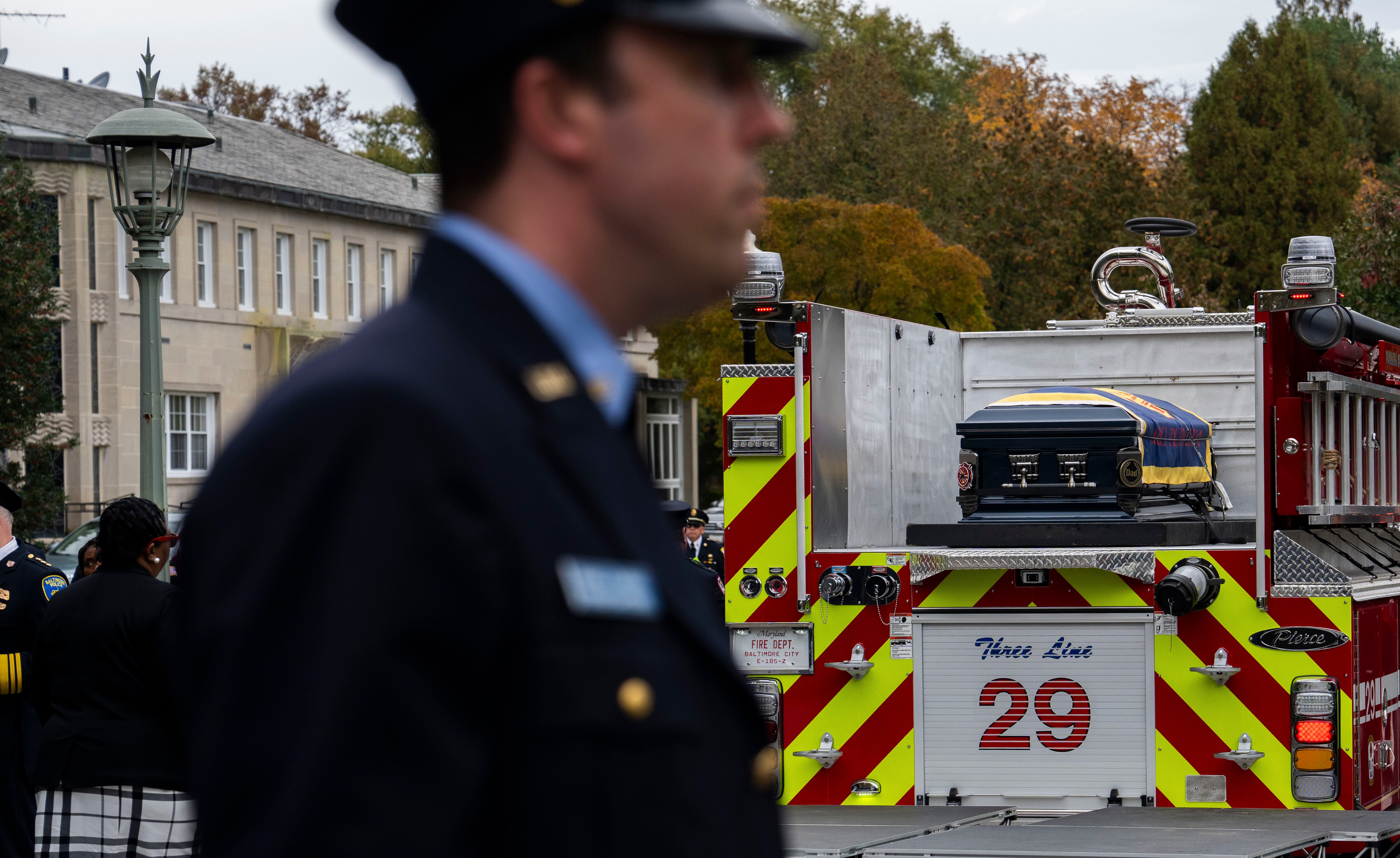
The Baltimore Fire Department was understaffed while relying on aging equipment and outdated training standards when two firefighters died in a blaze 2 1/2 years ago, according to an investigative report obtained by The Banner.
Acting Capt. Dillon Rinaldo, 26, and Firefighter/EMT Rodney Pitts III, 31, died fighting an October 2023 rowhouse fire in Northwest Baltimore on the 5200 block of Linden Heights Avenue. Their deaths marked a period of less than two years when the city Fire Department lost five firefighters battling blazes.
The Stricker Street fire took the lives of three firefighters in January 2022. A comprehensive report on what went wrong was released about 10 months after the deaths, prompting the resignation of then-Chief Niles Ford.
But the Linden Heights report has only been shared with family members and other stakeholders earlier this year.
“I think there were mistakes made and they won’t admit it,” said Dillon Rinaldo’s mother, Geraldine. “I don’t want any other moms to go through this.”
The 300-page report obtained by The Banner described a “catastrophic failure” of substandard equipment. It also found “basic job-related functions” were “severely lacking” in a department that was teaching outdated tactics in its academy. The report, which was dated Feb. 19 of this year, said the department had addressed the findings or was working toward fixes.
Geraldine Rinaldo said city fire officials came to visit her and her husband during the first week of March to share the report. Her husband, a fire chief in New Jersey, raised questions with them about what he believed were discrepancies in the report’s findings, she said.
The Banner asked the Fire Department on March 24 why the report has not been released. John Marsh, a department spokesman, replied, “Your media request has been received,” but did not respond to follow-up messages.
The Fire Department on Thursday denied a public records request for the report, saying it was not finalized.
The fire unions say they are in the dark.
“The only thing I can say for certain is that we have been patiently waiting for it, asking for it, and being told it’s coming,” Josh Fannon, president of the International Association of Firefighters Local 964, which represents supervisors, said of the report. “But the waiting game has been going on a long time.”
Matthew Coster, president of the International Association of Firefighters Local 734, said he was working with the Fire Department chief “to get more information on when the report will be out.”
Pitts’ mother did not return a request seeking comment.

A copy of the report reviewed by the Banner includes a cover letter from the department’s current chief, James Wallace.
Wallace wrote that an internal Board of Inquiry delved into the fatal fire, adding that its work was guided by a several key questions: “What can BCFD do better? How can we enhance our training, policies and procedures, communication, and operational readiness to prevent a tragedy like this from occurring again?”
In October 2025, the federal Bureau of Alcohol, Tobacco, Firearms and Explosives determined that the fire was accidental, though the cause could not be determined. The Maryland Occupational Safety and Health found no violation of laws or regulations.
Wallace’s internal inquiry board included members from the city’s Fire Department, as well as those from outside departments, who identified an array of problems as well as areas for improvement.
The report concluded that Rinaldo and Pitts were likely exposed to temperatures exceeding 1,000 degrees. Their entry through the building’s front door created ventilation that increased the temperature, the report states, but evidence shows the pair never turned on the hose as they advanced. A flow of water can cool gases and reduce the risk of a flashover, which is when all combustible materials ignite simultaneously.
The report notes that the firefighters were not trained on that technique.
“They were not exposed to or instructed on the tactic of flowing water while advancing to the seat of the fire necessary for the modern fire environment,” the report said.
Baltimore began training on such “flow-and-move” techniques in September 2024, the report said.
Career firefighters who were also on scene described the fire to investigators as uniquely hot. Some called the heat “paralyzing” and “unbearable,” while others said it was the “hottest fire of their lives,” according to the report.
That heat resulted in “multiple catastrophic failures” to Rinaldo and Pitts’ breathing equipment, with failures in their facepieces and breather lines. The chin strap attached to Pitts’ helmet was melted and his hood was “charred and embrittled.” The deterioration of Pitts’ breathing equipment harness made it harder to extract him from the fire, one firefighter told the board.

The report said the department’s breathing equipment was 12 years old and far behind current standards. The department was able to use American Rescue Plan Act funds to upgrade their equipment after the Linden Heights fire, and in July 2025, put into use the model compliant with 2018 standards, according to the report.
But the report said it was “critically important” to note that the equipment would “not have held up,” given the intensity of the blaze.
The air supply for both men was depleted within two minutes of the equipment failure, the report found.
Both firefighters were found near the front entrance of the home they entered, but the report showed it took critical moments to extricate them. Crews initially raised a ladder to the home’s second floor, believing Pitts and Rinaldo were upstairs.
Another firefighter reported seeing Pitts through the building’s front window. The glass was broken, but bars kept him inside. The firefighter used a tool to pry away the bars, but watched Pitts fall inside, the report said.
“I can’t get out,” Rinaldo said during one of his final radio transmissions.
The board found that the department should increase its minimum staffing when responding to fire calls to allow supervisors to maintain their roles instead of having to jump in to help fight the fire.
“The ability for Captain Rinaldo to make calculated decisions on the fire environment’s changing conditions while engaging in the early moments of the firefight on Linden Heights was delayed and inhibited by the fact that he had to perform several physical tasks and make several critical decisions at the same time,” the report said.
Rinaldo was a lieutenant serving as an acting captain on the day of the fatal fire as part of an overtime shift to save money for his upcoming wedding. He was posthumously promoted to captain.
Pitts, meanwhile, was a probationary member of the department who had worked fewer than 20 shifts in total. He’d never been involved in a fire of such magnitude, according to the report. A new policy issued in August 2024 said probationary members should ride as an extra member — and not a full-fledged member of the firefighting team — to gain experience.
Others on the scene also filled in for more senior positions due to staffing issues. And according to the report, they “did not perform at the highest level of proficiency for their positions.”
Thermal imaging cameras “were not utilized to their fullest potential and ability” during the initial response, the report noted, and “any new officer promoted or hired after 2013 has not received formal training in the department’s three types of thermal imaging cameras.”
Geraldine Rinaldo said her son loved being a firefighter — “He wanted to be a fireman since he could walk and talk” — and didn’t complain about the conditions city firefighters endured. But she said she was “disgusted” when he once gave her a tour of his firehouse.
“I want justice for these guys,” she said. “I want these guys coming in to have proper gear, and for the politicians to stop thinking of themselves and take care of that city.”
Banner reporter Emily Opilo contributed to this article.



Comments
Welcome to The Banner's subscriber-only commenting community. Please review our community guidelines.