
Atlantic Coast managers voted Wednesday to cut by over a third the catch limit on a foundational and long-debated fish in the Chesapeake Bay.
The decision by the Atlantic States Marine Fisheries Commission — which slashes the cap on the Atlantic menhaden harvest in the bay by about 34% by 2028 — represents a compromise between the positions championed by environmentalists and a Virginia-based industrial fishing company. The company’s union workforce accounts for the vast majority of Atlantic menhaden caught along the East Coast.
For decades, environmentalists and recreational fishermen have fought the industrial fishing operation, Reedville, Virginia-based Ocean Harvesters. Opponents say the company’s boats have depleted the bay’s population of Atlantic menhaden and starved other important species such as osprey and striped bass.
Wednesday’s decision marks just the third time the commission has revised the limit on menhaden in the Chesapeake Bay. The new rule effectively reduces the bay’s annual menhaden harvest from 51,000 metric tons to 33,847 metric tons by the 2028 season — amounting to about 22% of each year’s coastwide quota.
The new cap passed with votes from members of every state delegation except Virginia. The Potomac River Fisheries Commission also opposed the cap, while representatives of the U.S. Fish and Wildlife Service and National Oceanic and Atmospheric Administration abstained from the vote.
A proposal supported by Maryland representatives to delay the bulk of the Chesapeake harvest until the end of the season fell short.
Read More
Although environmentalists celebrated the new limit in the Chesapeake Bay catch, they expressed disappointment at the commission’s decision to opt for moderated cuts to the menhaden quota along the whole Atlantic Coast.
The board voted a day earlier to cut the entire Atlantic Coast catch limit by 9% in each of the next two seasons — a reduction environmentalists said fell well short of what is needed to maintain the coast’s ecosystems.
The decisions come as scientific understanding of how menhaden are faring in the Chesapeake remains thin.
Though recreational and pound-net fishermen have reported steep declines for the fish in the bay, scientists are unsure how much the trend is caused by industrial fishing boats versus warming waters from climate change.
Funding for a study of the industry’s impacts repeatedly stalled before Virginia lawmakers but was finally approved this year. Researchers expect to publish preliminary findings as soon as late 2027 — one reason industry backers urged regulators not to make dramatic cuts at Wednesday’s meeting.
“All this is opinion. It’s not based on science,” said Joseph Grist, head of the Virginia Marine Resources Commission and a Virginia representative on the Atlantic Fisheries Commission management board. Grist said hundreds of people attended a public feedback meeting in Northumberland County, the industrial fishery’s base, where many wondered how managers could impose such a severe cut without the science to back it up.
“I didn’t have an answer for them,” Grist said. “Because last I checked we did things by science on this board.”
Fisheries managers at first considered a 50% cut to the menhaden harvest in the bay. A bipartisan group of Maryland state lawmakers endorsed that cut in September, and the commission received more than 40,000 comments this fall supporting the more stringent limit.
To Maryland residents and watermen, the struggles of menhaden are obvious, and the fish’s decline has driven many pound-net fishermen out of the business, said Allison Colden, Maryland director for the Chesapeake Bay Foundation and one of the state’s delegates on the board.
“We have gone from 100 pound-netters to 10 pound-netters to now maybe two,” she told the board. “These economic impacts in Maryland have already happened.”

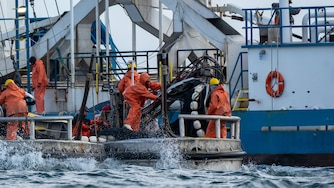
The Virginia port site employs about 260 workers at the last outpost of an industry that once spanned much of the Atlantic Coast. There, fishermen for Ocean Harvesters use spotter planes and huge purse seine nets to catch schools of menhaden. That practice is banned in all Atlantic states except Virginia, which gets three-quarters of the whole East Coast menhaden catch allocated by regulators.
Ocean Harvesters provides its catch to Canadian-owned Omega Protein, which processes menhaden into fish oil and fish meal.
Wednesday’s decision isn’t the first time regulators have capped the menhaden harvest in the Chesapeake.
Atlantic Coast regulators first imposed a 123,000 metric ton limit within the bay in 2006, a step that drew intense industry opposition at the time. The commission has lowered that cap twice since, to today’s 51,000 metric-ton ceiling.
What the new limit could mean for the industrial operation remains to be seen.
The fishery fleet has shrunk from more than 20 boats to six since the 1980s, and Kenny Pinkard, a spokesperson and former union leader for Ocean Harvesters, predicted last month that deeper cuts could spell the industry’s demise.
Pinkard opposed the compromise at Wednesday’s meeting, saying further limits on the catch within the Chesapeake Bay will amount to a pay cut for the union workforce in Reedville. For too long, workers with Ocean Harvesters and Omega Proteins have been the scapegoat for ecological problems in the bay, he said.
“If there’s no ospreys, it’s my workers — it’s Omega’s fault. If there’s no rockfish, it’s Omega’s fault. If a rooster doesn’t crow on the Eastern Shore, it’s Omega’s fault,” Pinkard said. “And that’s just how it’s been.”




Comments
Welcome to The Banner's subscriber-only commenting community. Please review our community guidelines.