
Join the huddle. Sign up here for Ravens updates in your inbox.
Over the last month, the Ravens have overhauled their coaching staff to a degree not seen since the earliest years of the franchise. They will open the 2026 season with a new head coach, three new coordinators and a mandate to stop showing up small in the biggest games. This is what we’ve learned about how the new coaches will try to create change.
Jesse Minter aims to take the Ravens back to the future
We heard it again and again, from former players on television, from AFC rivals, even from pillars of their own locker room. No one felt uncomfortable facing the Ravens in 2025.
This toothlessness manifested in their mediocre statistics, in their 3-6 record at M&T Bank Stadium, in their inability to secure crucial victories against the New England Patriots and Pittsburgh Steelers. A would-be Super Bowl favorite whimpered from the beginning of a lost season to the end.
Owner Steve Bisciotti knew it in his gut. That was why, even before the final missed field goal in Pittsburgh, he decided to fire John Harbaugh, his close friend and the best hire he ever made.
After an expansive search led by general manager Eric DeCosta and team president Sashi Brown, Bisciotti chose the most Ravensy replacement possible.
Read More
At age 42, Minter is 21 years younger than Harbaugh but hardly a babe in the woods by NFL standards. He coached under Harbaugh in Baltimore but made his coordinator bones elsewhere. Of all the first-time candidates on a busy coaching market, he came with the highest consensus approval rating. He offers dashes of risk and innovation atop a rock-solid foundation. He’s a well-struck iron down the middle of the fairway.
But, aside from affirming the Ravens’ enduring commitment to intelligence and stability, what does the choice of Minter tell us about where this franchise stands going into its 31st season in Baltimore?
It says the Ravens are trying to get back to something they lost.
“Our football identity — I would say — is physical, tough, relentless and together,” Minter said when asked to define himself as a coach. “There’s a physicality that comes along with that. There’s a mental and physical toughness that comes along with that. There are schematic things that come along with that.
“All the great coaches over time that have been here and that have led historical outputs on both sides of the ball, I think that all encompasses what it means to play like a Raven. And I’m really looking forward to building that with our team, creating our own identity in that regard and building on what’s been done here in the past.”

He’s too respectful to say the Ravens lost touch with that core identity in their last season under Harbaugh, but Minter would not be here if they had played tough, relentless, connected football throughout the 2025 season. They need to go back on the attack, to rediscover the blend of brutality and precision imbued into the franchise’s bones by Ray Lewis, Ed Reed, Terrell Suggs and many others.
Bisciotti and DeCosta are betting Minter, whose Michigan and Chargers defenses were on point, can recapture the foreboding aura that made M&T Bank Stadium a house of horrors for so many visitors.
If we needed proof that an elite defense can carry a team in the biggest game, the Seattle Seahawks, coached by Minter’s old Ravens colleague Mike Macdonald, just delivered it.
It’s fair to note that Minter’s introductory messaging could have been ripped straight from a Harbaugh TED Talk. Some fans worry the new coach shares too much DNA with the old, that he’s ill equipped to chart a fresh course.
But ridding the Castle of all things Harbaugh is not the goal. Minter’s old boss built an operation that won nearly 200 games over 18 years, staying largely on track through seismic personnel changes, unsettling scandals and the usual chaos of NFL life.
The point was never that Harbaugh’s regime had rotted to its core. The Ravens simply need pruning, a reimagining of what was already there, communicated by a coach who will seek new ways to connect.
The choice of Declan Doyle reflects Minter’s well-considered boldness
There were more known quantities available to Minter as he considered his most important hire. He’ll handle the defense, but he needed a partner who could match his imagination on the other side of the ball and pull the best from the Ravens’ most important player, quarterback Lamar Jackson.
It’s great to talk about reclaiming the legacy of Lewis, Reed and Suggs, but even the team’s most important defenders freely acknowledge their Super Bowl ambitions begin and end with Jackson.
So, yes, Minter could have tabbed Kliff Kingsbury or some other offensive coordinator with a track record of rolling up yards and points. No one would have blinked.
Instead, he picked a guy who has never called plays in the NFL or for a college powerhouse, an offensive architect who’s not even a full year older than the quarterback who will operate his system.
We don’t know what a Declan Doyle offense will be. No one does, though we can guess based on his work translating Ben Johnson’s plans into action for the Chicago Bears.

What we know is Minter trusted his own judgment enough to choose a relatively unproven coach with whom he was not previously connected. He’s operating boldly, just what you want to see from a new leader stepping in for an 18-year institution.
In his statement accompanying the hire, Minter praised Doyle’s “innovative mindset, collaborative spirit, team-first approach and extensive NFL experience.”
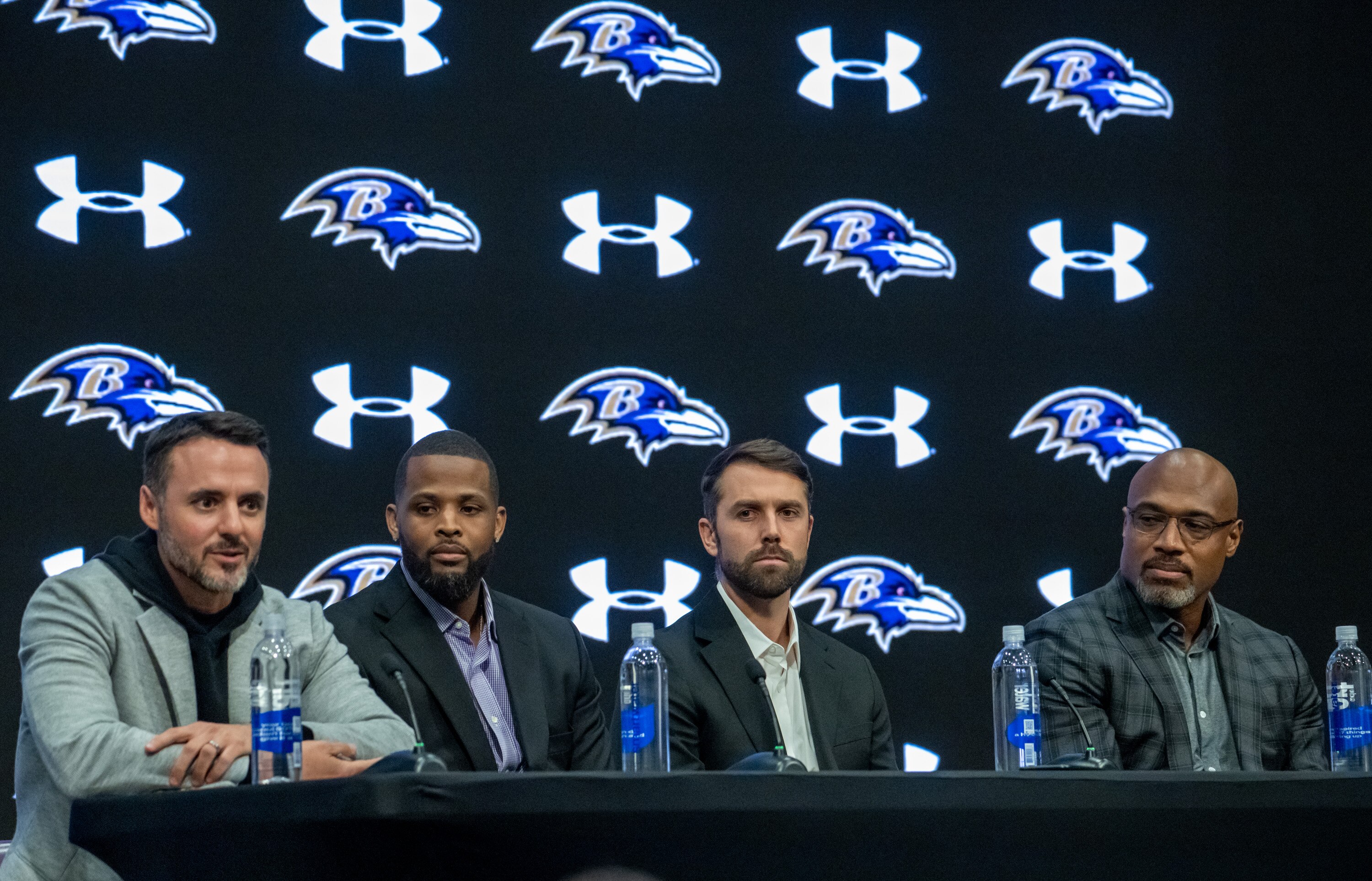
“We see football the same way,” he said Wednesday at a news conference introducing the team’s new coordinators.
“He was looking for someone like him on the offensive side of the ball,” Doyle said, speaking with conviction and answering questions in detail throughout his debut encounter with Baltimore reporters.
Ever since Sean McVay showed that 31 isn’t too young, the NFL has veered toward fetishizing youth for youth’s sake, especially among offensive coaches. But Minter’s words hinted at a key point about Doyle. Though his birthdate screams wunderkind, he’s rooted in some of the league’s essential coaching trees (most notably Kyle Shanahan’s and Sean Payton’s).
Fans have reason to dream big, given Jackson’s past successes with new coordinators. He won Most Valuable Player honors in his initial forays with both Greg Roman and Todd Monken. Will Doyle, who seems likely to lean on some of the same zone runs and presnap deceptions that worked for his predecessors, find a similar spark with the franchise quarterback?
He has talked about relying less on Jackson’s improvisational genius — the second act of the play, as Doyle calls it.
“That first play can be more consistent sometimes with his eyes and with his footwork,” he said, indicating he plans to coach the two-time MVP hard.
Minter believes he has found someone who can help Jackson unlock the final door to greatness; the Doyle hire sets up as one of the first major tests of his judgment.
It will be Minter’s defense, but you can’t go wrong getting Anthony Weaver back in the building
Minter plans to call the defense, just as Macdonald does in Seattle. As he noted, to operate otherwise would be to squander one of the greatest talents he brings to the Ravens.
Thus, his hunt for a defensive coordinator felt less weighty than his search for an offensive visionary. That said, the reunion with Weaver, a fellow finalist for the job Minter won, shows real wisdom.
As the Ravens aim for a return to defensive excellence, their schemes and teaching methods will flow from Minter. He’ll have the final say on game day, an exciting prospect given what we saw from him in Los Angeles. But, with his new breadth of responsibility, he’ll need an outstanding communicator to help implement his vision during training camp and weekly practices.
When asked what he’d want from his coordinators, he said: “I’m looking for leaders and connectors and relationship builders and schematic expertise, but, most importantly, guys that the players believe in. [Coaches] that are willing to dive deep and build really strong relationships with the players.”
He might as well have said, “I’m looking for Anthony Weaver.”

“He’s a leader. He’s a connector. He’s a relationship builder,” Minter said Wednesday. “I don’t think anybody could get more out of our guys than him.”
If there’s a knock against Weaver, it’s that the defenses he coordinated in Miami and Houston did not impress statistically. Critics said his schemes were overly fussy to the point of becoming muddled.
That won’t be a problem with the Ravens.
They know how good Weaver is at teaching young players, earning trust throughout the locker room, communicating a bigger vision to reporters and fans. He’s going to be some team’s head coach in the next few years, and it makes all the sense in the world to leverage his leadership skills while he’s available to support Minter.
Weaver acknowledged his disappointment at not getting a head coaching job but described his return to Baltimore as “hardly a consolation prize.”
He and Minter talked frankly about their dynamic, about what it would be like for Weaver to take on a role that outside observers might see as a demotion from his play-calling job in Miami. Weaver aspires to win a Super Bowl and draw the best from a new generation of defenders. “I don’t need to be a head coach to do that,” he said.
His warmth and humility in answering the question hinted at why he’ll make the perfect deputy. Minter could not ask for a more qualified conduit to his defenders.
Every move toward reform was tempered by a nod to experience
It’s exciting, but also risky, to hand your MVP quarterback’s future to a 29-year-old with scant experience at significant parts of his job. How did Minter mitigate that risk? By pairing Doyle with Dwayne Ledford, a seasoned offensive line coach and run designer from Atlanta, and Joe Lombardi, Payton’s former offensive coordinator (and Doyle’s former boss) in Denver.
We can see the care this first-time head coach put into building his staff, checking distinct boxes with each hire and covering potential weaknesses with complementary strengths.
Minter saw two puzzles, one offensive and one defensive.
“Declan has his experiences and where he’s been. We want him to be surrounded by people that can help him do the job at the highest level,” he said. “So there’s a few that he’s worked with prior. There’s a few that maybe I have history with. And there’s different levels of experience, different levels of guys who have maybe been play-callers, passing game coordinators, all those different types of things that can really help support a younger, newer play-caller, that I felt like maybe I had when I was coming up in that type of position.”
On the other side of the ball, he was looking for “teachers, connectors, fundamentalists.” That might mean Weaver, who called an NFL defense last year, or it might mean secondary coach Mike Mickens, widely acclaimed for his work shaping rising defensive backs at Notre Dame.
“It really was irrelevant of pro experience, college experience, years of experience,” Minter said.
Harbaugh’s tenure taught us many lessons; one was the importance of staff composition. His best teams tended to benefit from deep, adaptable coaching talent. When the Ravens struggled, by contrast, an uninspired coordinator choice or subpar player development often contributed.
Some of Minter’s staff choices will work. Some probably won’t. What we can say is that this son of a coach — he joked that his dad, Rick, was his easiest Ravens hire — has thought deeply about how all the pieces fit.

Now the ball is in Lamar Jackson’s court
We can spend the next seven months shouting Minter’s praises, speculating on how he and his staff will change the product we see on the field in September. It’s going to be a fascinating year for anyone who cares about Baltimore football.
But none of it will amount to anything if DeCosta cannot address fatal flaws in a roster that fell short in 2025. And that will be difficult to do if the Ravens don’t move to reduce Jackson’s $74.5 million salary cap hit.
Bisciotti said as much when asked about Jackson’s future as franchise centerpiece: “The urgency of that matters to me because we’ve got free agents, and I don’t want to go into free agency with that hanging over our head. And I made that clear to Lamar, and I think he was very appreciative of my stance, and hopefully willing to work with Eric and not get this thing dragged out into April like it was the last time. It was very hard for [DeCosta] to build a roster when that thing is not settled.”
The Ravens have about three weeks to negotiate an extension with Jackson that would likely resemble the deal he signed in 2023 and make him the highest-paid player in the league (until the next franchise quarterback signs). If they can’t, Bisciotti said, they will have to restructure his contract, pushing money into void years to reduce his immediate cap hit.
Every other move they will make, including a down-to-the-wire attempt to keep Pro Bowl center Tyler Linderbaum, depends on Jackson.
Minter has spoken as sunnily as possible of his quarterback, calling Jackson the best player in the league and saying they’ve had “wonderful conversations.”
None of that guarantees Jackson will feel great urgency to negotiate on the Ravens’ desired timeline. Though he has said he wants to be in Baltimore, he keeps his own counsel and was in no mood to discuss specifics of his (or the team’s) future after last season crashed to a disappointing end.
Did Jackson want this coaching teardown? We might never know. What we do know is the Ravens executed it in hopes of getting the most from their quarterback’s remaining prime.
Now it’s Jackson’s turn, not just in contract negotiations but when we get to May and June — time to get back in the building and master Doyle’s revamped offense (the young coordinator made it clear Wednesday that he’ll hope to have all hands on deck for those initial sessions). For all of this to work, the Ravens need Jackson to be all in.



Comments
Welcome to The Banner's subscriber-only commenting community. Please review our community guidelines.