
Join the huddle. Sign up here for Ravens updates in your inbox.
In Week 1, the Ravens looked like a Super Bowl contender. In Week 2, they looked more like the team that got Jesse Minter hired as coach.
Welcome back to September football, a world of small sample sizes and premature proclamations, where not even Minter knows for sure whether the Ravens are closer to the team that crushed the Indianapolis Colts in their season opener, or to the team that crumbled at home Sunday against the New Orleans Saints.
“I have said this a bunch — in reality, it is your identity as a player [that] needs to show up in those crunch-time situations,” Minter said Monday.
Some Ravens have fared better than expected. Others have fared worse. As the team prepares for Sunday’s game in Rio de Janeiro against the Dallas Cowboys, here’s a look at three players with notable starts to the season.
C Jovaughn Gwyn
Start with the good: Gwyn’s ground game work has been impressive through two games. His run blocking grade on Pro Football Focus is second among qualifying centers, and he doesn’t have a “blown block” on 49 run plays, according to Sports Info Solutions.
And now for the bad: Gwyn’s pass blocking has been a liability. He has allowed five pressures on 73 drop-backs, second most on the team, behind only rookie right guard Vega Ioane (six), according to PFF. Gwyn’s pass blocking efficiency on what the site defines as “true pass sets” — plays excluding three or fewer pass rushers, play-action, screens, short drop-backs and a time to throw of under two seconds — is the second-worst among qualifying centers. Only the Carolina Panthers’ Luke Fortner has more blown pass blocks at the position.
Gwyn entered the season with just 11 career offensive snaps and no starts, and that inexperience has shown. In Week 1, a holding penalty on a play-action drop-back cost Ravens rookie wide receiver Ja’Kobi Lane a goal-line touchdown. Three plays later, a communication breakdown led to an unblocked Colts pass rusher barreling between Gwyn and left guard John Simpson, spoiling a fourth-and-goal drop-back. Jackson negated another quick loss with a Houdini-esque escape that turned into an explosive scramble.
On Sunday, the Saints tested Gwyn with “A” gap blitzes (between the center and guard), most often when the threat of a run appeared. It’s unclear whether the Ravens’ breakdowns were due to the structure of the play or the presnap communication, but Saints inside linebackers Kaden Elliss and Pete Werner combined for seven pressures, according to PFF. Maybe Gwyn’s most costly mistake came on a second-and-18 drop-back late in the third quarter, when his indecisiveness on a double-A-gap blitz pickup handcuffed running back Derrick Henry as well, leading to an 8-yard sack.
What’s next? When Minter named Gwyn the Ravens’ starter two weeks ago, he called it a “Week 1 decision, not necessarily a permanent decision.” With Danny Pinter (knee) lost for the season, longtime Cleveland Browns starter Ethan Pocic is Gwyn’s top competition for snaps. The 31-year-old’s recovery from the Achilles tendon tear he suffered in December limited him in training camp and the preseason, but his physical and mental comfort should improve every week.
The Ravens’ next two games will test Gwyn’s ability — and perhaps offensive line coach Dwayne Ledford’s patience. Cowboys star defensive lineman Quinnen Williams has gotten off to a slow start, but he has game-wrecking potential. And in Week 4, the Ravens will have to contend with Tennessee Titans defensive tackle Jeffery Simmons, an All-Pro with nine pressures this season, the most at the position.
ILB Trenton Simpson
Simpson entered his fourth and perhaps final season in Baltimore in a tenuous spot. Not only was he ostensibly a placeholder for Teddye Buchanan, who’s still working his way back from the torn ACL he suffered at the end of an impressive rookie season, but there were also questions about what Simpson’s starting role would even entail. How much playing time would he get if the Ravens leaned less on nickel personnel (typically two inside linebackers and five defensive backs) and more on dime personnel (typically one inside linebacker and six defensive backs)?
Through two weeks, Simpson has played only about 60% of the Ravens’ defensive snaps (74 of 122 overall). But when he has played, he’s played well.
“I think Trenton is playing like one of our best players right now,” Minter said Monday. “He is playing really fast and decisively. He is playing with a ton of physicality. He is seeing things and going and playing very downhill, which is great to see. So, I don’t think he has done anything to say, ‘We need to take this guy off the field.’”
Simpson’s best work has come when he’s on the attack. He has three pressures, including a quarterback hit, on just nine pass rush snaps, according to PFF. He was one of the Ravens’ most efficient pass rushers last season, too, when he had 12 pressures on 48 pass rush snaps.
But Simpson has impressed elsewhere. He finished second on the team Sunday with three run stops — tackles that constitute a “failure” for the offense, according to PFF — including a play in which he shoved Saints right tackle Taliese Fuaga (listed weight: 325 pounds) aside at the line of scrimmage on a 2-yard gain. And Simpson’s rarely looked out of place in his 25 coverage snaps, making an impact as a screen defender with his sideline-to-sideline speed.
What’s next? Buchanan has appeared in every practice over the team’s first two weeks, but never as a full participant. When he is cleared for games, he could need an acclimation period to get up to game speed. Even then, there’s no guarantee that he would be more reliable or productive than Simpson. The starting role could be Simpson’s for longer than just September.
Whether Simpson could have a bigger role on game day is also unclear. His snap share rose only slightly from Week 1 (59.3%) to Week 2 (61.8%), and dime personnel gives Minter more flexibility in his coverage choices. But Simpson gives the Ravens a pass rush presence that almost every Ravens defensive back lacks. He can also credibly line up as an off-ball linebacker and an edge rusher, as well as a slot defender in some scenarios.
“We will have to figure out, make sure we have our best guys on the field for any given situation,” Minter said, “but major kudos to Trenton Simpson and how he is playing right now.”
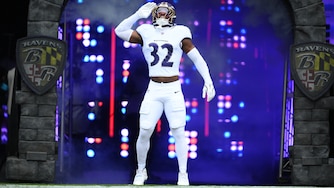
S Malaki Starks
The Ravens’ safety room was one of the team’s most impressive in training camp. Starks and Jaylinn Hawkins’ downfield coverage rarely invited deep targets. The starting pass defense was almost always well organized. And Kyle Hamilton, widely believed to be the NFL’s best safety, said early in camp that he “wouldn’t be surprised” if Starks made the leap to greatness.
“I don’t see a reason why he cannot be the best at his position in our league,” Hamilton said. “He has all the talent, all the mentality, just the approach to the game.”
But through two games, Starks has been arguably the Ravens’ biggest disappointment. Only 10 safeties with at least 50 defensive snaps this season have graded out worse on PFF.
In Week 1, Colts wide receiver Josh Downs separated easily from Starks in man coverage on an in-breaker he took for 25 yards on Indianapolis’ opening drive. In the third quarter, Starks was a half-step late to his run fit and couldn’t get a hand on running back Jonathan Taylor during an 18-yard gain. On a 21-yard run later in the quarter, Taylor stiff-armed Starks to the ground at the second level.
On Sunday, he had more troubles in space. There was a missed tackle on a 12-yard catch-and-run by Saints wide receiver Chris Olave and another miss — one of several — on a 25-yarder by tight end Juwan Johnson. Kick returner Barion Brown also raced by Starks on a 53-yard return that set up a field goal near the end of the first half.
In coverage, Starks was involved in the breakdown that led to New Orleans’ first fourth-quarter touchdown. As Olave and wide receiver Devaughn Vele ran a “scissors” concept — Olave, on the outside, broke for the post route, just as Vele, in the slot, broke for a corner route — Starks and cornerback Marlon Humphrey both drifted toward Vele. That left Olave wide open for a 21-yard touchdown.
“I have a lot of confidence in the guys that we have,” Minter said Monday. “Again, take this moment, take this opportunity: ‘OK, how can I do better on this play, this play, this play?’ I have a lot of confidence in Malaki Starks, and so I am confident that he will bounce back and be the type of player that I know he can.”
What’s next? Starks started slowly last year before ending his rookie campaign as one of PFF’s highest-rated safeties over the second half of the season. His job’s not in any danger; bumps were expected as Minter implemented his defense. Hawkins struggled mightily Sunday, too. Neither played a snap during the preseason.
But with Starks’ relatively modest athletic profile, he has less margin for error with his technique and his mental processing. In Los Angeles, Minter’s Chargers defenses impressed not only with how many check-downs they forced, but also how well they tackled in space. Starks had his ups and downs finishing off plays at Georgia and in his rookie year in Baltimore. The Ravens will need improvement there, even if he continues to keep downfield passing attacks at bay.



Comments
Welcome to The Banner's subscriber-only commenting community. Please review our community guidelines.