
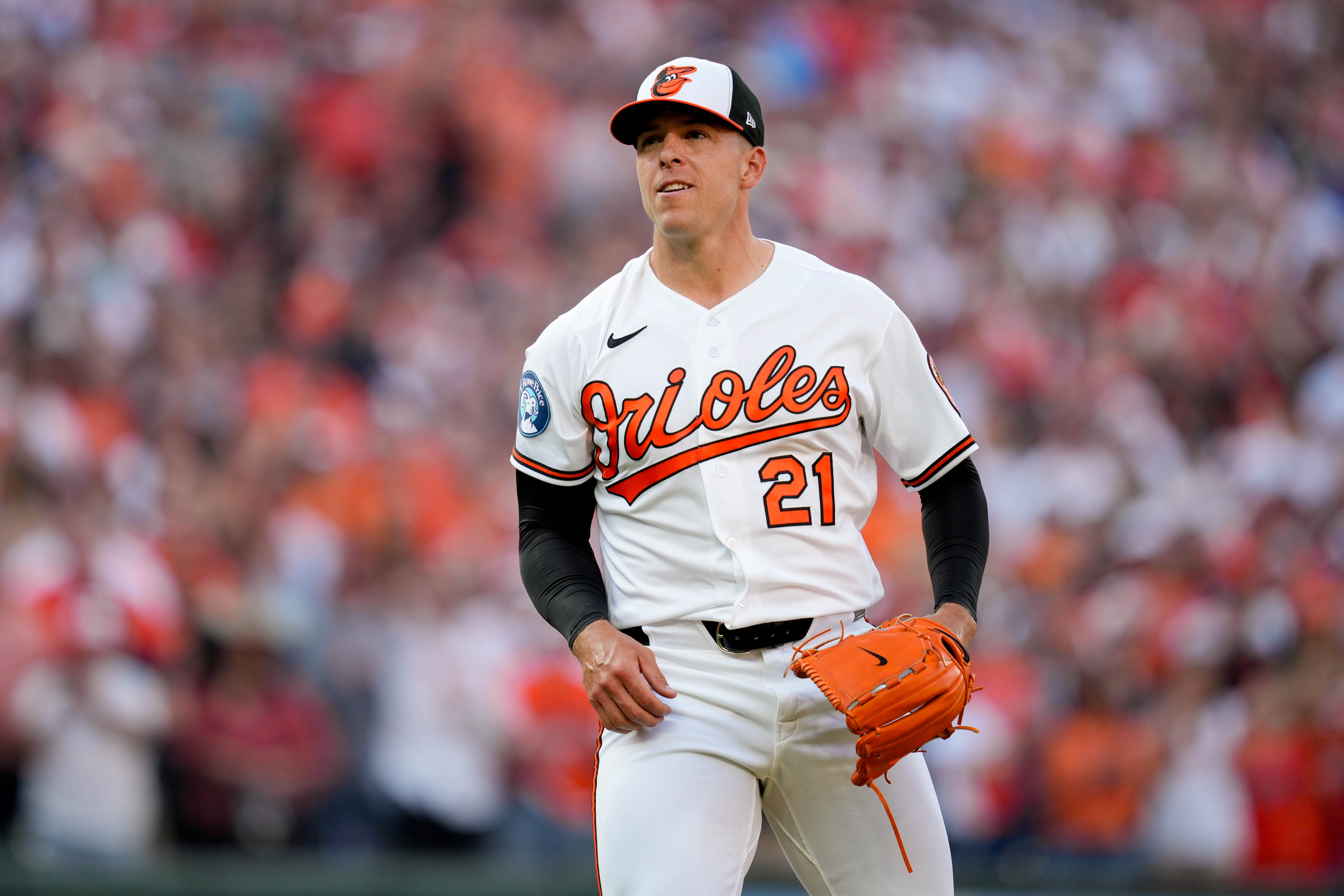
So frequently during the second half of last season, Ryan Helsley found himself huddled in the analytics room, looking for an answer to a question that made no sense. He couldn’t figure it out. Nor could the pitching coaches with the New York Mets.
The thing is, Helsley felt fine. His pitch shapes and velocity, in his mind, were good. And, beyond a pitch-tipping situation that he resolved by changing his setup prior to delivery, the right-handed reliever was at a loss for why his results were so poor.
“It was bad, looking at it from an up-in-the-sky point of view,” Helsley said of his second half with the Mets.
He joined ahead of the trade deadline from the St. Louis Cardinals and was expected to be a lockdown force in the bullpen. Instead, Helsley produced a 7.20 ERA in New York.
“But, if you dig a little deeper, there was some good in there,” Helsley said. “And overall I felt good and felt like my stuff, on paper, was too good to be having the second half that I did.”
He had the second half he did, however, and this winter Helsley was charged with analyzing what happened and how he could fix it. He lives in Tulsa, Oklahoma, and he works out at nearby Oral Roberts University. He doesn’t use a specific offseason pitching coach, as many hurlers do. Instead, Helsley bounced ideas off friends and former coaches, and when the Orioles called him, they agreed almost immediately on what he could bring.
Read More
The takeaway from those conversations was Helsley shouldn’t “reinvent the wheel,” he said. But there were adjustments. Orioles pitching coach Drew French called it “a tiny turn of a screw here and there.”
With all of his bolts tightened, Helsley hasn’t necessarily been lights out. But the Orioles and Helsley feel the head-scratching results that left him searching for answers in New York are behind him.
“It can be hard when you’re struggling and it’s such a hostile situation like that, and you want to contribute to the team’s winning, and you’re throwing these high-leverage situations,” Helsley said.
The feedback from president of baseball operations Mike Elias, French and pitching strategy coach Ryan Klimek this winter, even before Helsley signed with Baltimore, helped renew his internal belief. And manager Craig Albernaz named Helsley the team’s closer in December, leaving no doubt the Orioles trusted him.
“They had a lot of great things to say and kind of reinforced how I felt and positively thinking about my stuff overall and the results,” Helsley said. “There’s so much out of your control in this game, and if you just focus on results, it’s going to be tough and you’re going to have a miserable time out there, because at some point you’re going to blow games and have bad outings. It’s just part of it.”
Those blown games occurred soon after Helsley arrived in New York, but he prefers to look more closely at predictive statistics that prove the synopsis of Mets pitching coaches: bad luck.
Expected ERA takes into account the amount of contact and the quality of contact against a pitcher to remove the randomness of defense behind him. Helsley’s expected ERA for the Mets was 4.40, according to FanGraphs, which is about three runs better than his actual numbers.
His FIP (fielding independent pitching, which only counts outcomes a pitcher can control: walks, hit batters, homers and strikeouts) was 5.19, which isn’t great but was two runs better than his ERA. He maintained his velocity, and his horizontal and vertical break was roughly the same as it always had been.
“I tried to stay positive and believe in myself and use the coaching staff there in New York,” Helsley said. “They did a good job and dug deep and couldn’t really find an answer for it in the moment. Just a ‘keep trusting your stuff’ kind of thing.”
That led Helsley into the winter looking to strengthen his strengths: a four-seam fastball that can reach triple digits and a slider that misses bats. But he also worked on a splitter, and with the Orioles the development of that pitch became a larger focus.

Helsley said the splitter will help him most against left-handed batters. While the rest of his repertoire largely runs in on a lefty, the splitter can skirt away off the plate.
“You’ve seen the split with Helsley. It’s a very real option for him,” French said. “The split is a potential wipeout pitch. This guy is not only a 100-mph arm. He’s a really, really good mover, a guy who controls the running game, and he kind of compartmentalizes everything you want the closer to be.”
And, after moving the starting position of his hands, Helsley feels he has ruled out any pitch-tipping issues. He used to begin his windup with his glove and right hand about a foot from his body. Now he tucks both against his chest, which blocks the view of any keen eyes attempting to determine which pitch is coming.
Helsley said the new hand position feels “almost second nature now.”
The Orioles needed a trusted back-end arm as right-hander Félix Bautista recovers from shoulder surgery. It’s unlikely Bautista will return this season, so the onus is on Helsley to handle close games in pressure situations.
So far, he has done well. He allowed a run in back-to-back outings, which included a walk-off loss to the Pittsburgh Pirates. But Helsley has four saves, and while the contact against him has often been hard, he hasn’t buckled with runners on base.
And when he does — because the life of a closer will surely feature a tough break — last year’s struggles in New York only strengthened his resolve.
“You don’t pitch as long as he has and have the success he has had by just hanging, living and dying by results,” Albernaz said.





Comments
Welcome to The Banner's subscriber-only commenting community. Please review our community guidelines.