
Join the dugout. Sign up here for Orioles updates in your inbox.
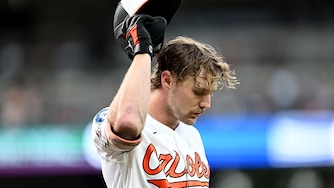
It was the second game of the season. The Orioles went on to lose to the Minnesota Twins. And Gunnar Henderson, who struck out three times and was hit by a pitch once, wound up slamming his bat in the dirt after he stranded the bases loaded in the sixth inning with a casual fly ball to right field.
Even then, at that early juncture, the self-applied pressure on Henderson seemed to take its toll.
Fast-forward to the end of the season, and the final statistics would be respectable for most shortstops. Henderson, however, is not supposed to be most shortstops — he was the American League Rookie of the Year in 2023 and an All-Star in 2024 who earned MVP votes.
Henderson will remain a centerpiece of Baltimore’s roster, but what he learned during this disappointing year for the Orioles and himself individually relates back to that moment in the second game of the season.
“A lot of it was — well, some of it was — probably a little bit of doing too much in certain situations,” Henderson said. “Just not allowing myself to take over, and then me trying to force stuff to happen.”
Baseball is hard enough as it is, and a wrist injury that nagged Henderson for half the season probably didn’t help matters, either.
Four scouts from opposing organizations who spent time this season observing the Orioles largely agreed with Henderson’s self-assessment. One said that it appeared as though Henderson tried to hit a five-run home run at times — an impossibility, to be clear — and that the Orioles’ volatility trickled into his own game.
Another wondered if Henderson’s wrist injury, which he played through, may have led to decreased success against four-seam fastballs and a reduction of his all-fields power. The third noted his usual athleticism that carries his game reduced, especially at the plate, into more of a robotic swing. And the fourth said his career-high chase rate was an issue.
All of them posited that the early ramp-up for the World Baseball Classic — and, subsequently, not playing much with Team USA — may have adversely affected Henderson, as well as other players. Losing spring training repetitions can’t be discounted.
He hit a career-worst .169 against four-seam fastballs, and his .232 average against all fastball types (including sinkers and cutters) was also the lowest of his career. Henderson’s pull-side fly ball percentage, meanwhile, was the highest of his career at 22.8%.
In 2024, when he produced an .893 on-base-plus-slugging percentage, those numbers were vastly different. He demolished fastballs to the tune of a .275 average, and he hit far fewer pull-side fly balls (14.9%, the lowest of any full season in his career). Of Henderson’s 37 homers that year, plenty of them were to right field. But even the deep left-field wall at Camden Yards couldn’t contain his power the opposite way.
In 2026, though, Henderson pulled 23 of his 24 homers to right field. The other was to straightaway center.
That coincides with a decline in several batting metrics that tend to lead to positive results. Between 2024 and 2026, Henderson managed 3.6 fewer mph on his average exit velocity, and his bat speed through the zone was 2.1 mph slower this year than two seasons ago.
Henderson’s chase rate rose to a career-high 30.4%, which means he swung at almost one-third of pitches that were outside the strike zone (although his chase rate improved as the season went on). In 2024, his chase rate was 23.2%.
“Broad strokes,” the fourth scout said, “he’s become a worse decision maker while also hitting it less hard.”
But beyond the statistics and analytics, the third scout, who has watched Henderson since he entered pro ball, said, “I’ve seen Gunnar always play with his pants on fire,” and yet, this season, it appeared as though he was weighed down at times.
That’s an observation manager Craig Albernaz seemed to allude to during the final series of the season.
“For Gunnar, it’s knowing that, especially with Pete [Alonso] now and being around Pete, Gunnar doesn’t have to shoulder the load,” he said.
Albernaz said Henderson is at his best when he plays with a certain freedom in the field and on the bases, while also focusing on an all-fields approach with the bat.
“He doesn’t have to be the sole guy taking on all the weight,” Albernaz said. “... When our team is functioning on all levels, everyone shoulders the weight, and I think Gunnar’s in a spot now where he understands that.”
Henderson will take a beat before fully delving into his season. But once he analyzes it — although he’s done plenty of studying during the year, too — perhaps the most noticeable aspect was the absence of an all-fields hitting approach. And with it came a decline in production, from his .893 OPS in 2024 to .712 in 2026.
“A couple games here and there, I’ve shown it’s still in there,” Henderson said. “It’s not a matter of it just disappearing one day. It’s just the game. Obviously, the pitchers are getting paid, too, and they’re getting paid to make adjustments to you and get you out. So, I feel like they did a really good job of making adjustments, and I just didn’t make the adjustments I needed this year.”
Henderson noted the back half of his season improved. He found more holes as the year went on. Luck may have turned his way, but he also switched from a traditional bat knob to an axe-handle bat, which he said helped his wrist.
From the depths of a .590 OPS in July, Henderson recorded an .824 mark in August and a .731 OPS in September. That, at the very least, creates positive momentum heading into the offseason.
Another hard-to-measure aspect of Henderson’s struggles may rest with a revolving door of hitting coaches. The Orioles have rolled through coaches in that area since 2022; he has dealt with seven different hitting instructors in those five seasons.
Henderson admitted that can be a complicating factor, because there’s an acclimation period between player and coach to consider. With Henderson gone for much of spring training while playing at the WBC, he had less time in low-stress settings to work with Brady North and Dustin Lind.
During the season, the coaches have about a dozen other hitters who need their time, Henderson said, and it’s challenging to do exhaustive work in the cage and then go play a game.
“It’s hard to make big-time adjustments when you’re in the middle of a game, or before a game, and go up there and face 98 and 99 every night,” he said. “It’s really hard to do that during the season.”
There will be more time for that this offseason and in spring training, whenever that may arrive, given the threat of a lockout. Perhaps that will help fix some of this.
Because no matter what the Orioles do this winter, he will be a key part of it. In fact, anything close to the 2024 version of Henderson might’ve been the difference between October baseball and the early 2026 conclusion.




Comments
Welcome to The Banner's subscriber-only commenting community. Please review our community guidelines.