
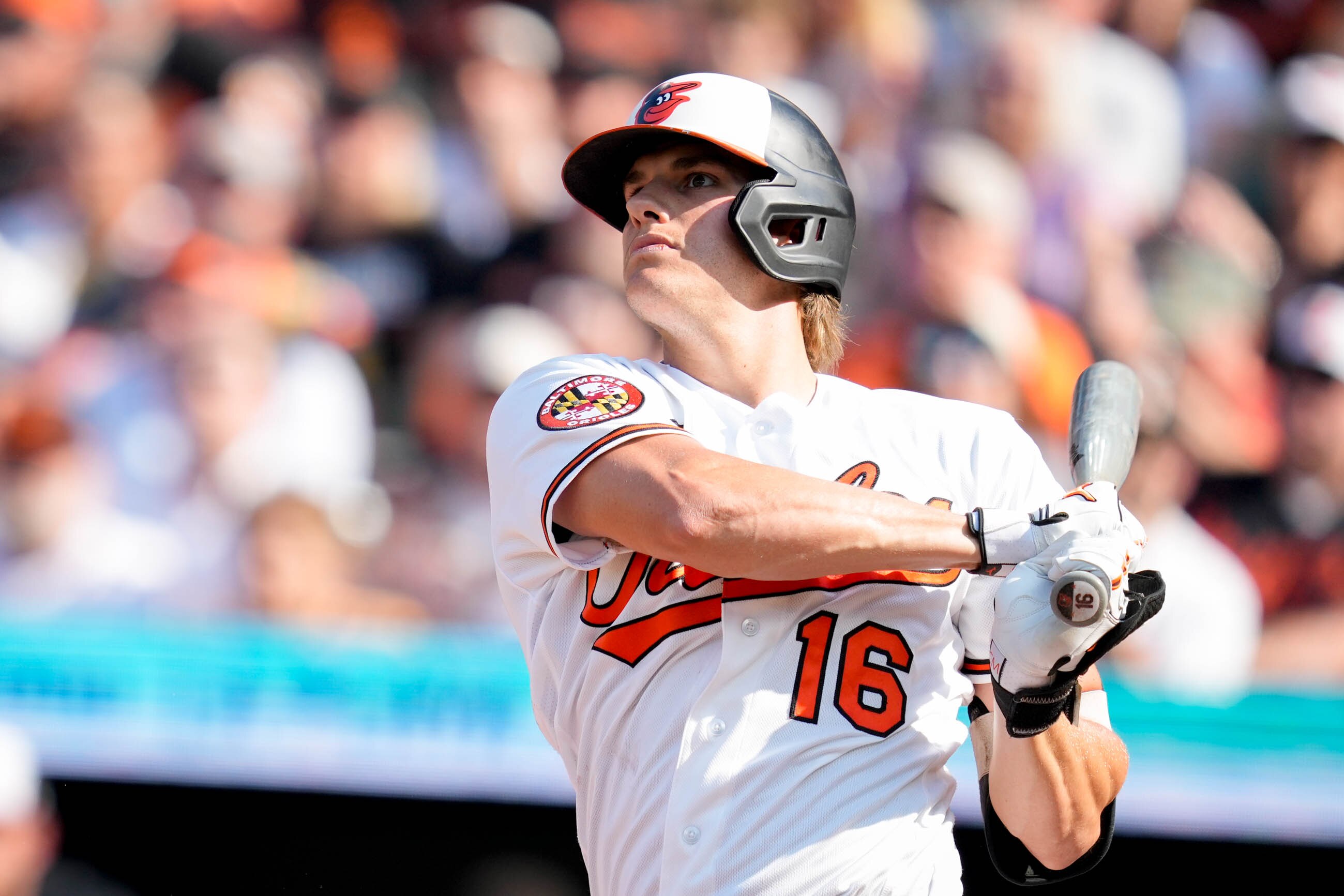
At TBT Training in Boca Raton, Florida, over the winter, Coby Mayo wanted to be fooled.
The Orioles third baseman wanted to see pitches with the craziest spins possible so that, when he returned to the majors, the junk that is so deceptively thrown here wouldn’t seem so bad.
He and his trainers ramped up the speed on a pitching machine, and using baseball-size foam balls, they imitated the sliders and curveballs and changeups at their most extreme movement profiles.
“That was the first time I really went into the offseason and grinded like that with off-speed,” said Mayo, who is etching a role as Baltimore’s everyday third baseman in Jordan Westburg’s stead. “This was the first offseason I really pulled out the machine and we really used that to our advantage and tried to see every shape possible, because during the season you don’t know what these guys are going to start throwing, and I just want to be ready for everything.”
When Mayo said he wanted to be ready for everything, he was talking about pitch shapes. He may as well have been talking about his entire baseball future.
The winter was full of uncertainty. The main consideration was whether he would even play for the Orioles or if he’d be involved in a trade. He spent the beginning of the offseason focused mainly on first base, which is where the Orioles shifted him last season. But then the Pete Alonso signing — and, later, Westburg’s injury — prompted Mayo to move back to third base.
Read More
He pushed all of that aside and tried to focus on one certainty: The breaking balls he saw in the majors were much more imposing than those in the minors. That’s not to say minor league pitchers aren’t deceptive. But, at the major league level, the command is much more precise.
“Guys in the big leagues, they can throw that 0-0 slider in the zone,” Mayo said. “They can throw 0-1 sliders, ball to strike or on the corner. And then, two strikes, everything is going to be strike to ball, strike to ball, strike to ball.”
That might have been the most difficult adjustment for Mayo in his limited time with the Orioles in 2024 and 2025. The 24-year-old whiffed on 43.8% of the breaking balls he swung at in 2025. In 2024, which was a smaller sample, his breaking ball whiff rate was 57.1%.
There was an attack plan against Mayo that many young players experience. In 0-2 and 1-2 counts — the most favorable for pitchers — Mayo saw a breaking ball more than half the time.
“It’s why it’s tough getting down early in the count and getting to two strikes,” Mayo said. “We’re all good enough hitters to hit with two strikes, but you can look at the analytics with 0-2 counts or 0-1 counts and your average, OPS, everything goes down drastically.”

Still, Mayo came through twice Sunday in two-strike counts. His first knock in the series finale was a blooper that landed down the left field line for a double. He managed to hit the up-and-in fastball because he recognized the slider that came before it and fouled the away pitch off.
And, in the seventh, Mayo recognized the spin early in an 0-2 count so he could clobber a high fastball for a run-scoring single.
“Even his ground ball out, I believe it was 105 [mph] off the bat, so he’s squaring balls up,” manager Craig Albernaz said.
Part of the benefit that comes from Mayo’s frequent off-speed training is that he may whiff less frequently against those pitches. Perhaps more importantly, if Mayo picks up the spin more quickly, he won’t even swing at those pitches. He’ll force a pitcher to attack with a fastball — a pitch he can do particular damage against.
Throughout the spring and into the season, Albernaz emphasized the phrase “day one.” He hopes his players form a mentality to challenge themselves, “that every day they show up, it’s day one. You can’t worry about the past. Learn your lesson, leave the event.”
The same goes for the future, “because in this game, if you worry about the future, you’re going to drive yourself nuts,” Albernaz said.
Mayo would understand that better than almost anyone on this team. His winter could have been filled with self-doubt or concern over where he might end up. Instead, the high-spin drills that occupied much of his time in the cages filled his mind.
Because of that focus, Mayo entered this season ready to hold down third base when an unforeseen injury occurred.
“He has a great opportunity ahead of him,” president of baseball operations Mike Elias said, “and I think he’s ready.”




Comments
Welcome to The Banner's subscriber-only commenting community. Please review our community guidelines.