
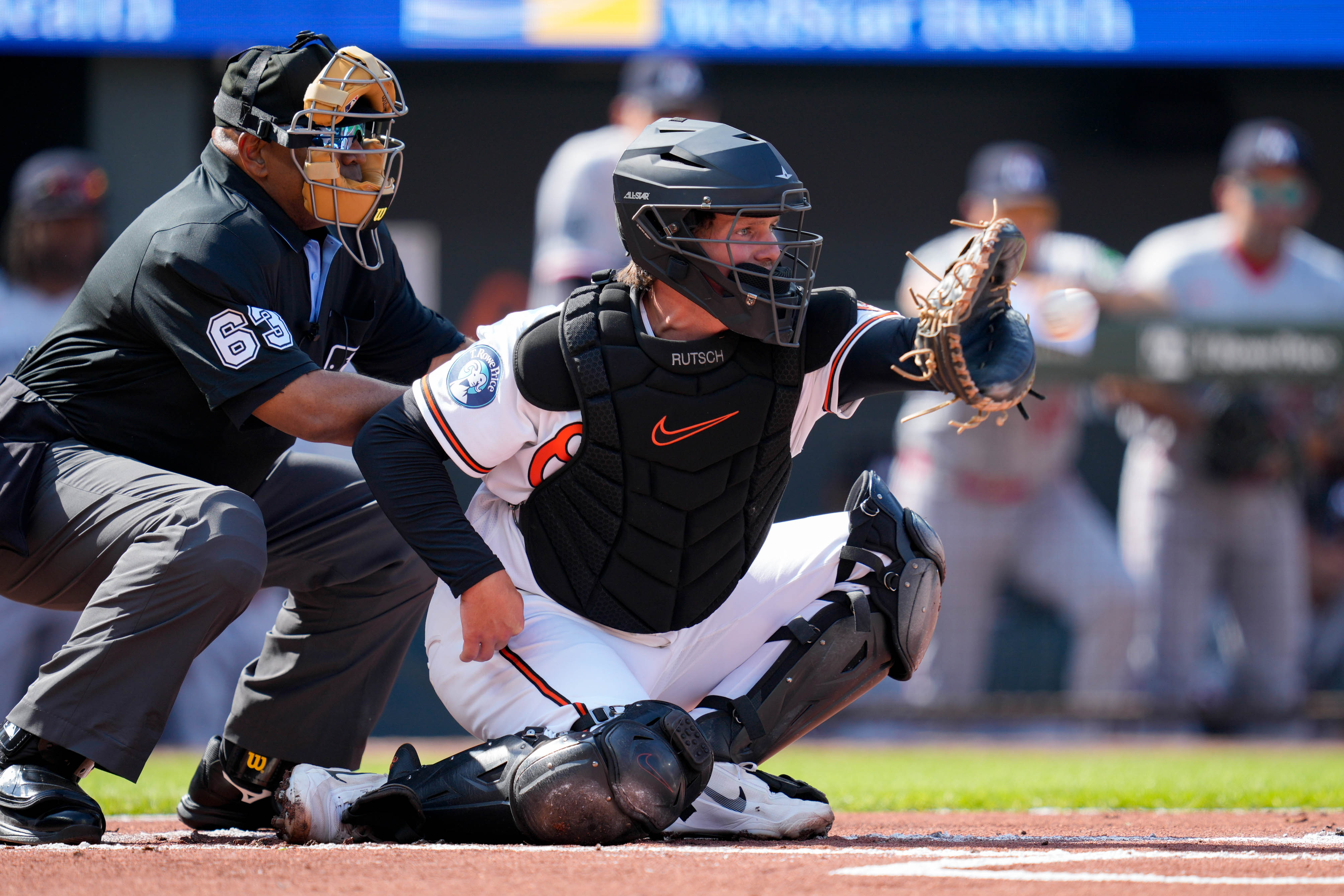
The subtle art of catching begins before the pitcher ever releases the ball. It’s a shimmy from Adley Rutschman, a turn of the hips to prepare for the impending pitch. It’s the knee down — the right knee this year after years with his left knee in the dirt — and an upright posture, creating a large target for the pitcher.
For Rutschman, a defensive whiz even when he was drafted first overall in 2019, the process of perfecting his receiving and blocking has spanned years. The search will never end.
“Just trial and error,” he said.
Rutschman’s latest look might be his best yet, though. With the help of manager Craig Albernaz and catching coach Joe Singley, Rutschman spent the spring trying different setups — specifically which knee to have in the dirt.
“Off the right knee I’ve been able to present the ball better,” Rutschman said. And the early metrics on his catching show he is finding success to rival his rookie season, when he he was one of the best pitch framers and blockers in baseball.
Two oblique injuries likely played a role, but Rutschman’s defensive metrics regressed last year. He was closer to league average in blocking and framing than ever before. But, after a spring of analyzing how Rutschman should set up behind the plate, Albernaz, Singley and the catcher settled on his right knee being in the dirt for the first time ever.
He’s seeing immediate progress. Rutschman once more looks like a premier backstop.
“Setup is massive,” Singley said. “It’s what gives you a chance. And he’s worked on it a lot in spring training and here, and ultimately the goal there is just to keep balls in the box and be in a position to react, with the main goal in mind of preventing runs all across the board and keeping the pitcher in the strike zone.”
Rutschman’s evolution behind the plate has been interesting to watch. When he arrived in Baltimore in 2022, he used a traditional catching setup. He crouched, knees bent, cleats the only things touching the dirt.
His mobility in that stance was strong, and that’s one of the possible benefits of maintaining a traditional setup. Rutschman recorded 18 blocks above average, according to Statcast, which was in the top 1% of catchers.
But, in 2023 and beyond, Rutschman shifted to various iterations of a left-knee-down setup. In some, his right leg kicked out to the side. Occasionally, he compacted himself with his non-dirt knee close to his frame. It all worked at varying degrees — he has never been a below-average pitch framer or blocker — but he wasn’t as exceptional as his first year.
So why’d Rutschman ever change?

Catcher is the most physically taxing position in baseball. One of the benefits of a knee-down setup is it takes pressure off both knees compared to crouching for 100 or more pitches a day. To ensure Rutschman’s long-term health, a knee down may sacrifice one or two blocks, but if it keeps him on the field, it would be worth it.
Rutschman’s injuries last year likely hurt his mobility and his swing. He finished 2025 with a career-low 2 blocks above average, although his framing metrics were favorable. This year, Albernaz has been intentional in building days off into Rutschman’s schedule.
He referenced overlapping with catcher Buster Posey with the San Francisco Giants in 2021. In hindsight, Albernaz said, Posey wished he had taken more days off.
“He’d play five in a row and then he played first, and then five in a row, and then his body just crashed on him,” Albernaz said. “That’s something, just being very cognizant of with Adley. He’s feeling great, in a great spot. We’re going to find spots to push him, but early in the year, to me, it’s not the right time with the position he plays.”
The knee-down setup may help with that, but there are other benefits to it. Albernaz, a catcher by trade, said, “pitch framing, it starts with the setup.”
And so far, with Rutschman’s new setup, the metrics are great. He’s in the 98th percentile for framing and the 69th percentile in blocking. Some of his blocks recently have come in massive moments, such as a pick and throw to first Wednesday to end an inning on a dropped third strike.
“You want to make sure that your body is in the right spot, in the right place to leverage the pitch, and I think that’s what gets lost in the knee-down setup,” Albernaz said. “People think you just go knee down, you’re automatically going to get the low pitch. But to me you have to be anchored to the ground, have a good, strong base, even though you have a knee down, and that allows your top half, your posture, to be in the right spot.”
Albernaz took this writer’s notebook and drew home plate. He pointed to the angled portion, then drew another line matching it on each side of the plate.
“You want to make sure you’re keeping strikes as strikes,” Albernaz said, and the catcher’s setup is critical in that. For a pitch away from a right-handed batter, for example, the catcher will want to turn his hips and shoulders slightly to match the angle of the outside of the plate. In doing so, the catcher can catch the ball between his shoulder blades, which makes it easier for an umpire to recognize the pitch as a strike.

“What your glove does and your body does before the pitch is the art of pitch framing. It’s not after the pitch,” Albernaz said. “The post-catch move, if it’s big and rigid and slow, that’s where you don’t get the calls or keep strikes strikes. You want to make sure the way your glove is working with the ball flight.”
Rutschman agreed in that pitch framing has more to do with accurately presenting a strike as a strike than it does in stealing a strike on a pitch outside the zone. The introduction of the automatic ball-strike challenge system may result in that outside strike call being overturned anyway. But, if Rutschman does his job correctly, the umpire should recognize a strike as a strike.
A misnomer of the knee-down catching setup is that it’s worse for blocking. Rutschman said it’s really a case-by-case basis.
“Everyone’s body is different and constructed in a different way, and that’s why you play around with it and find stuff that works,” Rutschman said.
What works about having one knee on the ground at the major league level may not work for a high schooler, though. Singley and Rutschman are often asked by up-and-coming catchers whether they should use a knee-down or crouch stance, and the answer isn’t so simple.
“You see a lot of guys knee down here, because they can move off a knee,” Singley said. But not every catcher is that agile. “For kids, especially when I’m asked or teach, I say, ‘What position can you get into that you can react the best out of?’ If something is hindering you, then don’t do it.”
Added Rutschman: “I have the fortunate aspect of catching big league pitchers, and I kind of know their misses a little bit more and I’m getting less spray. The balls in the dirt are usually a little bit easier to handle. Whereas, even in college and high school, you get guys throwing all over the place and there are passed balls left and right. If I’m on a knee [in high school], well, my framing is better but I’m also giving up six wild pitches a game.”
In one sense, Albernaz said, with the body being lower in a knee-down stance, catchers have a fraction of a second longer to decide whether they can catch the ball or must drop to both knees to block it. That can help blocking and framing.
The timing is also important. If crouching, a late break to block a ball might result in a worse block.
“If you’re still moving when the ball hits you, it doesn’t deaden the ball,” Albernaz said. “It’s going to carom more.”
A catcher has only a second in which to decide all of those things. The prepitch setup, then, makes or breaks his success. Rutschman has tinkered with the way he sets up over the years, and he probably will continue to tinker the rest of his career.
But this current iteration of his setup, with his right knee in the dirt, leads him to looking once more like the Rutschman long known for his defensive prowess.



Comments
Welcome to The Banner's subscriber-only commenting community. Please review our community guidelines.