
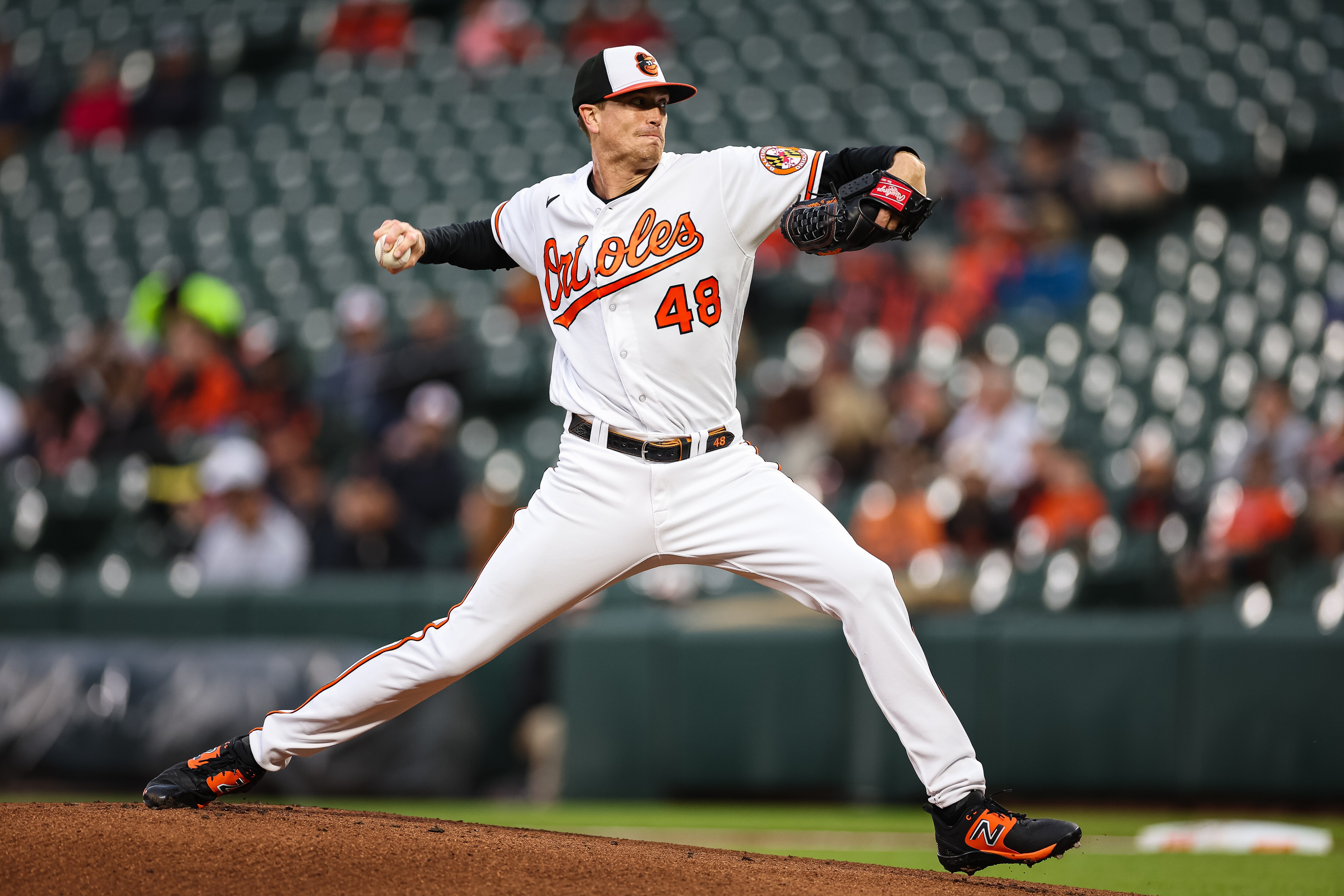
After all this time, it was an odd sight to see an Orioles starting pitcher spin around on the mound, searching the rain-dreary sky for the flight of a hard-hit ball.
Kyle Gibson didn’t have to do it through the first six innings of his start Saturday. Nor did Tyler Wells before him, or Dean Kremer and Kyle Bradish on consecutive nights earlier in the week. Through Grayson Rodriguez’s final four innings Sunday, he didn’t experience the feeling of watching a ball land where no fielder can reach it, either.
All things must pass, however, so Gibson turned and craned his neck as he watched the Detroit Tigers finally put an end to Baltimore’s 30-inning starting pitching scoreless streak. It came in the seventh inning, in the form of a drive from Zach McKinstry that just snuck over the right-center field wall.
Before that swing, Gibson had retired 18 of the last 19 Tigers batters he faced. He matched his career high with 11 strikeouts. He continued what has become a trend for these Orioles starting pitchers, because momentum is a difficult psychological barrier to overcome for any hitter in the box looking to solve a puzzle their brethren haven’t cracked either.
McKinstry may have ended the shutout streak, but it was only a dent in Baltimore’s 5-1 victory. The Orioles (13-7) have now won nine of their last 11 games and secured their fourth straight series win.
“I said it from Day One in spring training, the talent here is incredible,” catcher James McCann said. “The chemistry from the young guys that have been together is very apparent from the moment you walk into the clubhouse. And now they’re learning how to win, and win together. You see, every night’s a different guy.”
They’ve won because of their pitching, a statement that might’ve seemed hard to believe at the beginning of the season, when only two pitchers lasted six innings or more throughout the first nine games. But beginning with Sunday’s outing in Chicago, when Rodriguez closed his outing with four scoreless innings, he jumpstarted this stretch that has included strikeout poses from Yennier Cano and an inning-ending back-pedal from Bryan Baker.
The confidence is showing through from this staff. And even with a few breakthroughs from the Tigers, Baltimore’s pitching staff has allowed just two runs in its last 44 innings.
“Just baseball,” manager Brandon Hyde said. “We’re going to have good moments, and not-so-good moments, and good starts, and not-so-good starts. And right now, we’ve been rolling off some really good starts, and the bullpen has been pitching just absolutely outstanding.”
Gibson struggled in the first inning, allowing a single from Javier Báez and then walking two batters. He threw just 11 strikes among his 24 first-inning pitches, but Gibson stranded the bases loaded and returned to blow through Detroit’s order for six innings.
When McCann visited Gibson on the mound during the first inning, he told his fellow veteran to throw the ball through his glove, not at his glove. For lack of a better word, McCann said some of Gibson’s pitches were “dying” when they reached the plate.
Between innings, McCann and Gibson huddled again in the dugout. The right-hander noted some mechanical adjustments he’d make, such as finding more comfort out of the stretch when forced out of his full windup. McCann recalibrated their course of attack. And between them, they set the stage for a strong bounce-back.
“Every inning’s a different inning,” Gibson said. “I came in after the first, looked at my report and that’s where I find my confidence, that’s where my preparation kind of locks me in, and you kind of figure out what pitches you’re supposed to throw the next hitter. Like, that first inning, if I give up three or give up zero, it’s over already. If I’m sitting there harping on the first inning, then I’m not going to be able to go out and do what I want to do in the second inning.”
In that second inning, Gibson struck out the side on 13 pitches.
He allowed just two hits — Báez’s first-inning knock and McKinstry’s homer on Gibson’s 96th and final offering — before leaving in the seventh inning. That allowed Cano to enter and do what he has done since arriving last week as a call-up to help a taxed bullpen.
He struck out three batters, struck his poses and continued a streak in which he has retired all 17 batters he’s faced thus far. Cano became the first Oriole pitcher to retire that many batters to begin a season since Fred Holdsworth retired 24 straight batters in 1976.
“He’s nasty,” McCann said of Cano. “It’s pretty simple: He’s nasty.”
Almost lost in this all was the offensive support that enabled the pitching staff to work with room for error — as if they had any need for it. Adley Rutschman’s RBI single in the third scored Gunnar Henderson before Ramón Urías stepped in with two outs and the bases loaded.
Urías, who was later ejected by home plate umpire Vic Carapazza, cleared the bases with a one swing, blasting a double off the right-field fence. Hyde said the three-run double “pumped me up” while the ejection — which Hyde said was for an equipment violation for Urías tossing his helmet and bat — “bummed me out” and surprised him. And for good measure, McCann clobbered his first home run for the Orioles in the fourth.
That lead was more than what Gibson required, even if he finally saw the scoreless streak end. He maintained a run of form that is only gathering speed, and no offense has found out how to press the brakes yet.



Comments
Welcome to The Banner's subscriber-only commenting community. Please review our community guidelines.