
Chris Davis wasn’t going anywhere.
All of his teammates from the Orioles’ turnaround in the 2010s under Buck Showalter were gone, as were the manager, the front office and everything else about that era when the Orioles turned the reins of the franchise over to Mike Elias in 2018.
But the once-feared slugger, who earned his seven-year, $161 million contract in 2016 with a monstrous four-plus seasons as an Oriole, was here to stay. He’d fallen off badly and had years left on that deal. No other team wanted him.
Much of what happened in the ensuing years under Elias felt like a direct response to Davis’s presence — the contract that kept him here, sure, but also the dysfunction and siloed organizational structure that defined that time.
That doesn’t make Davis any less worthy of this weekend’s induction into the Orioles Hall of Fame alongside Storm Davis and Jim Russo. He was an undisputed star and a foundational piece of some of the best Orioles teams this century.
His induction, though, does come at a unique time. All the organizational synergy, data-driven decision-making and thoughtful long-term roster management that were meant to deliver the Orioles the sustained success that never came last decade have over the last two years lost much promise.
Read More
The Hall of Fame weekend will take place as a disappointing Orioles team — still in the playoff picture thanks to the American League’s broader mediocrity — is playing its final series before Elias has to pick a path for the Aug. 3 trade deadline.
I doubt anyone could have predicted they’d be honoring a man whose re-signing with the team in 2016 marked the beginning of the end for its last competitive window at a time when the rebuild spawned in response to its collapse is now in such peril.
But here we are.
This weekend, though, is about remembering the best of Davis. He was acquired in 2011 and broke out for a surprising Orioles club that ended an extended playoff drought in 2012 with 33 home runs and an .827 OPS.
The club didn’t reach the postseason the next year, but Davis had an epic offensive season, with 53 home runs and a 1.004 OPS. He failed to re-create that performance in 2014 and, though the Orioles were improbable division champs, they had to navigate the playoffs without him because he was suspended for violating MLB’s drug policy. In 2015, Davis hit 47 home runs with a .923 OPS thanks to a second-half tear that led him into free agency on a high note.

The Orioles, as we know, were preparing to let Davis walk. Dan Duquette was running baseball operations and told Davis’s agent, Scott Boras, about a prospect named Trey Mancini who they expected would fill in for the long term. (Boras, after hearing at length about how good Mancini would be, called a lieutenant to ask how he didn’t know about such a promising player.)
Duquette then traded for Mark Trumbo as a short-term Davis replacement in December, and in January Boras and then-owner Peter Angelos worked out a deal for Davis to return at great cost to the organization.
That wasn’t uncommon around the game at that time — Boras had a way of getting his clients the deals he felt they deserved. But in an organization that lacked alignment between the front office under Duquette and the field under Showalter, it was just another layer of dysfunction added to the mix.
It also represented an outsize investment in trying to maximize the playoff window the club was already in. The Orioles missed the playoffs in 2015 but had three more years before star Manny Machado was set to be a free agent, and they felt they could sustain their competitive run by keeping Davis.
They made the playoffs again in 2016, but things deteriorated the next two years, culminating in a massive 2018 deadline sell-off and the dismissals of Showalter and Duquette at the end of the season.
As Peter Angelos stepped aside and his sons, Louis and John, sought to take control of the organization, the Davis contract loomed large in their thinking. They wanted a less expensive team, to be sure, but also recognized that the Orioles needed a new way of doing things. There was plenty of good that happened in the preceding years and also plenty that could have gone differently if everyone had been on the same page.
Elias, bringing a few key lieutenants from Houston, spent years creating an organization in which the greatest strength may have been its alignment and cohesion. Data-driven decision-making was at the heart of everything, on and off the field.
The same principles that helped the club identify young talent were used to develop it on the field, and in the first few years, when the team was bad on purpose, roster decisions weren’t made explicitly to change that.
Any kind of valuable major league player was flipped for prospects who might sustain a winner down the line, though there was nothing he could do with Davis, who retired in August 2021 after undergoing hip surgery. The Orioles started to turn things around in 2022, when some players they added with the high draft picks yielded by those losing seasons joined a surviving core from the rebuild. They won the AL East in 2023 and returned to the playoffs in 2024.
By all accounts, the plan was working, and the Angelos family selling to a group led by David Rubenstein and Michael Arougheti before the 2024 season only added to the optimism that had built through the pivot away from the Davis era.
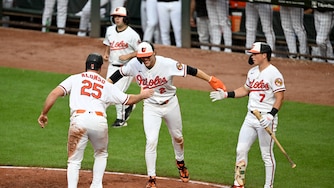
It turned out that was all there would be to celebrate for a while. The 2025 season started disastrously, and there was no recovering. Elias pivoted this offseason to a much more aggressive posture, signing slugger Pete Alonso and trading for outfielder Taylor Ward and starting pitcher Shane Baz while hiring Craig Albernaz as manager to help get the most out of a stagnating homegrown core.
Four months in, the Orioles are 53-56 and staring at a second straight season out of the playoffs. Even accounting for how random baseball can be, that’s hard to fathom, considering the trajectory this was on — it sure appeared that the Orioles’ strategic decision to look at everything that happened before 2018 and use mistakes like Davis’ contract to reimagine the operation was the right move and would deliver playoff victories.
So perhaps it’s helpful, as these late-summer celebrations of the team’s past often are, to have Davis’s return pull the attention away from the current team’s plight. But that effect might not last. Fans who’ve already booed and jeered the home team will undoubtedly do so again if the series against Philadelphia (which has lost 10 of 13 games since the All-Star break) goes awry.
Davis knows a thing or two about that kind of reception at Camden Yards. This weekend will prove that time can change that. But it’s running out on this particular team, and on a weekend when the club is running back to Davis to pop ticket sales and celebrate all those towering home runs he hit, we’re about to find out if time is running out on the era of Orioles baseball that his onerous contract spawned, too.


Comments
Welcome to The Banner's subscriber-only commenting community. Please review our community guidelines.