
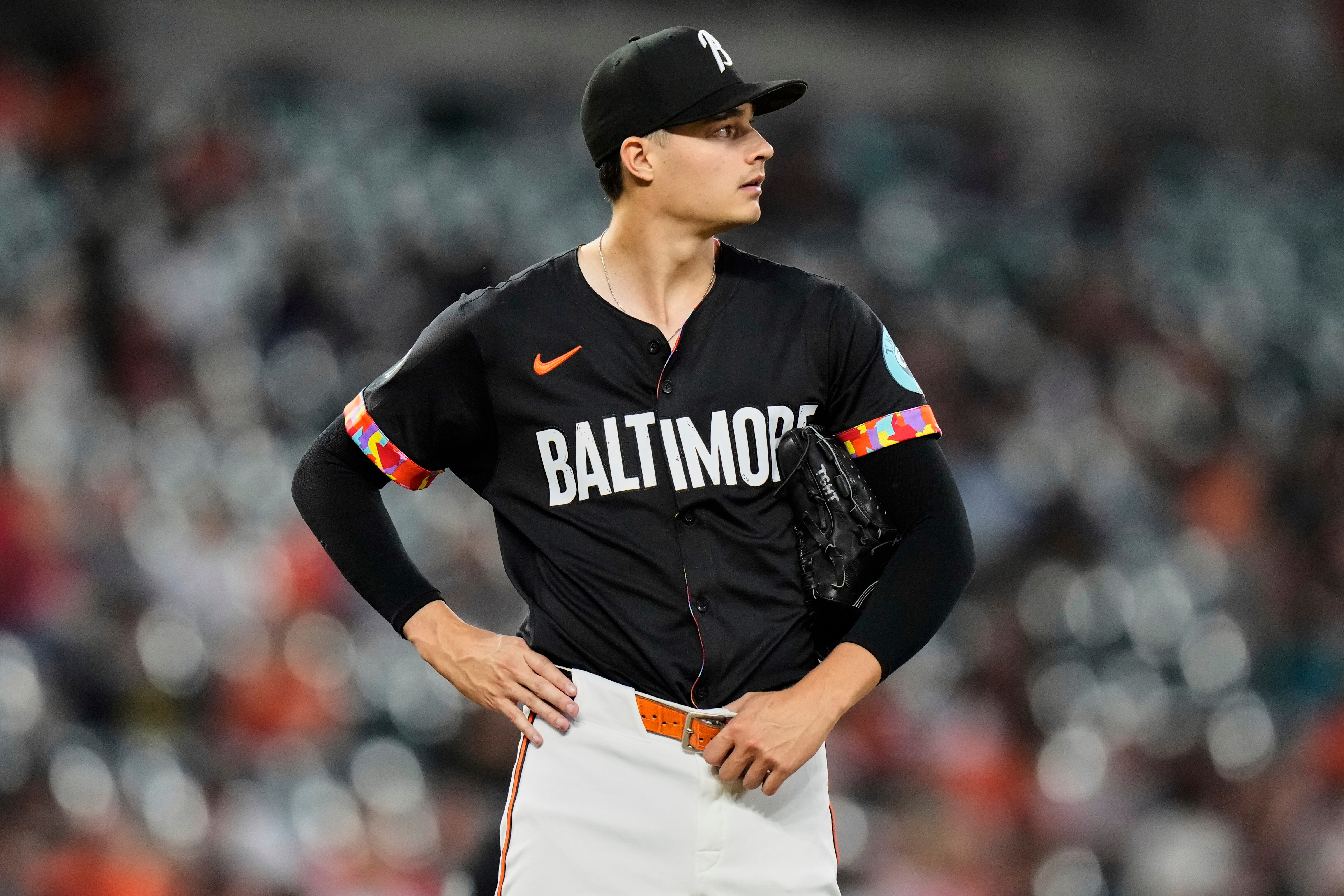
Cade Povich has no problem if you tell him he sucks. The Orioles pitcher has heard that before, either by the implication of not making a team growing up or overtly through social media messages.
But the threat his wife, Sophia, received last week crossed the blurred line of an angered fan and became another disturbing example of what players and their families deal with in the extreme. The messages to Povich’s wife, sent through Instagram, warned of sexual violence and included threats to find her in public.
It was so far beyond the line of what is acceptable, and Povich and his family are far from alone inside the Orioles’ clubhouse when it comes to receiving threats of that variety. Povich posted the messages on X, he said, because he wanted to raise awareness and, he hopes, force some sort of change in behavior and enforcement.
“We all have an understanding that most of these threats aren’t going to actually bring anything, but at the same time, you never know,” Povich said. “The biggest thing for me is I don’t want my wife, or if I have a kid, to see that and go out in public and be fearful that one of these people saying something like this is going to come after them, that they need to be looking over their backs 24/7.”
The Orioles, Povich said, took action in pursuing the account in question. And the left-hander credited the reaction from baseball fans extending beyond supporters of the Orioles, many of whom made him and his wife feel like “they’re going to look out for us. That has been amazing.”
In a statement, an Orioles spokesperson said the club takes immediate action in these situations to put “resources in place for the support, safety, and security of our players and their families.”
And a spokesperson from the Major League Baseball Players’ Association said the organization “takes each and every threat very seriously. As threats and concerns about safety arise, our Director of Security coordinates with Players, teams, league security and law enforcement to ensure athletes and their families are protected on and offline.
“Once we are made aware, we have had success in identifying the individuals behind these accounts to mitigate the threat and hold them accountable,” the statement read.
But at its core is a problem with no easy solution. Those actions from the MLBPA and clubs are reactive — necessary steps, but they don’t prevent new messages from different accounts.
At the center of this, most players think, is the rise in sports betting and the availability of access to players through online platforms. And as teams and the league at large partner with sportsbooks, Orioles pitcher Tyler Wells feels the onus is on those parties to step up their efforts to crack down on the online abuse that comes as a result of gambling.
“Whether you’re guilty by association or you’re just guilty in general, there is no way around it,” Wells said. “You are then put into the position of, if you’re going to be part of it, you’re going to need to be part of the solution. You can’t just be part of the problem. It’s not to say that they intended it to be a problem. No one intends for it to be a problem. But ultimately, it’s a cause and effect.”
Wells said the messages Povich’s wife received “pisses me off.” He’s glad the account was outed publicly.
“Everyone thinks they have an invisible cloak on, and that they’ll never know who they are,” Wells said. “It’s evident more and more as time kind of goes on, especially with the sports betting stuff, it just seems to be one of those things that creates a lot of anger toward players that are going out there and giving their best efforts. It’s completely undeserving. You almost feel bad for the individuals who are sitting there writing this stuff to you, because of them being so absolutely miserable with their own lives that they’re going to take the time to ridicule us for something that is kind of out of our control.”
One potential solution Povich considers is preventing bets on individual statistics or player performances. By keeping it team-resulted oriented, it could take some of the ire away from a specific player. But even then, Povich conceded, a muffed punt in a crucial moment may still lead to vile messages to that individual.
When Jackson Holliday’s dad, Matt, first began playing in the majors, an aggrieved fan would have to buy a ticket and express their displeasure from the stands or send a letter. Now, they can fire off a message almost instantly.
“Maybe I ruined their parlay or something,” Holliday said. “That’s usually a go-to. But that’s kind of the base of it. I’ve had a few that made me slightly uncomfortable, like, ‘I hope your plane crashes.’ Me and Rutsch [Adley Rutschman] got the same one.”
When Jeremiah Jackson made his first major, noticeable mistake in a major league game — dropping a fly ball at Wrigley Field in his first series for the Orioles — the rookie was lambasted online. One set of direct messages was so vulgar, he said, that he brought it to security.
“Some of it is them wanting a response out of you, and I feel like it would be worse for me to respond than just kind of ignore it and send it to our team who handles that, and they do a great job,” Jackson said. “Obviously, you have to kind of understand what the DM is, and if it’s something you feel can end up in putting you in harm’s way, you obviously want to speak up. When you get DMs of threats of certain nature, you don’t want to play around about that, because someone could be deranged.”
Holliday said he has changed the comment settings on Instagram to make sure only accounts he follows may write.
Jackson quickly altered his direct message settings after this month’s threat; no one can contact him now unless he follows them first.
Last week, Povich wasn’t the only pitcher to address problematic messages online. Seattle Mariners pitcher Tayler Saucedo and Saucedo’s girlfriend shared a message that wished him dead.
Wells noted that athletes are increasingly targeted in other ways, pointing to when Cincinnati Bengals quarterback Joe Burrow’s home was burglarized in December 2024. Kansas City Chiefs stars Patrick Mahomes and Travis Kelce were also victims, and in February, authorities charged seven men from Chile and alleged they were part of a theft ring that targeted “high-profile professional athletes when they are known to be away from home.”
To Wells, it was a reminder that players are not incognito in the cities in which they live. There are people who know where athletes live, what cars they drive, where they dine.
“That’s the scary part. It gets scarier and scarier every day from a security standpoint for players and their families,” Wells said. “And I hope that the organization as a whole, or all the organizations come together as one, to find a way to provide good security for the players who are going out there and making them money.”
And as Wells considers it, the entire act of gambling is foolish.
“You’re betting on an uncontrollable. What sense does that make?” Wells said. “You expect it to just work out for you because you put money on it? No. It’s life. The most unpredictable thing that could ever happen is just living on a day-to-day basis. With sports betting in general, it’s one of those things like, you should go in with the mentality that you’re going to lose whatever bet you made, because realistically, that’s what they put the props on. They’re betting on the downfall to make money from you.”
But again, Wells and others do not care so much about something as simple as saying they suck. They can brush that off as the reality of being a professional athlete in the spotlight. Taking it a step further, however, is where the issues really start.
“As soon as you start attacking our wives and families, that’s where you’re taking a step that will inevitably be very costly to you,” Wells said. “The fact of the matter is we have people who know who you are. They will find you, and they will be able to bring justice to that if it is to that level.”





Comments
Welcome to The Banner's subscriber-only commenting community. Please review our community guidelines.