
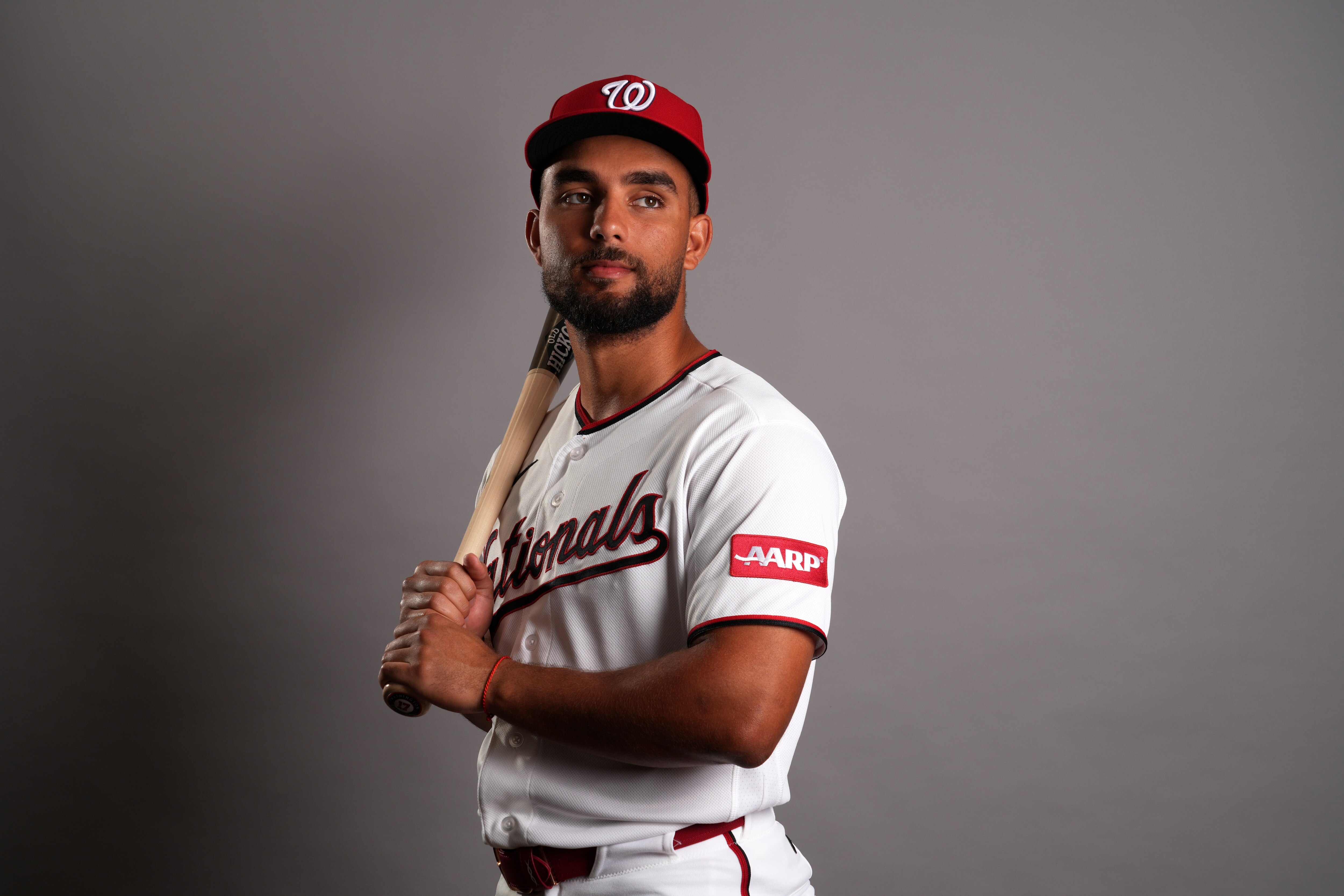
As the Washington Nationals make another attempt at a rebuild, they are viewing 2026 as a developmental year both in the major leagues and the minor leagues.
Their farm system looks vastly different than it did this time last year. There’s been an influx of talent acquired through trades and the draft, a revamped coaching staff and an implementation of new technology. There’s also been a concerted focus on building the proper processes and messaging to begin building the “player development monster” that new president of baseball operations Paul Toboni envisioned at his first press conference in October.
The results might not be immediate. Still, the Nationals are hoping for tangible improvements from their young prospects. Leading the pack is Eli Willits, the No. 1 pick in last year’s draft, who many talent evaluators view as the team’s top prospect. There are others worth following. Here are eight more prospects to watch this season:
Harry Ford (catcher)

The Nationals acquired Ford in a December trade that sent left-handed reliever Jose A. Ferrer to Seattle. Ford, 23, was a former top-100 prospect who debuted in the major leagues last season but would’ve struggled to find significant playing time behind AL MVP runner-up Cal Raleigh.
Two scouts, who spoke on the condition of anonymity because their organizations do not allow them to speak publicly about other teams, had solid reviews. One scout called Ford an interesting catching prospect with “a legit hit tool.” The other called Ford a “good acquisition” for the Nationals but said he is “hardly a difference-maker.”
The Nationals believe he can, at least, be their long-term solution behind the dish. Keibert Ruiz signed an eight-year, $50 million contract in 2023 and has underperformed since. Drew Millas is the only other catcher on the 40-man roster.
Ford projects as a hitter who can hit 15-20 homers a year in the majors. Behind the plate, Ford worked with catching coach and run game coordinator Bobby Wilson during spring training on a new technique to improve his setup and his receiving.
Washington had a tendency to rush prospects to the majors in years prior under former general manager Mike Rizzo. But in a rebuilding year, they can be patient with Ford to ensure he’s ready to get the majority of the catching reps once he does return to the majors.
Seaver King (shortstop)

King, the Nationals’ first-round pick in 2024, enters this season with heightened expectations after a strong campaign at the Arizona Fall League.
King, 22, was a polarizing prospect inside the Nationals’ organization from the moment the team selected him. Some believed he shouldn’t have been taken ahead of outfielder Cam Smith — taken four picks later by the Chicago Cubs — for a variety of reasons, including his propensity to hit ground balls.
Last season, King started the season 3-for-35 in High-A Wilmington. Some believed mixed messaging about pulling the ball in the air threw King off. Once he did find his footing, many believed King was promoted to Double-A Harrisburg too soon. He finished the season with a .244 average and a .631 on-base-plus-slugging percentage.
But King was one of the best hitters at this year’s Arizona Fall League. One scout said King was a unique college hitting prospect — he played two seasons at Wingate, then one at Wake Forest and likely needed more time to develop. The scout “loves King” and thinks the 22-year-old is “going to play in the big leagues for a long time” but doesn’t think he’s a long-term fit at shortstop and needs to improve his swing decisions to tap into more power.
The Nationals, now seemingly in alignment on King’s development plan, agree. They believe better swing decisions will help improve his ground ball rate. And the Nationals want King to hit the ball in the air — line drives to all fields. A scout for another organization, who spoke on the condition of anonymity because their organization does not allow them to speak publicly about other teams, said the team’s internal metrics on King are promising: King’s ground ball rate this spring has dropped by almost 10% from last season, and he’s catching the ball farther out in front of the plate.
Ronny Cruz (infielder)

Cruz, 19, was one of two prospects the Nationals acquired from the Cubs for Michael Soroka at last year’s trade deadline, led by then-interim general manager Mike DeBartolo.
At the time, Cruz was displaying high exit velocities as an undersized 18-year-old. In 48 games in the Arizona Complex League last season, Cruz batted .270 with a .745 OPS.
The hope is that, as his body fills out, those velocities will continue to trend upward. Like most teenage prospects (18-year-olds), swing decisions will be crucial to his success. The Nationals have made that an emphasis at spring training for many players, including Cruz. If he can improve, the Nationals could have another budding infield prospect on their hands.
Marconi German (infielder)

German, much like Cruz, is a project and won’t be in the majors any time soon. At 18, German will likely play stateside for the first time this year in the Florida Complex League.
His numbers last season in the Dominican Summer League turned some heads: .283 with a .992 OPS, 18 extra-base hits, 33 stolen bases and more walks (43) than strikeouts (42). Those in the organization like German’s plate discipline and contact ability and believe he has a high ceiling.
One scout called him “super athletic” and lauded his bat speed: “He’ll be a good Complex League follow.”
Davian Garcia (right-handed pitcher)

This spring training, the Nationals have stressed to their minor leaguer pitchers the importance of adding velocity. Perhaps no one has embodied that more than Garcia, a 22-year-old righty who pitched in A-ball last season.
The Nationals have helped pitchers to do this by getting stronger in the weight room. They’ve incorporated more activation exercises and taught pitchers how to move more efficiently on the mound.
Garcia, a sixth-round pick in the 2024 draft, throws from a low arm slot that can help generate swing and miss. His fastball averaged 93-94 mph last year. He had a 3.47 ERA in 22 appearances.
Now, his fastball is up to 97-98 mph, and he complements it with a slider. He started the Nationals’ spring breakout game and pitched a scoreless frame.
Yoel Tejeda Jr. (right-handed pitcher)

Tejeda, listed at 6-foot-8, has been averaging 96 mph on his fastball during camp. Last year, Tejeda was around 93-94 mph. A 14th-round pick in the 2024 MLB Draft, Tejeda was relatively raw out of college, making just 21 appearances and eight starts. He still has a lot of room to grow.
Tejeda, 22, had a 4.03 ERA in 18 starts a year ago, but a 3.43 ERA in 16 starts with Single-A Fredericksburg. He features a five-pitch arsenal: four-seam fastball, two-seam fastball, slider, sweeper and splitter.
One scout said he worries about Tejeda’s secondary pitches, specifically his slider. Another scout agreed, questioning whether he can miss enough bats as he progresses through the upper levels of the minor leagues.
Jackson Kent (left-handed pitcher)

With two of the Nationals’ best starting pitching prospects (Travis Sykora and Jarlin Susana) sidelined to begin the season, Kent is an intriguing pitching prospect to watch at the upper levels of the minor leagues.
A fourth-round pick in 2024, Kent has a four-pitch arsenal that includes a fastball, changeup, slider and curveball. His changeup is his go-to secondary pitch. The Nationals focused on improving his slider last season. Kent had a 4.61 ERA in 24 starts, but allowed three earned runs or fewer in 17 of them.
During camp, those within the organization have raved about his steps forward, saying his pitch shapes have improved. They’re encouraged by his improved delivery, something he worked on during the early portion of spring training. He’s added velocity, but has to show he can maintain it for a full season.
Miguel Sime Jr. (right-handed pitcher)

At 18 years old, Sime has an electric fastball that routinely touches triple digits. That alone is enough to generate excitement about the Nationals’ fourth-round pick in the 2025 MLB Draft.
What comes next for Sime is developing his secondary offerings. One scout believes Sime projects as a reliever and says his success comes down to his secondary offerings.
The Nationals have worked with Sime on developing a slider and believe he’s made strides this spring, in addition to gaining feel for his splitter.
Sime didn’t appear in a game following the 2025 draft and will likely get his first taste of affiliate ball this season.
“If we’re talking about guys that, after the season, could be a top-three guy in the system, he jumps out pretty quickly,” another scout said.


Comments
Welcome to The Banner's subscriber-only commenting community. Please review our community guidelines.