
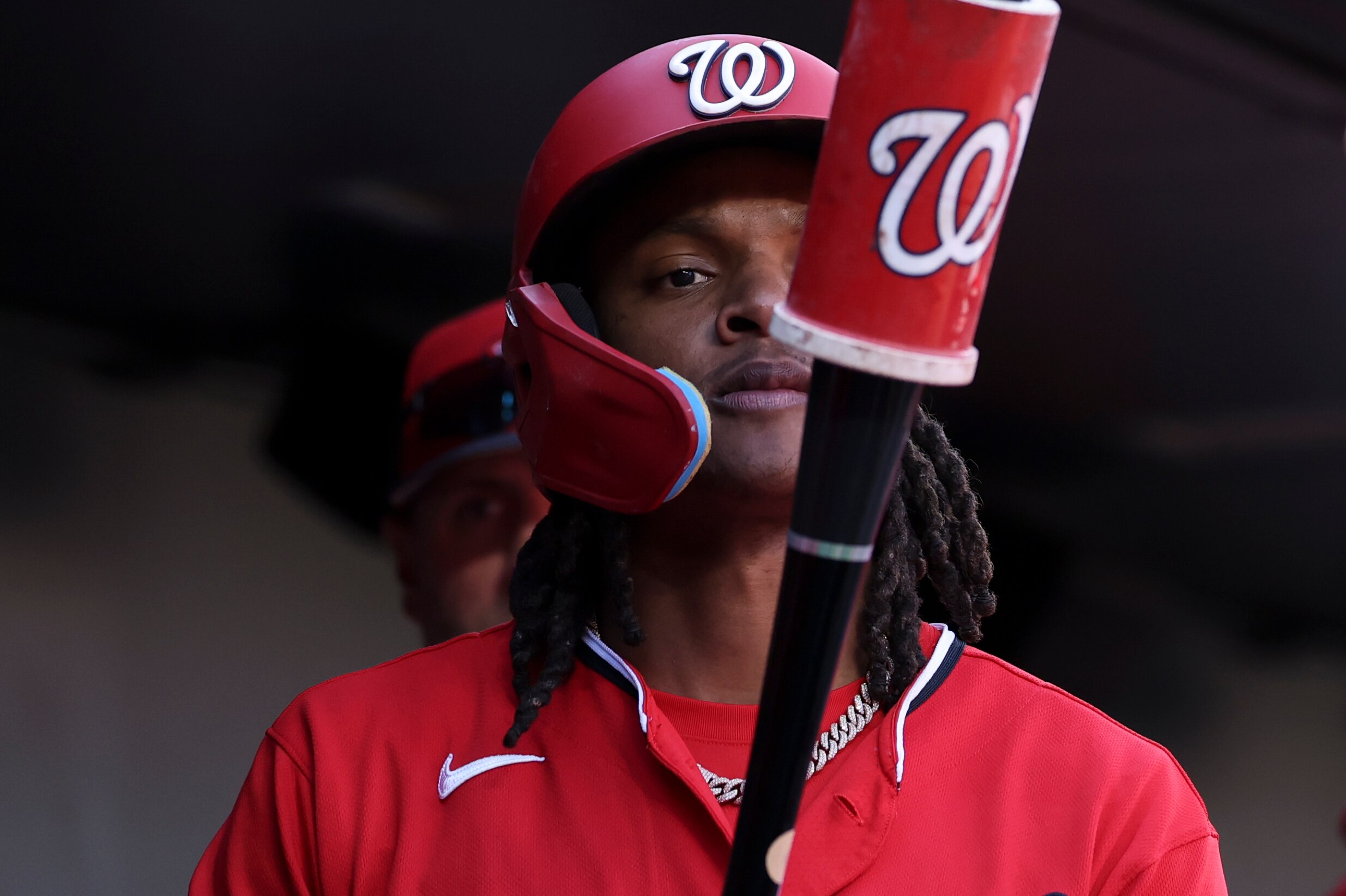
On Wednesday afternoon, before the Nationals’ series finale against the Phillies, CJ Abrams and Luis García Jr. sat like two schoolkids in their chairs, using their lockers as makeshift desks. With paper and pen in hand, the duo leaned over and wrote on a sheet, occasionally turning to each other for help.
Before each game, the Nationals’ hitters have homework. They each fill out a sheet of paper titled “Go Zones,” which contains two rows of five miniature strike zones. Each zone has a specific area highlighted in green with the word “GO.” Each hitter checks the areas he’s looking to swing at. There’s space at the bottom of the paper for players to leave notes. Then they talk as a group through their game plan.
“It’s a mental thing,” Abrams said. “It starts in practice. Whenever you’re taking BP, whatever your go zone is, just stay there. And, if it’s thrown somewhere else, take it. … And then in the game you just got to go out there and hit, stay disciplined.”
Shortly after Abrams finished his sheet, a team nutritionist approached him with a device used to test players’ hydration. She tapped Abrams’ tongue a few times. Then she showed him the screen as the results loaded. Abrams, equally amused and confused, said: “I don’t know what I’m looking for.” Turns out, he was well hydrated. He smiled and nodded.
Daylen Lile was next, but he quipped: “I got to do my homework first.”
Players doing pregame homework was something I’d never seen in five years covering the Nationals. Every major league team game plans for opposing pitchers. That wasn’t unique. But this level of detail was.
Read More
The differences in the Nationals’ culture behind the scenes, most notably the new regime’s willingness to think differently, make me believe this version of the Nationals’ rebuild could work. It’s far too early to know for certain.
Yes, the Nationals are playing a more inspired brand of baseball. Still, the parade route shouldn’t be mapped out yet. There’s too much that’s unknown.
A new season often brings new routines that don’t last for a full campaign. It’s easy to buy in early when the Nationals are 3-3 and were one strike from taking a series from the Phillies.
New ideas and technology don’t automatically equate to victories. Not every decision made by new president of baseball operations Paul Toboni or manager Blake Butera will pan out.
In the long term, there are bigger questions. Will players develop in the majors and minors as expected? Will the front office make the right moves down the road? And, perhaps most important, will the Lerners spend enough to build a winner again?
Yet there seems to be an openness to hearing and implementing new ideas, which should give Toboni and Butera a better chance to succeed.
That’s not to say there weren’t new ideas or thoughts in years prior. There were plenty. They just weren’t always heard or valued. It felt as if the Nationals, led by former general manager Mike Rizzo and manager Dave Martinez, were intent on using their past as a blueprint back to contention. And that blueprint was contingent on a pocketbook that wasn’t open anymore.
In my eyes, a shift came after Rizzo and Martinez were let go in July. Under interim manager Mike DeBartolo, the Nationals began to think a bit differently. They implemented data into their decision-making, from trade deadline acquisitions to waiver claims to game planning.

Martinez and Rizzo weren’t opposed to data but weren’t avid endorsers of incorporating analytics into decision-making.
One example from last season was striking. In 2024 and 2025, analysts were rarely allowed in the clubhouse. When Washington’s former hitting coaches met with a group of analysts, they’d take the elevators to the team’s offices at Nationals Park. Following DeBartolo’s promotion, analysts began to come down to the clubhouse for meetings. It was a subtle change but showed a willingness to incorporate more perspectives.
Beyond the data, there seems to be an acknowledgment among the new leaders that building a strong organization can’t be rushed. Of course, there’s urgency to win. Yet they also seem willing to be patient and make sure things are done right.
My lingering feeling, especially the last two years, was that the Nationals wanted to expedite their path back to contention without building the processes to do it sustainably.
Rizzo deserves ample credit for nearly a decade of sustained success that culminated in the team’s 2019 World Series title. That’s rare in baseball and shouldn’t be overlooked. But, as the team attempted to rebuild in 2021, it felt as if the Nationals were spinning their wheels. It seemed the team’s past successes held the Nationals back from being forward-thinking in the years that followed.
The Lerners should shoulder some of that blame. Some in the organization felt they didn’t provide the Nationals enough funds for additional technology. Others felt they didn’t provide the financial flexibility to build robust staffs in the minor leagues and amateur scouting department.
The Nationals had Hawkeye cameras, an advanced video capture and data system that helps teams track player performance, at each of their minor league affiliates last season but had a camera on only one field at the spring training facility in West Palm Beach, Florida, according to a person familiar with the team’s equipment. They were one of the few teams last year that didn’t have Trajekt arcs, a pitching machine with a video screen and a hole that attempts to replicate opposing pitchers’ arsenals. They purchased three during the offseason.
The Lerners shouldn’t take all the blame, though. The Nationals rushed prospects to the big leagues when they weren’t ready, painting an external picture of an ascending rebuild when there were cracks. They seemed averse to adopting new strategies, though many were suggested.
That’s where this all feels different. The Nationals’ new staff isn’t handcuffed by the weight of doing what’s been done in the past. They’re willing to start from scratch.
“I think a lot of it is like they haven’t seen what’s happened before,” outfielder Jacob Young said of the new staff. “They’re not even thinking about the losses or the bad times we had back then. They’re kind of just that fresh start, and it brings in a fresh start to a lot of us. … That’s the biggest difference, just the energy in here.”

If you’re a Nationals fan and you’re still reading, you might have just rolled your eyes. I don’t blame you. I can’t think of the last time I heard a fan say, “I fell in love with the Washington Nationals because of their diplomatic rebuilding strategy.” You want to win. You heard this in 2022. Bear with me.
The Nationals’ insistence on communication with and education for their players will only help to raise the floor — and ceiling — of their potential. The feeling among players is that there’s clear messaging from the front office and staff about what each player’s expectations are.
That went as far back as the offseason. Young, for example, said he heard from Toboni often when his name was mentioned in trade rumors. Toboni’s honesty and transparency throughout the process were meaningful to him.
Teaching, at the major and minor league levels, has been a vital part of the Nationals’ developmental plan. The staff has been using data to highlight to players what their strengths are and providing a game plan of how to maximize those strengths.
During spring training, the Nationals had pitchers and catchers stand in front of the group to explain their pitch sequencing in games. Many of the examples were positive, allowing batteries to explain why they chose the pitches they threw. Pitchers said it served as a learning opportunity.
Before each game this season, the position players have gathered for a hitters meeting. It starts with addressing the night prior — plays that were executed well and ones that weren’t. The Nationals have preached the little things before. But now players are receiving concrete instruction through video, reinforcing positive plays and addressing mistakes.
In Chicago, the Nationals showed a clip of James Wood running hard on a routine ground ball on opening day. They showed the error that led to a loss in the second game of the season. A day after beating the Phillies on Monday, the coaching staff displayed instances of good baserunning that extended innings or led to runs.
“Everyone always tries to preach the little things, but these guys get super excited when we execute certain things like that,” Wood said.
The in-game results have been positive. Will their methods translate over the coming months and years? Only time will tell. But the Nationals are trying something new. And it’s worth paying attention to.





Comments
Welcome to The Banner's subscriber-only commenting community. Please review our community guidelines.