
There’s no way to sugarcoat it: The Washington Nationals’ 10-5 loss to the Phillies on Thursday, their third straight ninth-inning bullpen collapse in as many days, was demoralizing.
Any word in the thesaurus next to devastating probably fits the description. Dispiriting. Disheartening. Or even ...
“F-ing sucks,” said reliever Gus Varland, who allowed five runs in the ninth and was optioned to Triple-A Rochester after the game.
Sure, that works, too.
A chorus of “Let’s Go Phillies” chants rang throughout Nationals Park as Washington fans headed toward the exits, their team becoming the first in major league history to allow a go-ahead home run in the ninth inning of three consecutive games.
The loss, which puts the Nationals squarely at 41-41, leaves a lingering feeling that this is the beginning of the end for the team’s success this season. It’s the easiest response to feel after six straight losing seasons.
Read More
Yet the Nationals have shown an ability to bounce back this season on countless occasions.
So even after suffering three excruciatingly painful losses against one of the best teams in baseball, why should we suddenly stop giving this team the benefit of the doubt now?
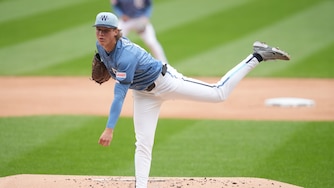
“It hurts,” said right-hander Cade Cavalli, who pitched six innings and gave up two earned runs. “I’m not going to sit here and say it doesn’t hurt. But we know that there’s 162 games in this season. We’re barely halfway, got a lot of ball left. It’s part of our nature as competitors that we’re not going to lay down. We’re going to dig deeper and try to win those ballgames.”
Admittedly, I’ve had to check myself a few times this month. My feelings about this group have been clouded by the 2024 and 2025 Nationals. Those teams hovered around .500 in the early going,, only to fall apart.
So when the Nationals got swept by the Marlins earlier this month, I figured the fall was inevitable.
Then the Nationals took four out of six on a West Coast road trip, punctuated by a demoralizing 11-10 loss to the Giants where they led 10-1 after seven innings. They fell 10-2 in the ensuing game to the Mariners. That felt like the real end.
What happened next? They won their next four games to earn two series wins. The Phillies series, then, shouldn’t serve as an omen. After all, this series was a litmus test.
The Phillies, who boast one of the most experienced rosters in baseball, are 36-17 since April 28, when Don Mattingly took over as manager. Only the Brewers have a better record.
The Nationals, with an inexperienced roster that wasn’t expected to compete this soon, entered Thursday’s game 9-2-1 in their last 12 series dating back to May 12.
Sometimes, talent and experience win out. And in this instance, it took those plus a historic collapse for the Nationals to lose a series they ultimately could’ve won, if not swept.
“Tough, I really don’t know if there’s another way to put it,” outfielder Jacob Young said. “There’s no moral victories in baseball and sports, but you’re toe-to-toe with a team that’s in playoff contention that you know is going to be at the top, leading the division. ... You got to take that from it, at least.”
One series doesn’t change my perception of this team. I didn’t think they were a legitimate World Series contender because of their pitching. But I still think they can maintain their pace of playing just better than .500 baseball for the whole season because of their elite offense.
The Nationals’ upcoming schedule features four series against the Orioles, Red Sox, Pirates and Astros. Three of those teams are currently under .500 and the Pirates are one game above. They then face the Yankees at home and have two more series out of the All-Star break against the Athletics and Rockies, teams also under .500. Mostly winnable matchups, though nothing is ever guaranteed.
I’m not blind to the Nationals’ bullpen deficiencies. The Nationals rank 29th in bullpen ERA (5.05) and 26th in bullpen WHIP (1.45). They have the lowest strikeout rate of any bullpen in baseball. They don’t miss bats. Opponents have a .432 slugging percentage against them, the third-highest mark in the major leagues.
There aren’t immediate answers, either. Teams aren’t looking to trade bullpen arms this far from the deadline. Waiver claims tend to be dart throws. They can option arms up and down from Triple-A Rochester. The simplest answer is they have to find the relievers who can separate themselves from the pack.
“You got to throw strikes,” manager Blake Butera said. “If we’re afraid to do so, we’ll keep giving the next guy [an] opportunity until somebody steps up and shows they want the ball and they’re ready to go attack.”
The Nationals bullpen, excluding openers, allowed 22 runs over 9 1/3 innings in the three losses to the Phillies. That won’t continue. A reliever is never as bad as his worst three appearances — no matter how bad he was — and he’s never as good as his best three bullpen days, either.
Let’s also not forget that the Nationals have the best offense in baseball. They scored nine runs on Tuesday without star shortstop CJ Abrams. They drove in five runs Thursday against NL Cy Young candidate Cristopher Sanchez in the first three innings. Even with the potential for regression, the hitters haven’t shown signs of stopping.
And then there’s the part you can’t exactly calculate.
On Wednesday, during batting practice, I asked Nationals president of baseball operations Paul Toboni what impressed him the most about his group. He sat on the bat rack by the tunnel in the home dugout and grinned.
“Just in terms of how they’re going about their work and their prep, they have a really unique way of keeping it light,” he said, his voice getting lost by the players laughing on the benches behind them. “While at the same time, when it’s time to get serious, when it’s time to prepare, they do an excellent job with it.”
The Nationals have shown an uncanny ability to flush the prior game, win or loss. Perhaps it comes from their manager, who said it’s his and his staff’s responsibility to move on or else they’re not doing the best job they can.
Or perhaps it’s what multiple players said postgame after these losses: They’re young and don’t know any better. They’ve bounced back after tough losses before. They believe they can do it again.
Any player in a losing clubhouse would likely say these things. But even after the Nationals’ worst loss yet, I’m inclined to believe them.




Comments
Welcome to The Banner's subscriber-only commenting community. Please review our community guidelines.