
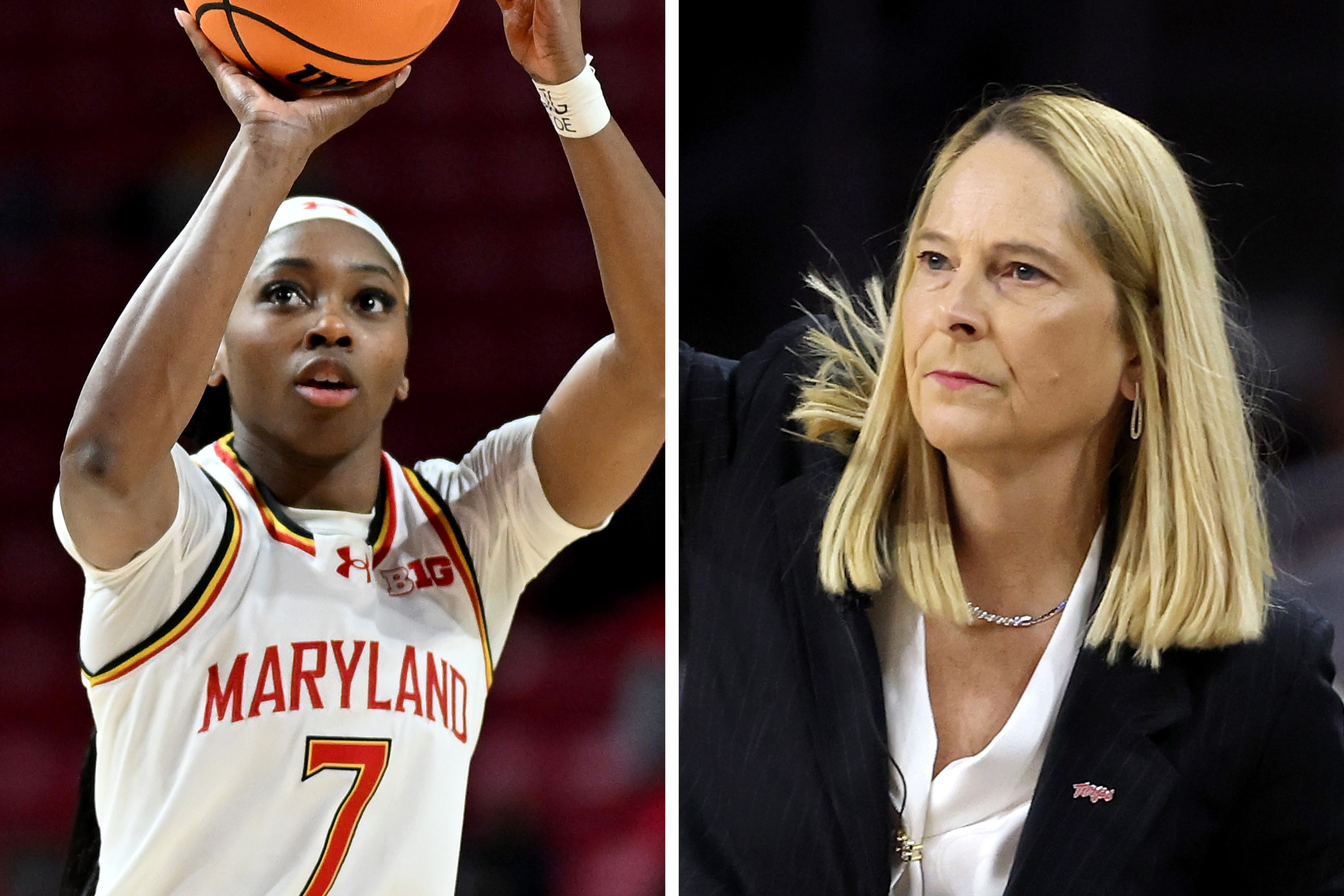
The viral third-quarter exchange between Maryland coach Brenda Frese and star guard Oluchi Okananwa has captured more attention this week than the Terps’ second-round loss to former ACC rival North Carolina.
“It opened up a bigger conversation, which is a good thing,” Okananwa wrote in a text message to The Banner Thursday.
The optics of the moment — Frese chiding her standout player on the sideline — can be open to various interpretations, especially when viewed on mute.
Frese is white. Okananwa is Black. Some have raised concerns of racial sensitivity. Others saw Frese’s passion, pointing to her winning results and slew of former players in the WNBA as proof of her coaching success. For those who work in sports, it was simply coaching.
The interaction occurred after the college junior made a series of mistakes, including a traveling violation, missed foul shots and a botched layup. Veteran coach Frese took the Duke transfer by the wrist, got in her face and started repeatedly jabbing at her chest.
“I need you to lock in,” Frese yelled, “and stop being distracted.”
It’s a far cry from the sideline antics of the late Bob Knight (remember the chair-throwing and allegations of player abuse?). Frese can also be seen on video mouthing, “I believe in you, but you’ve got to want this moment” amid the animated talk before tapping the leading scorer on the shoulders and sending her on her way.
The star guard, known for her sense of style in her personal life as much as her slashing abilities, said it is important to acknowledge the way race and gender can shape how moments are perceived — especially in sports.
But here, “it resonated because it was real — raw emotion, competitiveness, and the relationship between a player and coach," Okananwa wrote.
“I feel like this moment has really been celebrated as the epitome of tough love which all of us need in our lives regardless if you’re an athlete or not.”
The moment would have been treated differently had it involved men, she added. Not “bigger or smaller” just “different.”
“In men’s sports, that kind of intensity is often expected and even celebrated so I truly don’t believe there would be much negativity surrounding the way Coach B was speaking to me had we both been males,” Okananwa wrote. “In women’s sports, especially as women, we’re held to a different standard when it comes to how we show emotion.”
Winning the national championship in 2006 didn’t bring Frese as much attention as the viral moment, Frese joked when reached for comment Thursday morning.
For Frese, the exchange was about “coaching with passion.”
She didn’t think the moment would catch anyone’s attention. After all, it wasn’t anything different than what she has done her entire three-plus decades in coaching.
“It didn’t rank because that’s just who I am and authentically who I am every single day,” she said, adding that the ”raw moment" being caught on camera gave the national audience the opportunity to read her lips or hear the message as a glimpse into what it’s like from a “coaching angle.”
“When you get to listen fully before you jump to conclusions and you fully see the word, you understand what took place, then watch what she does after the fact, you connect the dots and put it all together,” she said.
The optics of the “raw moment” between two strong women is likely what captured the attention of the public.
“Women are held to a different standard,” Frese said. “I would say even men and women in our own sport are held to a different standard. And what a man can get away with in our sport compared to normally what females can. It’s different based on a gender bias.”
Karsonya “Kaye” Wise Whitehead, a professor of communication and African and African American studies at Loyola University Maryland, suspects the racial dynamics generated the enormous attention.
“I can see it from both perspectives,” she said. “I understand the other perspective as this white woman, a white older woman, in the face of this young Black girl, pointing, yelling in her face. But if you don’t know the game, if you don’t see it from that perspective, it feels different.”
Whitehead said the media reaction has surprised her — especially when people have been able to decipher what Frese was saying to Okananwa, who made a postgame statement that she loved to be coached hard and wanted Frese to continue coaching her the same way.
In a sport driven by motivation, Vernon Harris is not surprised that casual watchers can misinterpret what they saw between the Maryland coach and player.
Harris, who coaches the varsity girls basketball at St. Timothy School for Girls in Stevenson,, said he could see how others unfamiliar with the dynamics of the coach and player relationship could jump to conclusions.
“I can honestly see as a Black man yelling at a young white lady, a young white basketball player. I can see it. I can feel it,” he said of the hypothetical. “I could see them not understanding.”
Ultimately, coaches need to do things their own way in order to be effective, Harris believes.
Jessy Morgan, athletic director for Garrison Forest School in Owings Mills,
said most people don’t get to see this side of women’s sports, which is why it has been so “jarring” for them.
“But I love it,” she said.
“A men’s coach can do that night after night,” Morgan said. “The camera catches this and it’s major news.”
Frese said she has always led “from the heart with great intentions.”
She has been fortunate in her relationships with all of her student athletes that she has been able to coach, she added — “especially with diversity of color. It has always been with the right intentions.”



Comments
Welcome to The Banner's subscriber-only commenting community. Please review our community guidelines.