
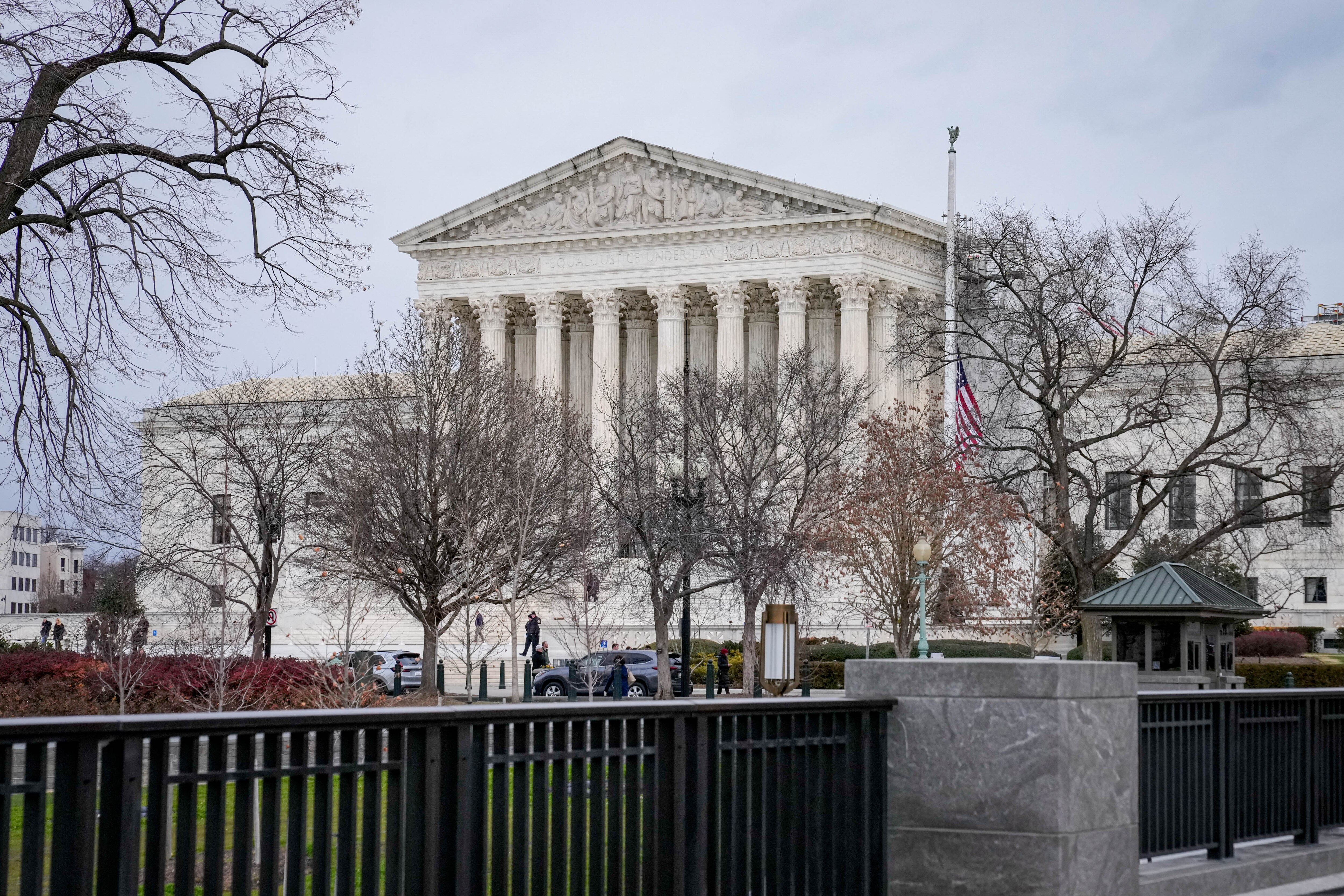
The U.S. Supreme Court on Tuesday ruled against a law banning “conversion therapy” for LGBTQ+ kids in Colorado, a ruling that also could apply to Maryland’s ban on the discredited practice.
An 8-1 high court majority sided with a Christian counselor who argues the law banning talk therapy violates the First Amendment. The justices agreed that the law raises free speech concerns and sent it back to a lower court to decide whether it meets a legal standard that few laws pass.
Justice Neil Gorsuch, writing for the court’s majority, said the law “censors speech based on viewpoint.” The First Amendment, he wrote, “stands as a shield against any effort to enforce orthodoxy in thought or speech in this country.”
Gorsuch’s opinion drew support from two of the court’s liberal justices, Elena Kagan and Sonia Sotomayor.
Similarly, a state could not ban talk therapy designed to affirm a minor’s sexual orientation or gender identity, Kagan wrote.
“Once again, because the State has suppressed one side of a debate, while aiding the other, the constitutional issue is straightforward,” she wrote.
In a solo dissent, Justice Ketanji Brown Jackson wrote that states should be free to regulate health care, even if that means incidental restrictions on speech. The decision, Jackson wrote, “opens a dangerous can of worms” that “threatens to impair states’ ability to regulate the provision of medical care in any respect.”
Maryland banned conversion therapy in 2018, one of 23 states to do so.
Gov. Wes Moore’s office said he is working with the state attorney general to determine how the ruling affects Maryland’s law.
“Governor Moore believes Maryland should stand on the side of protecting children, supporting LGBTQ+ young people, and following the medical consensus — not indulging a dangerous practice that major medical organizations have long rejected as harmful,” said Ammar Moussa, a spokesman for the Democratic governor, in a statement.
Richard Madaleno, who was one of the lead sponsors of the ban when he was a Democratic senator in 2018, said he’s hopeful the court ruling doesn’t wipe out Maryland’s law.
Madaleno said it can be particularly harmful to LGBTQIA+ young people when their parents or guardians try to push them into therapy to change who they are.
“We have witnessed plenty of young people attempt and complete suicide over these issues,” said Madaleno, who now works as Montgomery County’s chief administrative officer. “And that’s why stepping in and trying to make sure Maryland has common-sense limitations on what type of therapy can be provided to young people is so important.”
Phillip Westry, executive director for FreeState Justice, a Baltimore nonprofit providing free legal services to LGBTQIA+ people across the state, pointed to data from The Trevor Project, that hundreds of LGBTQ+ youths in Maryland reported experiencing threats of being subjected to conversion therapy in recent years.
“This decision raises serious concerns that we could see these practices reemerge — not just in Maryland, but in nearby states — creating a pipeline of harm that is increasingly normalized and harder to regulate," Westry said in a statement.
The Supreme Court’s decision is the latest in a line of recent cases in which the justices have backed claims of religious discrimination while taking a skeptical view of LGBTQIA+ rights.
Colorado counselor Kaley Chiles, who pursued the lawsuit with support from President Donald Trump’s Republican administration, said the law wrongly bars her from offering voluntary, faith-based therapy for kids.
Her attorneys argued that the ban makes it hard for parents to find therapists willing to discuss gender identity with kids unless the counseling affirms transition.
“I look forward to being able to help them when they choose the goal of growing comfortable with their bodies,” Chiles said in a statement. “Counselors walking alongside these young people shouldn’t be limited to promoting state-approved goals like gender transition, which often leads to harmful drugs and surgeries.”
Colorado disagreed, saying its law does allow wide-ranging conversations about gender identity and sexual orientation and exempts religious ministries. The state says the measure simply bars using therapy to try to “convert” LGBTQIA+ people to heterosexuality or traditional gender expectations, a practice that has been scientifically discredited and linked to serious harm.
The law doesn’t violate the First Amendment, Colorado argued, because therapy is different from other types of speech since it’s a form of health care that the state has a responsibility to regulate.
The 2019 law carries the possibility of fines and license suspension, but no one has been sanctioned under it.
The court’s ruling is expected to eventually make similar laws in other states unenforceable.
Maryland legislative leaders, including Senate President Bill Ferguson, said lawmakers would need to consider if there’s anything they can do to further protect Marylanders from harm after the ruling.
The General Assembly this year considered a bill that would allow malpractice lawsuits against conversion therapy practitioners. The bill, sponsored by Del. Bonnie Cullison, has not made it out of committee. A version in the Senate sponsored by Sen. Cheryl Kagan, a Montgomery Democrat, also has stalled.
Cullison, who also was a lead sponsor of the 2018 ban, called the ruling “disappointing.”
“Conversion is a really strong word,” the Montgomery County Democrat said. “You are converting someone to something they are not.”
The Associated Press contributed to this article.


Comments
Welcome to The Banner's subscriber-only commenting community. Please review our community guidelines.