
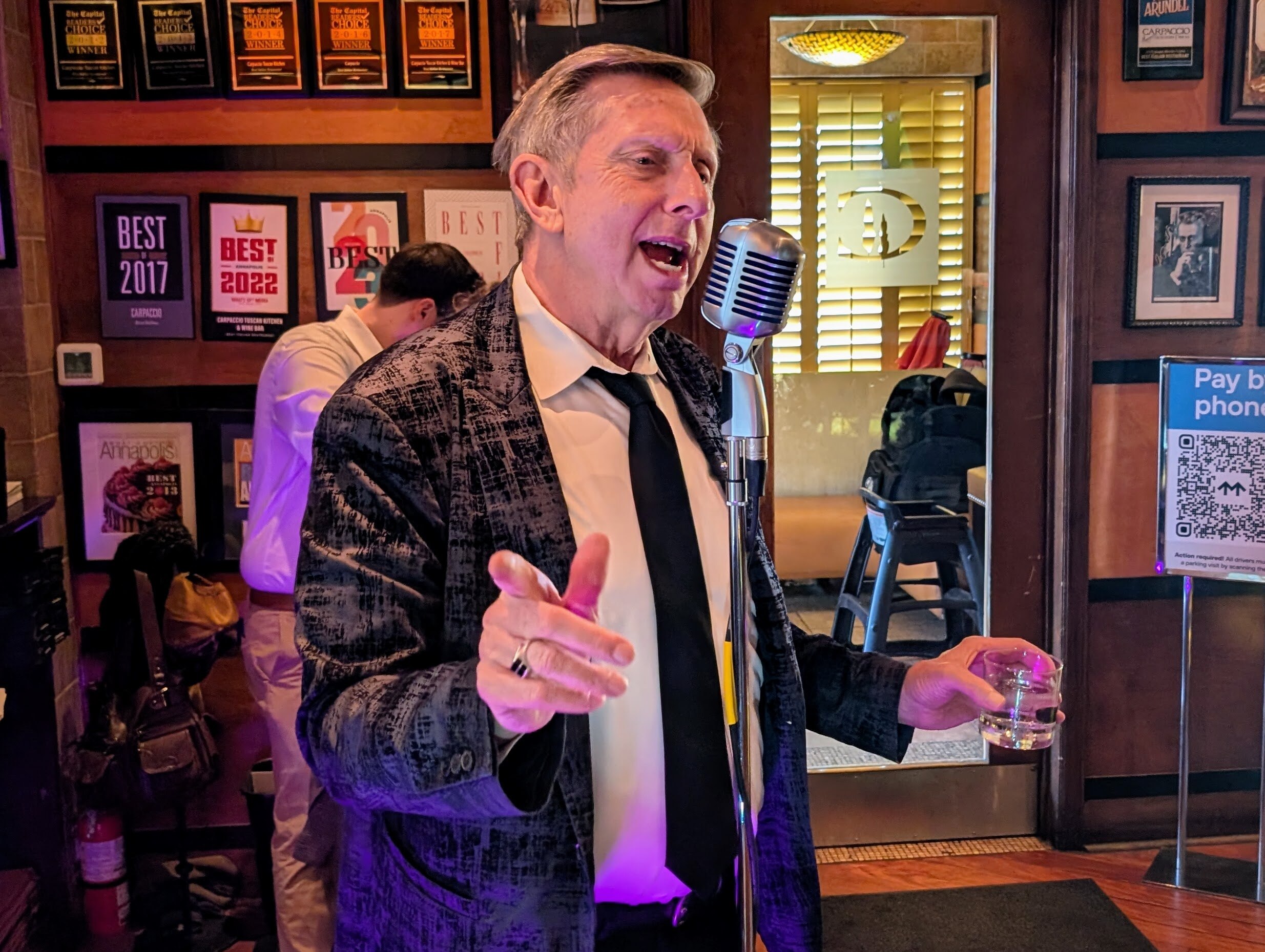
Across the dining room from me and my plate of calamari fritti, Frank is singing his greatest hits.
“Fly Me to the Moon,” “Summer Wind” and “Luck Be a Lady” pour from the darkened corner of an Italian restaurant in Annapolis.
Frank’s voice is as smooth as Jack Daniel’s on the rocks, floating over recorded music coming from small speakers set up behind him. Frank’s tie is undone, just so.
How, I ask my wife, do you get to be a Frank Sinatra impersonator?
“I’m not an impersonator. But I try to represent the music,” Wendell Rakosky says when we meet in a coffee shop near his Ellicott City home.
“I call myself a tribute artist.”
With 180 shows a year, the tribute is keeping Sinatra’s persona alive. You can hear him this month singing for your supper in Annapolis, Fulton, Gambrills, Columbia and College Park.
And he’s adding a new act. He’s booked the main stage Thursday night at Maryland Hall in Annapolis for “The Life of Frank Sinatra — Doing It My Way,” a mix of music and video with an AI-generated Sinatra.
“It’s an AI voice doing the narration,” Rakosky says. “And at the end of, for example, the Tommy Dorsey years, he says, ‘Now, let me come out and sing a few songs from Tommy Dorsey.’
“And I come out, and I’ll do three songs from that era, and then the narration takes up again.”
As Rakosky explains this, the joy on his face is clear. But the mind-blowing nature of what he does requires me to ask him to explain it again.

It’s an AI Sinatra telling his life story, or rather Sinatra’s, and then introducing a tribute artist, not an impersonator, to sing the songs of Sinatra’s musical eras.
“Hello, my name is Francis Albert Sinatra,” the voice says. “I was born on Dec. 12, 1915, in the town of Hoboken, New Jersey.”
Rakosky wrote the script, gathered the music, videos and photos, then tinkered with AI software to read his words in the voice of a man who died in 1998.
He booked the 700-seat theater, and although he doesn’t expect to fill it, he’s excited to perform for the audience that finds him.
“This is just a passion project. This is not something where, hey, I think I’m going to be the next Michael Bublé and take off,” Rakosky says. “I wanted to tell a story of Frank’s life. OK?”
Tinkering with technology is how Rakosky got into this. He retired a decade ago from a human resources job at Lockheed Martin and began to get deeply into his longtime hobby, community theater.
He taught himself how to make music videos and posted them on YouTube as a side project. When the pandemic shut down his theater groups, he started figuring out how to livestream his performances.
“I had a show on Wednesday nights on YouTube called ‘Wednesdays with Wendell Live.’ And I was doing classic rock. I was doing blues music, because I have a whole blues setup,” Rakosky says. “And then I was doing Frank Sinatra, Michael Bublé and so on.
“People started asking for more Frank Sinatra stuff.”
As the pandemic restrictions began to lift, Rakosky ventured into restaurants and private events with a vintage-style mic, a tux and a cocktail glass.
“If you’re going to be doing lounge music, you got to look the part,” he says. “That’s why I always have a drink in my hand. It’s water.”

It’s been more than 25 years since Sinatra died, the singer who epitomized 1950s Las Vegas. Like everything else in American culture, though, Sinatra gets recycled.
There was the 2000 remake of his 1960s heist movie, “Ocean’s 11.” There was the cocktail craze and nods from contemporary singers.
In June, Seth MacFarlane, better known as the creator of “Family Guy,” released an album of songs Sinatra planned to sing, “Lush Life: The Lost Sinatra Arrangements.”
Six months later, Sinatra was on the pop music charts with “Ultimate Christmas,” 20 holiday songs from his Capitol and Reprise studio eras.
That enduring popularity is what Rakosky has tapped into.
“A lot of the customers say, ‘I haven’t heard this since I was a kid,’” said Riley Dichairo, manager of Carpaccio Tuscan Kitchen in Annapolis.
Customers reminisce about days past, tell stories about family and share memories of seeing the real Sinatra perform. Rakosky goes beyond Sinatra’s music, but it’s the meat of his performance.
Carpaccio was one of the first restaurants to book Rakosky. His act spread through a loosely connected group of Italian restaurants across the region, with names like Della Notte, Mezzanotte and Galliano.
Now there are non-Italian places to hear him, too, such as community centers, street festivals and private parties.
“He does have a very good following,” Dichairo said.
Our conversation about Sinatra is coming to a close.
Through all of it, Rakosky slips in and out of calling the subject of his tribute by his first name.
“They’re not Frank’s tunes.”
“Before ‘From Here to Eternity,’ Frank’s career had tanked.”
“There’s nobody else in Maryland that does Frank.”

For Rakosky, and maybe for other Sinatra fans, there’s an allure to his personality.
“Frank’s very confident. He loves his music. He wants to own every song he sings,” Rakosky says. “He’s got his own personality into it, meaning he tries to sing his story. It’s sort of the, I mean, mature bad boy.”
When I ask him about calling the singer Frank, Rakosky pauses for a moment and offers what, to him, is the obvious reason.
“Because that’s who he is. It’s like Madonna. It’s like Beyoncé.
“He’s Frank.”


Comments
Welcome to The Banner's subscriber-only commenting community. Please review our community guidelines.