
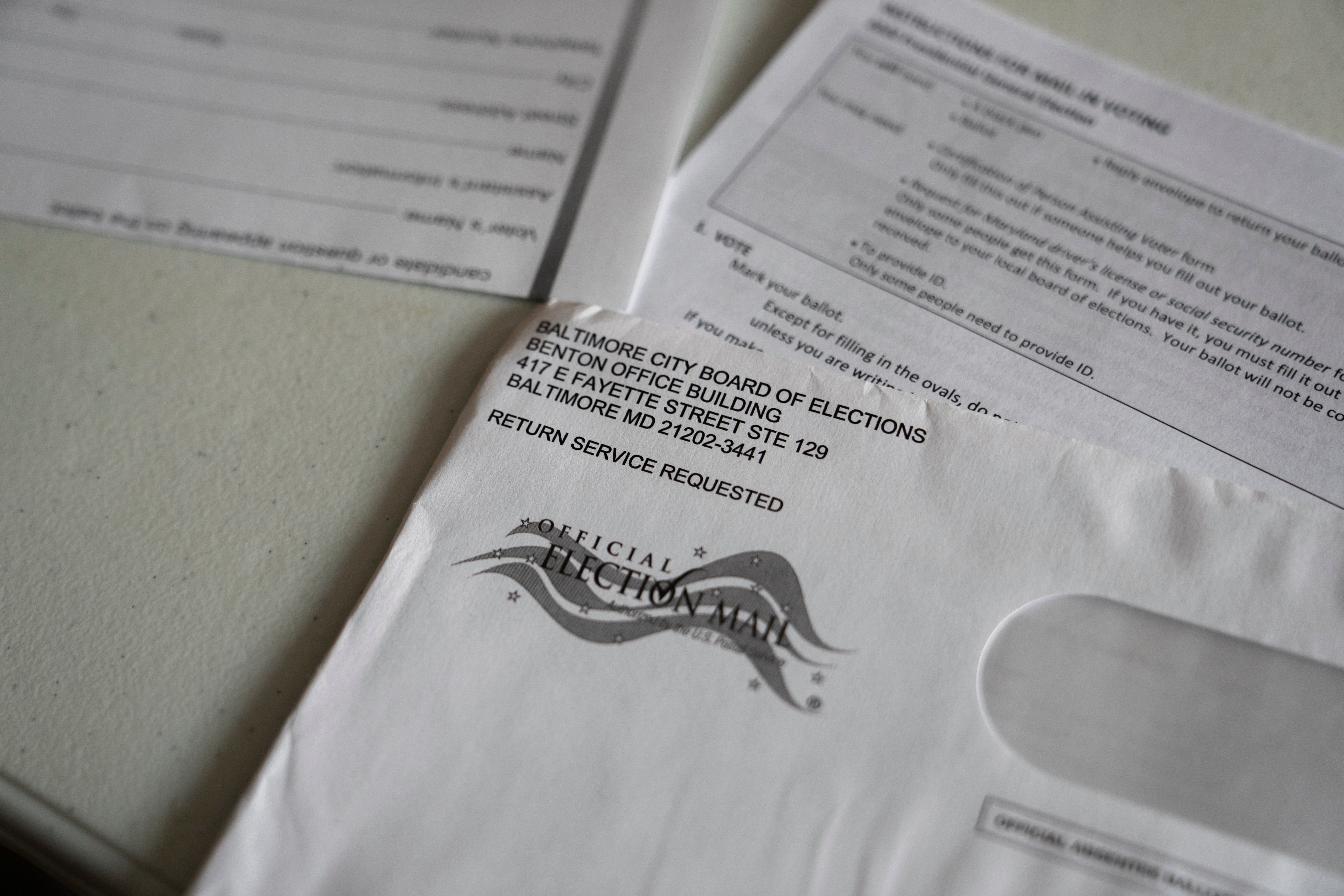
Brett Kavanaugh’s neighbors in Montgomery County love voting by mail.
A third of all votes cast in Maryland’s largest jurisdiction in 2024 were mailed in, the highest concentration statewide that year. It’s unclear if the U.S. Supreme Court associate justice voted that way, too.
No matter what his neighbors want, though, the jurist from Chevy Chase seems doubtful that all mail-in voting meets the definition of “Election Day” set by Congress.
“It really goes to just thinking about what Election Day or day of election means,” Kavanaugh said.
There’s an expectation that Kavanaugh and the court’s conservative majority will rule Election Day is the deadline for accepting votes, based on questions posed during oral arguments last week in a Republican lawsuit challenging Mississippi’s mail-in voting rules.
Yet even if the justices decide to disqualify mail ballots that arrive in election offices after the first Tuesday following the first Monday in November, Maryland voters will have plenty of time to adapt.

The unlikely hero isn’t far-seeing election supervisors. It’s not voter access advocates who helped change mail-in ballots from a pandemic expediency to a transformational evolution in how Maryland votes.
It’s the U.S. Postal Service.
The post office changed its postmark policy in December, making it harder for voters to send in their ballots right up to the close of Election Day and get them accepted.
Maryland election officials were ready to warn voters about the importance of sending in ballots early because of the change. Now, that message will explain the looming court decision, too.
“We were already going to have an aggressive voter outreach and education program regarding postmarks, making sure that individuals mail ballots in a timely manner,” said Jared DeMarinis, the state elections supervisor.
“That was the more ironic part.”

This is a partisan fight. It has been playing out since Maryland and 16 other jurisdictions decided to count mail-in ballots postmarked by Election Day, even if they’re received days later.
There’s no exact count, but that probably totals up to a few thousand votes every election in Maryland.
President Donald Trump started this after losing to Joe Biden in 2020, claiming without evidence that mail-in voting was just another way Democrats cheated.
“It got very partisan after 2020,” DeMarinis said. “And it never should have been. A method of voting is not a partisan activity.”
During the pandemic election, rules for obtaining “absentee ballots” were loosened to allow anyone to use them. Two years later, the name was changed to reflect the new reality.
Mail-in votes skyrocketed in Maryland from about 6% of the total in 2018 to a quarter of all votes by 2024.
Republicans spent the last six years pushing back, crying wolf about fraud. Democrats spent the time making it easier to vote.
Maryland added a network of 300 drop boxes, set uniform early voting dates and polling place hours, and expanded voter-registration outreach, particularly to 18-year-olds and veterans. Mail voting may be the most effective change.

Voters in Democratic counties embraced it.
In Montgomery County, the 166,773 mail-in votes in 2024 outnumbered ballots cast during 10 days of early voting by more than 10,000. In Prince George’s, the 99,166 mail-in ballots represented 24% of the total.
Even in purple Baltimore County, 26% of votes cast that year were submitted by mail.
Republican-dominated counties have rejected it. Mail-in votes made up 3% of the total in Kent County and just 2% in Garrett.
Maybe it’s not all politics. There’s the social aspect of going to the polling place.
“But you can’t discount that,” DeMarinis said. “Mail-in voting has now been politicized in a way that no other method of casting a ballot has.”
Whether the Supreme Court changes mail-in voting or not, the new outreach campaign will focus on guaranteeing that ballots arrive on time.
That was already the message because of the postmark change. The new policy stamps mail with the date it arrives at a processing center, not when a carrier picks it up.
That could mean ballots mailed on Election Day, or even the day before, would be postmarked a day late — disqualifying them.
“What we’re recommending is using the drop boxes that are picked up by election officials throughout early voting once we distribute them,” DeMarinis said. “Or, making sure that if you’re going to use the Postal Service, to mail your ballot early because of this postmark rule.”
Maryland also is considering setting up a two-track counting system. One would set Election Day as the deadline for counting ballots for president, vice president and Congress.
The other could permit continued voting after Election Day for state and local races, from governor to orphans’ court.
A lot depends on what Kavanaugh and the rest of the Supreme Court’s conservative justices decide. Oral arguments are not a guarantee of a ruling, just a hint at the justices’ thinking.
They could let the rules stand, carve out exceptions for primaries or make the changes take effect in the next election cycle. There doesn’t seem to be any sign they will end mail voting altogether.
“I’ve listened to the oral arguments,” DeMarinis said. “This could be a split decision, or it could be one written opinion about the one majority opinion as well. So we have to kind of wait and see how they’re going to rule.”
You have to wonder if Kavanaugh was thinking about his home state that day in Washington.

A Republican attorney for George W. Bush in the contested 2000 election, he was rewarded with a federal judgeship. Trump bumped him to the Supreme Court.
Kavanaugh asked the Republican lawyer if a June opinion would violate the principle that judges shouldn’t mess with voting in an election year.
“I don’t — I don’t think so," Paul Clement responded.
Ballots for the fall, he argued, are printed in September, so there should be time to add the new rules.
The justice didn’t ask Mississippi’s lawyer about the potential for voting chaos.
Maryland’s primary is June 23.
“Thank you,” Kavanaugh said.





Comments
Welcome to The Banner's subscriber-only commenting community. Please review our community guidelines.