
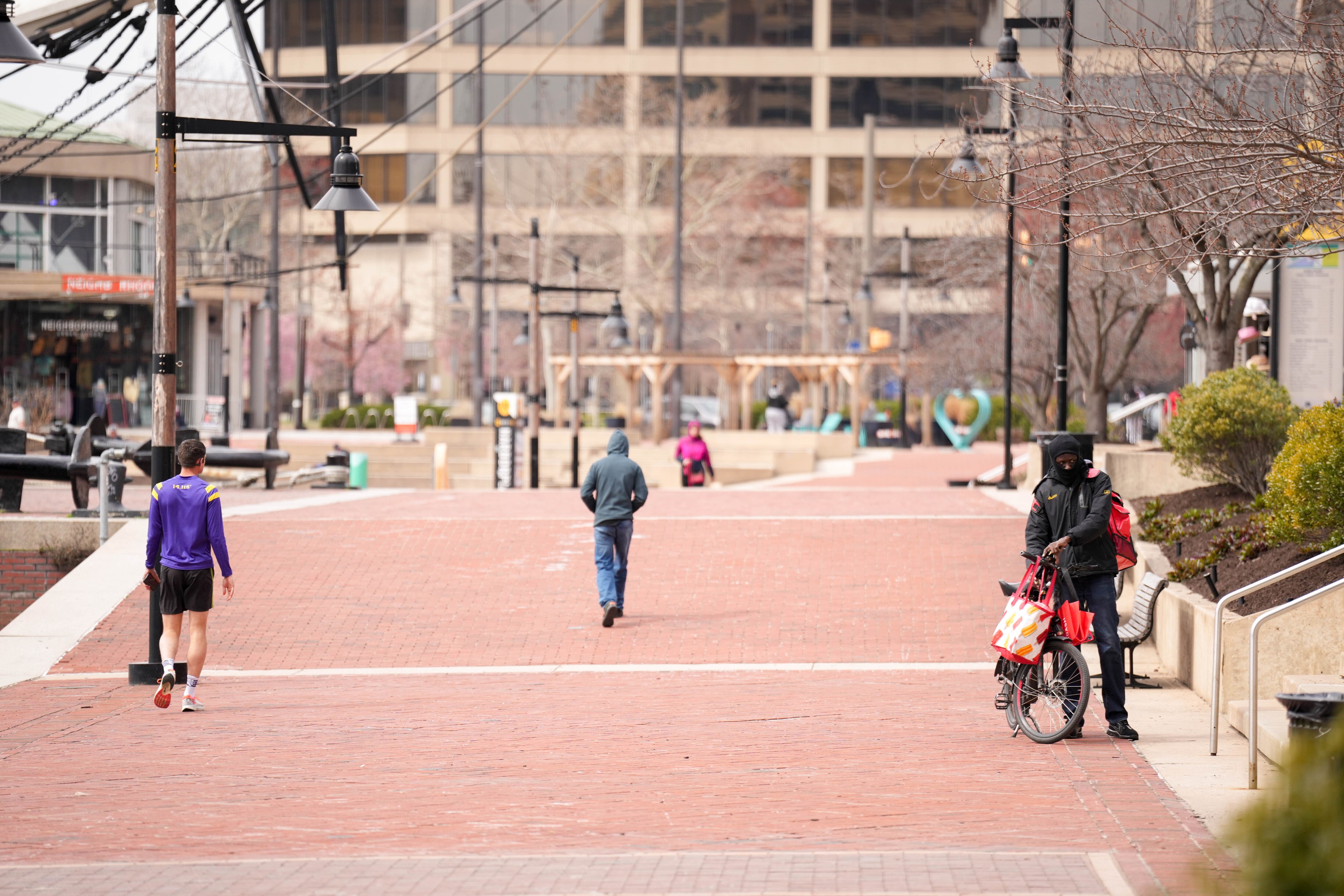
You wouldn’t know it now, when you can almost imagine tumbleweeds blowing around the empty brick walkways past the faded green pavilions. But Harborplace was once a busy, happening spot in Baltimore’s Inner Harbor. A place former Baltimore urban planner Dan Reed says was once “the regional living room.”
It hasn’t been like that in a long time.
“There’s nothing down here now. It’s a shame,” said Baltimore native Kenneth Joy, as he sat on the steps near the gazebos by the corner of Light and Pratt streets last week. A handful of workers, tourists and some friendly Jehovah’s Witnesses wandered by — a sparse population in a space that used to be bustling.
I want that back.
At its peak, Harborplace was the very definition of a third place — a gathering spot that is neither home nor work. These spaces where we all once came together, but have been threatened by realities like COVID, social media and the internet.
If Harborplace, set to be reimagined by MCB Real Estate, is going to remain relevant, it has to retain its original purpose as that space — for all, and not just for some.
There was some early criticism by many, including me, of the company’s plans for the development. Expensive apartments and a rooftop park looked exclusionary, and the planned new buildings appeared, to some, to obstruct the view of the waterfront.
But P. David Bramble, MCB’s managing partner and co-founder, says the plan was always to retain the Harbor’s place as “the city’s front porch. I grew up here, and that’s what it was for us."
The trick, he said, is to have enough things that draw money and a built-in audience while encouraging community. “What’s going on above is relevant to making it activated and alive,” Bramble said.
OK. I’m listening.
Third spaces can technically include bars, restaurants and gyms, but the most valuable are those with little or no barrier to entry — that don’t require a lot of money or an exclusive membership. Harborplace had some fancy restaurants and stores, but it also had cheap pizza and free benches outside to watch the water and just breathe it all in.

“It was vibrant, filled with life. A place I could spend time,” said city resident Tracy Johnson, walking recently by the World Trade Center as the water lapped nearby.
Bramble said the water will remain the unobstructed “star of the show,” and the new features will help pay for what’s on “the ground plane.”
“The whole purpose of the design is to make the land feel welcoming and inviting,” he said. “Harborplace is the linchpin.”
One of my issues, however, is that even a planned community is not one-size-fits-all. Without actual walls, there can still be an invisible velvet rope to keep some citizens out. And a lot of them are young and Black, said Doug Fireside, a former Baltimore City Public Schools principal and longtime city resident.
“The reaction is to criminalize young people hanging out with each other, in a way that wasn’t done when you were younger, and I was younger,” he said. “The fact of the matter is that we are all connected. Seeking that is literally human nature.”
As the mother of a middle schooler, I’ve seen the looks he and his friends get just riding their bikes and skateboards around the city where their parents pay taxes. The Inner Harbor and real third spaces must be what they were for us: “Somewhere a teen can go without having to spend a ton of money or get hassled for it,” said Reed, now the Maryland policy director for Greater Greater Washington.
Is everyone in the public on the up and up? Of course not. Joy pointed toward Rash Field, near where there was recently a shooting. “We have to get rid of them little badass kids,” he said.
Bramble thinks some of those problems crop up because of a lack of activity options. “There’s so much drama because there’s nothing here,” he said. He hopes to negate that with a refurbished Harborplace, including a proposed amphitheater and constant events and programming. “We’re going to fill it with so much.”
But all of this is not yet a done deal, he acknowledged. MCB is still raising money and navigating permitting, and hopes to start construction by the end of the year. Even if the changes go forward, it won’t solve every issue in the city.
“We’re not going to build Harborplace and all of a sudden, Baltimore will be perfect. That is not true. But there are things we can do in how we design and operate it,” Bramble said. “We honestly believe in Baltimore, and that if we make it really sexy and interesting and full of shops and fill it with people, it will work.”
Man, I hope so.
“The question is, will this remain the city’s living room?” Reed said. “There’s no real replacement for good public space.”



Comments
Welcome to The Banner's subscriber-only commenting community. Please review our community guidelines.